
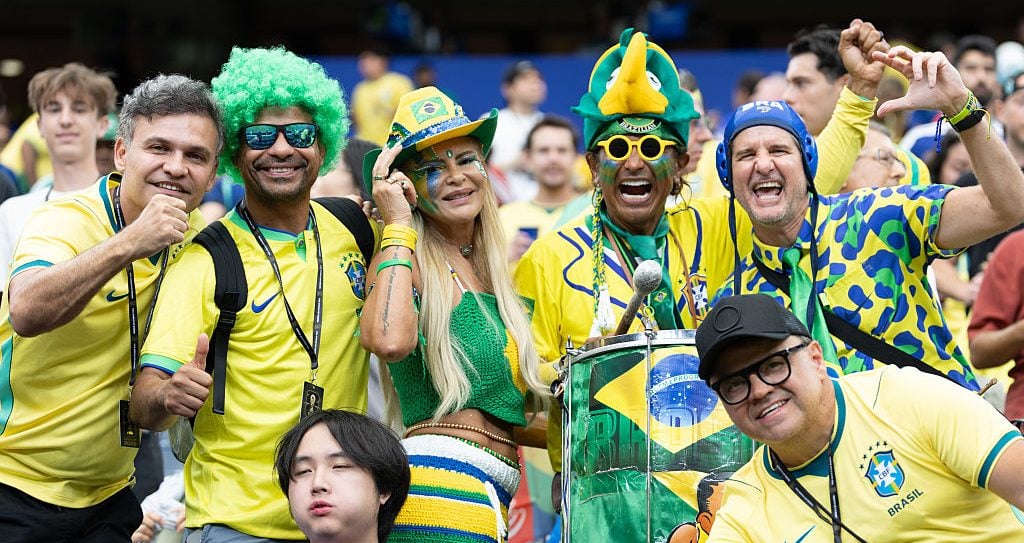
Out in the round of 16, amid tears and regrets not seen since Italia ’90. Brazil had arrived at this World Cup dreaming of another triumph in the United States, 32 years after the last one. Instead, it came up against football’s new reality: a game that has changed, where no name is untouchable and no reputation is enough on its own. And still, the support in the stands never faded. Not only because of the Brazilian fans, always colourful, inventive, impossible to mistake in the way they follow the game. But also because of the work behind the scenes that allowed them to be there, despite everything, at one of the most expensive tournaments ever held. Much of that is down to the persistence of an organised group, the Movimento Verde Amarelo (MVA), which for three decades has followed the Seleção wherever it plays.
They were there in the United States, watching Romario and Bebeto lift the trophy. Then again in Japan, with Cafu and Ronaldo completing the run of the five-time champions. The success brought larger numbers, naturally, but the MVA’s structure never disappeared. For 2026, the answer was to find support outside the stands. To reduce – or at least make more manageable – the cost of some of the most expensive tickets, through the backing of a long list of sponsors. Major Brazilian companies, from Betnacional to Ifood, chose to partner with the movement, covering part of the expenses – travel, equipment and match days – that supporters from Brazil would otherwise have had to carry. “These companies understand how important it is to be part of an event like this, and to do it through a mobilisation of this size,” one of the organisation’s members tells The Observer. “Our participation at the 2018 and 2022 World Cups, as well as the most recent Olympic Games, involved thousands of people. After that response, we saw a major growth in our following, in Brazil and abroad. Because our objective is to represent the national team supporters with the same consistency and passion that you see around the biggest clubs in the world.”
The stands were the proof. A sea of green and yellow that remained there until the very end, until Neymar’s penalty and the heartbreak that followed. “Of course, many supporters are still forced to pay huge amounts for these tickets. We secured an important allocation at reduced prices, but it was not enough to meet the demand from Brazilians who wanted to experience a World Cup, even without the financial means to do so.” Institutions such as the CBF, the Brazilian Football Confederation, also helped bring the price down, with tickets available through the MVA for as little as 60 dollars. The problem is the scale of the country itself. Brazil has 220 million inhabitants, and football and the Seleção occupy a place unlike almost anything else in national life. There would not be enough tickets in America to satisfy everyone who wanted one.