
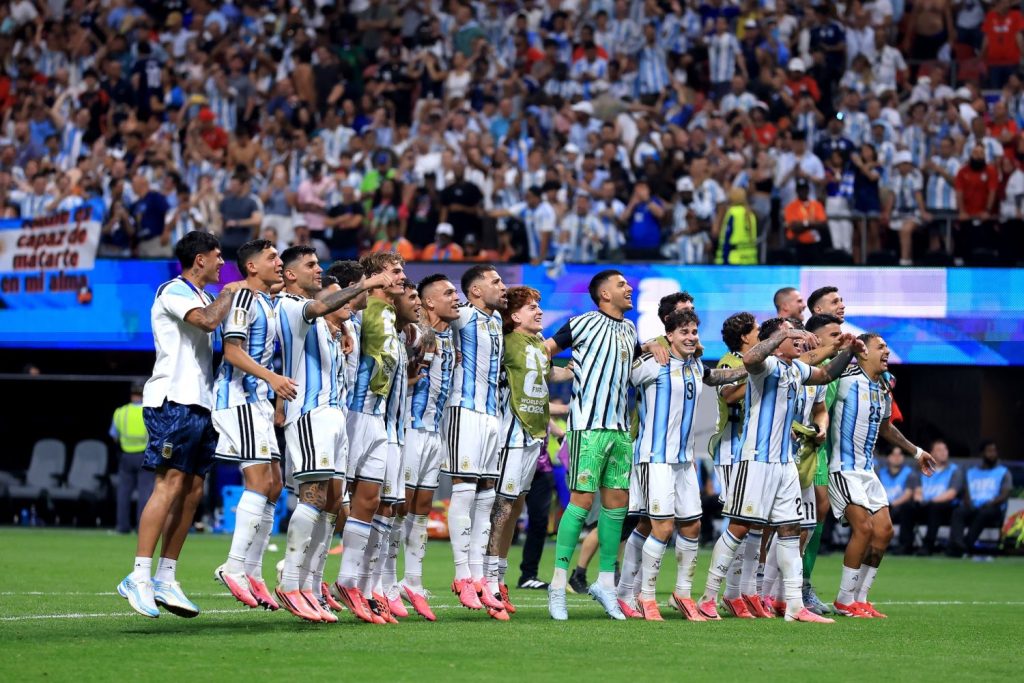
Lionel Messi’s tears at the end of the match against Egypt carried the weight of something far greater than qualification for the World Cup quarter-finals. There was joy in them, relief, a sense of release. They came only a few hours after the much heavier tears of Neymar and Cristiano Ronaldo, both forced to leave behind the dream of finally lifting the World Cup, their faces marked by disappointment. The images of the three defining figures of a generation almost belonged to two different stories: one about the end of a journey, the other about the possibility of extending one. Messi’s tears, though, came from somewhere else. He knew how close Argentina had come to elimination, how close they had been to watching the dream of defending the title won in Qatar disappear. He knew too that, this time, it had not been only his brilliance that had kept Argentina alive.
For almost the entire evening, the World Cup was slipping away from the Selección. Two goals down against Egypt in the round of 16, still carrying the tension of the difficult match against Cape Verde, Argentina were suddenly facing the kind of night that turns a tournament on its head. After only 19 minutes, Messi had missed the penalty that could have immediately restored balance after Ibrahim’s opener. It was the image of a game going in the wrong direction: the captain stopped by the Egyptian goalkeeper, a team lacking rhythm, a side that had unexpectedly become vulnerable. And yet, in the moment when everything appeared to be disappearing, the defining quality of Scaloni’s Argentina emerged: the ability to remain together.
Thirteen minutes were enough to change the entire match. Romero’s header from Messi’s delivery. Messi’s left foot for 2-2. Then, deep into stoppage time, Enzo Fernández rising to meet Lautaro Martínez’s perfect cross. From 0-2 to 3-2. A comeback that immediately entered the language of World Cup nights. The Argentine press looked beyond the scoreline. Olé celebrated the Selección’s refusal to surrender, the character that appeared when the match seemed lost. Clarín focused on the emotional reserves the Scaloneta continues to find when football alone is no longer enough. La Nación saw in the comeback the clearest expression of what this team has become: a group capable of carrying its leader through the moments when even he needs to be carried.
Because this time Messi was not the player who solved everything. He was still Messi, of course, still the greatest player on the pitch, but also something more human: a captain who missed a crucial penalty, struck the post, and spent more than an hour searching for a way back into the match. In previous versions of Argentina, a night like this might have taken everyone down with him. This time, the opposite happened. The team absorbed the pressure, stayed alive, kept believing, and waited for their number 10 to return to the place where he has always been most comfortable: deciding games when there seems to be no way through.
First came the assist for Romero. Then the equaliser that changed the entire atmosphere of the match. Perhaps this is the clearest difference between this Argentina and the teams that came before them. Messi remains the player who can alter the balance of a game, especially in a tournament as short and unforgiving as the World Cup, where a single touch can redirect an entire campaign. His teammates know it. They have built their role around it. They protect him, support him, make space for him, almost as if he belongs not only to them but to all of them.
It is no coincidence that so many of these players are the same ones who lifted the World Cup in 2022. Over these years, they have created something that extends beyond the dressing room. Watching them fight for each other, there is a sense of belonging increasingly rare in modern football. It appears in the smallest details: in the gestures, in the daily habits, in the willingness to sacrifice without hesitation. In the rituals too. The asado prepared by Emiliano Martínez and shared live on Instagram has become part of the mythology around this group, one of those small traditions that reveal something larger.
But the strength of this Argentina cannot be reduced to moments of celebration. Behind the images there is something more solid: trust, respect, relationships built over time, a culture created through years of shared experiences. Much of that belongs to Lionel Scaloni. The coach has created an environment in which every player feels involved, regardless of minutes played. He is a young manager surrounded by a staff that includes former greats such as Walter Samuel and Pablo Aimar, men who know the emotional demands of the highest level because they have lived them.
Scaloni manages his squad with a rare sense of closeness. During the World Cup, he allows players time with their families, convinced that balance away from the pitch matters too. But above all, he handles the difficult moments personally, making decisions with honesty and directness. The impact of the substitutes tells the same story. Against Egypt, Lautaro Martínez came on and provided the decisive assist for Enzo Fernández’s winning goal. It is no surprise that afterwards the Chelsea midfielder, along with the other players and members of the staff, spoke above all about the importance of the group. Before tactics. Before talent. Even before Messi.
This Argentina has built everything from a collective identity, from a team that understands the value of moving in the same direction. The individual brilliance remains. It always will. But the foundation is elsewhere. That is why the comeback against Egypt means more than a place in the quarter-finals. It confirms that the Scaloneta still carries the hunger that took it to the top of the world in 2022. With a group this connected, a coach who places people at the centre, and a Messi still capable of deciding the biggest moments, the possibility of winning two consecutive World Cups begins to feel less like fantasy and more like a real pursuit. Only one national team has ever done it: Brazil in 1958 and 1962, the only side in history to successfully defend the World Cup. After a night like this, Argentina’s dream remains alive. And it looks a little closer.