
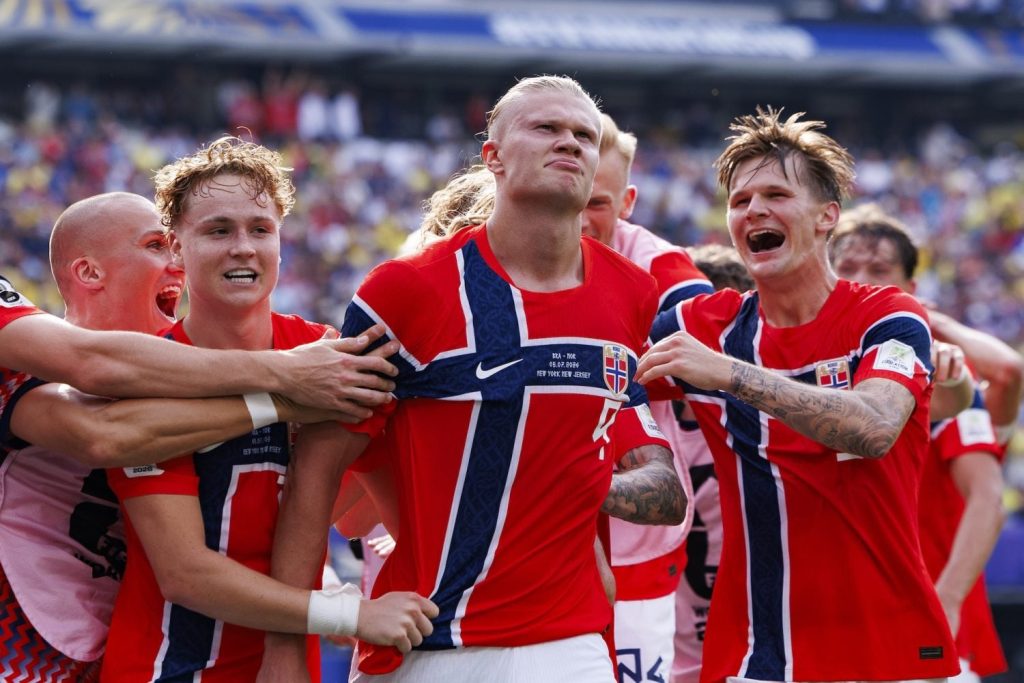
Maybe Norway won’t win the 2026 World Cup, and maybe the Brazil we saw in the United States can’t really be filed among the very best national teams in the world. Still, the match at MetLife Stadium in East Rutherford/New York — the same ground that will host the United 2026 final on July 19 — leaves something hanging in the air, large and slightly unresolved. Brazil–Norway 1–2 says more than the score, but not in a neat way. Erling Haaland is one of those players you don’t quite describe so much as you absorb: devastating, yes, but the word arrives late, almost politely behind the action. Phenomenal, stratospheric, all of it and still underneath, a centre-forward who bends tempo without ever asking for it to be adjusted around him.
From there the match opens onto a wider shift, though not cleanly or systematically. The old map of international football doesn’t quite hold anymore, the hierarchies feel more porous, less ceremonious. Norway producing a player like Haaland is no longer an exception to admire from afar but part of the present tense, and that player carries with him a version of football that can look more direct, more organised, at times more coherent than Brazil’s own, even when Brazil are Brazil, even when the names are Vinícius Júnior, Marquinhos, and the rest. For long stretches Brazil might even feel slightly unlucky not to be ahead. A missed penalty, correctly awarded after VAR corrected the initial decision, and two or three other moments that could have bent the match differently. The pressing is high, aggressive, part of a plan that at times works exactly as intended, with recoveries arriving in advanced zones and rhythm imposed in bursts that feel convincing in isolation.
And yet the balance never fully settles. Brazil step forward and step back in the same movement, pressing Norway and then allowing them to play through the first wave, as if the invitation is built into the structure. Nothing inherently wrong with that, especially against a team that can also circulate and control, but something in the control of the match keeps slipping away in ways that are hard to stabilise. This is where the game starts to drift into something larger, though without ever becoming fully theoretical. International football in 2026 feels like this constant overlap of identities: pressing sides becoming possession sides, possession sides becoming direct, roles sliding over each other without fixed borders. Norway can play through Brazil’s press, Brazil can press Norway with full conviction, and both things can be true in the same match without contradiction.
Inside that overlap Haaland sits almost still, in the sense that nothing around him really changes his basic condition: very few touches needed, maximum impact extracted. When Brazil leave possession and rely on intensity, the defensive phase behind it is supposed to be perfect, sealed, almost impassable. But that idea does not really survive contact with him. The first goal is pure physical authority, Gabriel Magalhães simply underneath a duel he cannot win in the air; the second is faster, heavier in its suddenness, a strike from a position that should not produce that kind of violence, with Alisson set and then immediately behind the moment:
Even beyond the goals, everything bends in the same direction. Long balls into him become contact points that never fully resolve into Brazilian control, defenders like Gabriel and Marquinhos absorbing collisions that keep spilling back into Norwegian territory. The structure adjusts around him almost instinctively, Solbakken reshaping with Bobb and Schjelderup for Sørloth and Nusa, not to reinvent the match but to keep Haaland in a zone where every touch carries consequence. Norway have other players, good ones, some very good, but the axis is clear and does not need interpretation. Everything leans towards it. And perhaps the most unsettling aspect is how little of this feels genuinely surprising anymore. The trajectory is already known: 27 goals in 14 international matches before this, a club career already fully formed, a sense that the scale of performance has simply continued without interruption into this level.
Brazil are not dismantled in a single moment, nor reduced to absence. There are periods where they look structured, even superior in possession, but the match does not ultimately reward that kind of continuity. It rewards the player who needs less time, fewer touches, fewer openings. And so Brazil leave New York not with a lesson neatly delivered, but with something less defined, something that doesn’t close. Norway leave with a result that feels almost ordinary once Haaland is part of it, which might be the most disorienting shift of all: not surprise, but the slow disappearance of surprise itself.