
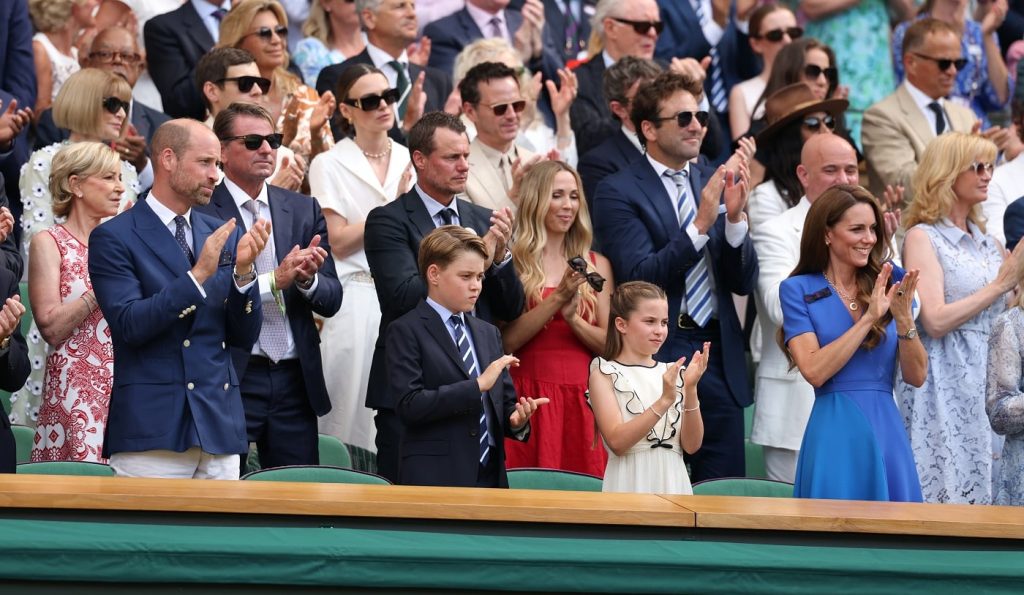
Wimbledon’s Royal Box is one of those places that exists well beyond its function. It is not simply the best seat on Centre Court at one of the world’s most prestigious sporting clubs. To experience it is almost a ritual, a symbol, a quietly theatrical expression of the message the All England Club wants to project: these are the most coveted seats from which to watch the most prestigious tournament in tennis. For two weeks every summer, those eighty green-upholstered chairs are occupied by a cross-section of contemporary power. Heads of state, members of the British royal family, entrepreneurs, artists, scientists, Olympic champions, Nobel laureates, actors, designers and musicians all find their place there. Jeff Bezos may be sitting a few rows away from the Princess of Wales, Catherine, while David Beckham and Pep Guardiola watch from behind Samuel L. Jackson. It appears almost accidental, but in fact says a great deal about the way Wimbledon constructs its identity.
Because entry to the Royal Box has never really been about wealth. There is no ticket to buy, no auction to win. You need an invitation. And an invitation is not something you ask for. It simply arrives. The All England Lawn Tennis Club describes the Royal Box as a space reserved for the royal family, the world of tennis and “people who have made a significant contribution to society.” It is a definition that is deliberately broad, almost idealistic, and one that over the years has allowed very different kinds of people to sit side by side. On one side are the biggest names in sport and entertainment; on the other, researchers, academics, doctors and figures recognised for their public service. In recent years that second group has become even more central, reflecting a deliberate choice by the tournament’s leadership. It was no coincidence that one of Centre Court’s warmest standing ovations in 2021 was reserved for Sarah Gilbert, the scientist who led the development of the Oxford–AstraZeneca Covid-19 vaccine.
As The Athletic noted, Wimbledon has no intention of giving up its glamorous side. Television cameras constantly search the crowd for famous faces and every day’s play brings another procession of celebrities. Yet the Royal Box never quite functions like the traditional VIP section at a major sporting event. It is not a red carpet transplanted into a stadium, but an institution that feels unmistakably British, beginning with its rules. Its dress code is almost as famous as the tournament itself, and this year became stricter still. Men are expected to wear a jacket and tie, while women are required to dress elegantly within a precise set of guidelines, including a ban on bare shoulders and thin straps. Even hats are discouraged, since they might block the view of those sitting behind. They are details that can seem excessive until you remember that Wimbledon’s aura has always been sustained by precisely this kind of detail.
This is the tournament that insists on almost entirely white clothing for its players, that refuses to install giant screens for football World Cup matches, that continues to refer to its courts by their historic names and that treats protocol as part of the spectacle. In 2015, Lewis Hamilton arrived at the Royal Box without a jacket and tie and was refused entry. A few years later, Pippa Middleton, Catherine’s sister, had to watch from an ordinary seat after arriving late. At Wimbledon, prestige makes very few exceptions, regardless of how famous you happen to be. Even the experience reserved for invited guests seems designed to reinforce that sense of discreet exclusivity. The day begins with drinks on the terrace overlooking the outside courts, followed by lunch in the Clubhouse, afternoon tea and, naturally, strawberries and cream. Not the same strawberries served elsewhere on the grounds, but a variety selected specifically for the Royal Box and, naturally enough, one that comes at a considerable cost.
Behind this perfectly choreographed machine lies an enormous amount of diplomatic—one might almost say political—work. Agents, publicists and representatives are constantly trying to secure invitations, while the organisers are left distinguishing genuine requests from attempts to trade on a celebrity’s name. On one occasion, someone even tried to reserve a seat by pretending to represent a Hollywood star, only to be exposed when it turned out the actor was filming on the other side of the world. Even so, the Royal Box retains something of a mystery. There is no algorithm that explains why one person is invited and another is not. There is only a tradition renewed every summer, deciding who, if only for a day, will come to embody Wimbledon’s own idea of excellence. Perhaps that, more than anything else, is the Royal Box’s enduring strength. It celebrates not simply those who are famous, but those who, in the eyes of the tournament, have left a mark.