
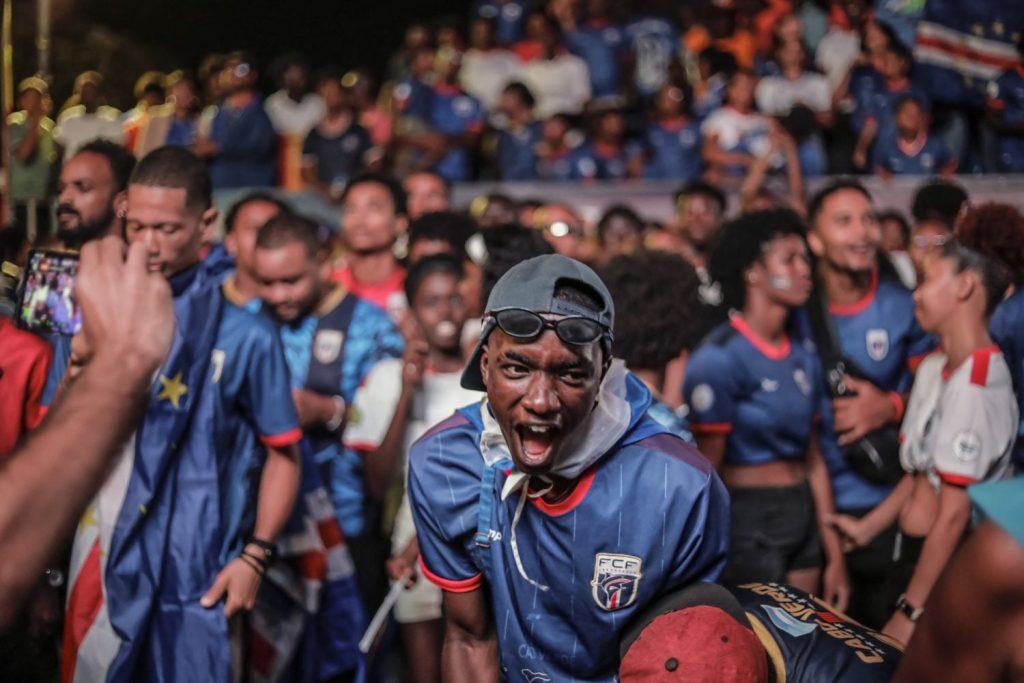
Cape Verde is a country in celebration, and there is no other way to describe the mood of a community experiencing, for the first time, the joy of a World Cup. Three draws in the group stage, against Spain, Uruguay and Saudi Arabia, were enough to take the national team into the knockout rounds, second in the group, without needing the expanded format that also admits the best third-placed sides, though nobody really speaks about that detail in the same breath. The Guardian ran a long report from the country, and what comes through is not so much analysis as atmosphere, the disbelief still intact, the ordinary happiness that has settled over everything and now moves towards a direct tie against Lionel Messi’s Argentina, which already feels too large for the language used to describe it.
“It’s incredible to live all this, Cape Verdeans and tourists are enjoying a month-long celebration, the country is proud of the team and the players, after every match cars go down into the streets to celebrate.” “For the match against Spain, many people here were given half a day off work, but in reality no one really worked that day,” and it is said almost without emphasis, as if that is the only possible version of events. The sense of suspension repeats itself in small variations, days without structure, or with a structure that appears improvised after the fact, and even the flag becomes something closer to habit than symbol in the way it appears across the country. Another testimony collected by the Guardian places it almost casually into everyday visibility: “Our flag, before the World Cup, could only be seen at the Presidential Palace or on a few public buildings, now everyone displays it with pride, on cars, on motorbikes, on balconies across the country,” and nothing in the tone tries to resolve what that shift actually means.
There is something contemporary in this form of national exposure, and something that has clearly been built slowly, over time, through scouting, movement, and a widening of where the team is actually sourced from, though this is never presented as a theory locally. Cape Verde has a small domestic league and a limited player base, the population a little over 525,000, and so the federation has long worked outside its own geography, into the diaspora, into inherited belonging rather than contained territory, which now feels less like strategy and more like condition. Coach Pedro Leitão Brito, known as Bubista, says it simply, almost as if nothing more elaborate is available: “We represent our islands, but also Africa.” From Morocco downwards, national teams have been built in similar ways, through multiple passports and overlapping systems of identification, and Cape Verde sits inside that wider pattern without fully dissolving into it. For Cape Verde the axis has often been Portugal, independence declared in 1975, and the Netherlands, though the map stretches further than that and doesn’t really settle anywhere cleanly, with players arriving from places that are not usually spoken in sequence.
Roberto “Pico” Lopes is one of the more unusual paths, born and raised in Ireland, brought into the national team through a LinkedIn message, a detail that keeps returning even when it should already feel normal. Dadinho, one of the federation figures involved in early scouting abroad, told El País: “In reality we were the first to go into Europe looking for players to add to the national team roster, then Morocco copied the model,” a claim that sits somewhere between memory and positioning. The question of who did it first remains open, but what is no longer open is the structure itself: 14 of the 26 players in the squad were born outside the country, and that fact now reads as background rather than exception. Over time, several others with Cape Verdean heritage — Nuno Mendes, Renato Veiga, Thierry Correia — have chosen other national teams, usually more immediately competitive ones, and this sits in the same landscape without needing to be separated from it. This World Cup, though, shifts the tone slightly, not into conclusion but into a kind of continuation that is harder to name without simplifying it.
There is also the layer of infrastructure, FIFA relationships, and Chinese-backed stadium projects across parts of Africa, which have left physical traces without fully defining what follows from them. In Praia, the capital, a 15,000-seat stadium has stood since 2013, already ordinary in its presence, almost unnoticed in the way it belongs to the city. A few months after its opening the national team reached the quarter-finals in its first Africa Cup of Nations appearance, and then in 2023 came a third place that arrived quickly, almost too quickly for the memory it produced. Now it is the World Cup, and the match against Messi’s Argentina, which gathers everything into the same frame without resolving anything inside it. It sounds like a fairytale, but it doesn’t behave like one.