
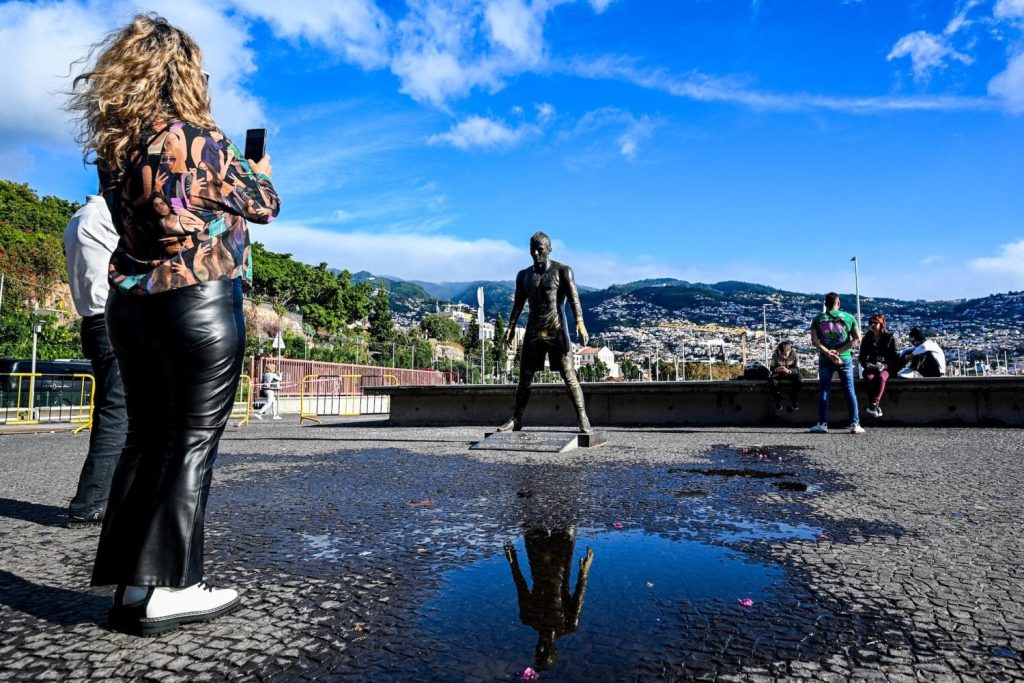
L’Équipe ran a long feature marked by a kind of hyperbole that barely feels like hyperbole once you stay with it long enough, with anecdotes that sound excessive only from a distance that no longer really holds. A taxi driver in Funchal: “Tourists kept asking us where Ronaldo came from, where he played his first matches. So we started inventing tours that take people through the key places of his formation. In summer we do them several times a day. It’s not our main source of income, but it’s not insignificant. Sixty to seventy per cent of clients in this segment are, essentially, children.”
Funchal. Madeira. The names tend to collapse into the same answer anyway: Cristiano Ronaldo. An island off the Moroccan coast, Portuguese in its long historical grain, a place of steep distances and slow bends in the road, but none of that really competes with the way it is now spoken about. Ronaldo is not an addition to Madeira’s identity so much as the point everything else gets referred back to, even when nothing explicitly asks for it. A player who has exceeded the category he belongs to, becoming a kind of moving structure: brand, economy, image system, circulation of value triggered by a gesture, a post, a name.
L’Équipe returns to it again in the same register, not insisting, just continuing. Airport named after him. A museum that has been accumulating visitors since 2013, numbers that are repeated more than they are verified in conversation. A hotel, a series of local investments, small economic loops that don’t announce themselves as dependency. Nike marking the origin point as if it were already a site, placing its logo near the demolished house, a few metres from where the pitch used to be, now reorganised into a Nike Campus with a different geometry and no need to explain the previous one.
Paulo Lopes, Diário de Notícias da Madeira: “Global interest in Ronaldo has somewhat faded since he moved to Saudi Arabia. But the love and reverence in Madeira remain enormous.” It is said without emphasis, as something already known. Ronaldo appears and disappears from the island in short intervals now. During the lockdown he returned and trained there, visible again in a way that felt temporary even while it was happening. After restrictions eased, the rhythm changed. His jet now uses Cristiano Ronaldo Airport mostly for family movement, connections that pass through rather than arrive.
Pedro Talhinhas, who has worked in the youth sector at Nacional da Madeira since Ronaldo’s early years, puts it more directly: “The island’s roads are too small for a permanent return. Both he and we would face difficulties in terms of security and freedom.” Small roads, limited space, a geography that does not expand for anyone in particular. Even that is not really an exception there.