
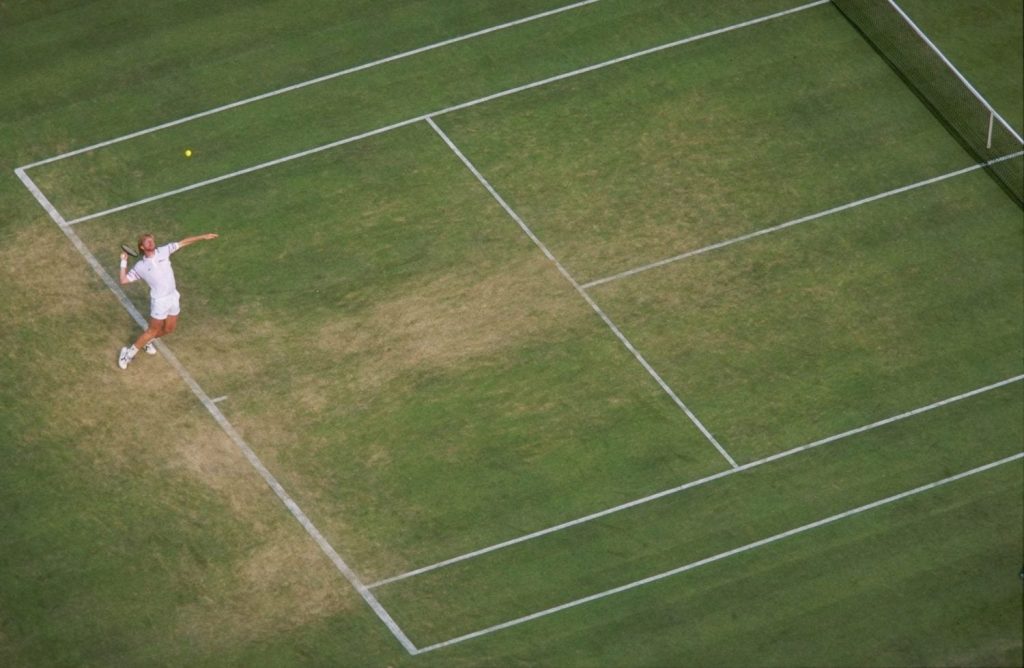
The first freeze-frame of Wimbledon – not the quiet residential suburb in south-west London, but Wimbledon, the Mecca of tennis – comes while walking along Church Road, just out of Southfields station: through hedges and dark green fencing, the practice courts. Young men and women in white striking balls across a vast lawn marked with chalk lines, an image not so far from English men in 1873 sending a white ball over an hourglass-shaped court laid out in the grounds of a country estate. An officer of the British Army, Major Walter Wingfield, formalised the game that year, modelling it on versions played indoors. He called it Sphairistiké – “playing with the ball” in Greek – though most soon said lawn tennis. Four years later, in 1877, the first tournament, and this suburban borough becomes the centre of a new sport: Ernest and Willie Renshaw, Reginald and Laurie Doherty, Arthur Gore, Tony Wilding – early names, early battles, rough courts at 21 Worple Road.
By the beginning of the new century, “Wimbledon” no longer means only the tournament at the All England Club, but the unofficial world championships themselves, and approaching Centre Court, the stadium topped by its retractable roof appears as a cutting-edge structure of the twenty-first century, while inside it remains the same dodecagonal building that for decades has been read as a private house, an Elizabethan theatre, an aircraft hangar. Out of the dark corridors, sudden daylight, and the eye moves immediately to the centre of this modern Colosseum: the most famous tennis court in the world, green and flat like a billiard table, still the most beautiful court in the game, a piece of land treated as something closer to ritual than surface.
The stands rise so steeply that spectators feel suspended above the court, enclosed in a tight shelter from everything outside, while the sharp snap of strings meets the softer thud of ball on grass, a familiar percussion that never changes, and inside this bowl, 14,000 seats built in 1922 for the first crowds of sporting superstardom, Suzanne Lenglen and Big Bill Tilden, and history begins to layer itself. Lenglen is still there, La Divine, six Championships, movement like dance more than sport, bare arms, bare ankles, brandy between games, argument, collapse, elegance in the same gesture, only one defeat from 1919 until 1926 when illness ended it, and she does not play matches so much as occupy them. Tilden follows, or remains, four appearances at Wimbledon, one title in 1930, but what stays is not the record but the presence: excessive, theatrical, uncontrolled, a man arguing with calls, with judges, with himself, giving away points after winning them, hitting four aces and tossing the fifth ball away without looking, and the court keeps him.
And others are added later, layer after layer: Federer and Nadal in 2008, a match that stretches until it loses its edges, rain interruptions, returns, delay, light draining from the sky before the roof exists, everything exposed, the ball struck with a force that earlier eras could not imagine and with a precision that seems almost detached from physics, the stadium filled with impact sounds like percussion written for two instruments only, and it ends in near darkness, players and crowd straining to see the same moving point, the court already becoming memory while still in use.
Thirty years earlier, Borg and McEnroe in 1980, the 18–16 tie-break, silence and eruption alternating without transition, and Evert and Navratilova nine meetings here, repeated tension never settled, serve-and-volley against baseline resistance, balance constantly shifting, before them Billie Jean King and Margaret Court, Rod Laver, Fred Perry, and others further back. The sounds remain – grunts, sliding shoes, contact, rebound – faint now but still present, embedded in the structure itself.
And then 1937, Davis Cup final, United States and Germany, Budge against von Cramm, Centre Court as national stage already described as the highest point of modern sport, an altar dressed as stadium. Cramm, aristocratic, composed, almost unreal in appearance, three Wimbledon finals lost, now something beyond redemption, while behind him pressure not visible to the crowd: Nazi authorities aware of what he is and what he is not allowed to be, what he is allowed to be only as long as he wins. Tilden in the stands, unofficial coach of Germany, outside his own federation, watching a friend, watching a system he no longer belongs to.
Three weeks earlier Budge had beaten him at Wimbledon, but this is not that match. Cramm begins at full speed, first two sets 8–6 and 7–5, clean lines, controlled aggression, then Budge adjusts, slowly then completely, absorbs and returns heavier, two sets each. The fifth shifts again, Cramm leads 4–1, almost there, then no longer, Budge plays without pattern, point by point, recovery after recovery, a sequence described as miraculous, the crowd already standing, no longer contained by seats. Five, six in the evening, no floodlights, the match held together only by remaining daylight, and it becomes duration until Budge edges it, finally 8–6 in the fifth, exhaustion as ending, while Walter Pate says no man living or dead could have beaten them.
Budge will win Wimbledon the following year, Cramm will not return, prison, war, survival, West Germany later, another life. Wimbledon falls silent during the war, grass without tennis, pigs on Centre Court, the royal box damaged during the Blitz, wood and structure giving way, sound without match, surface without play.