
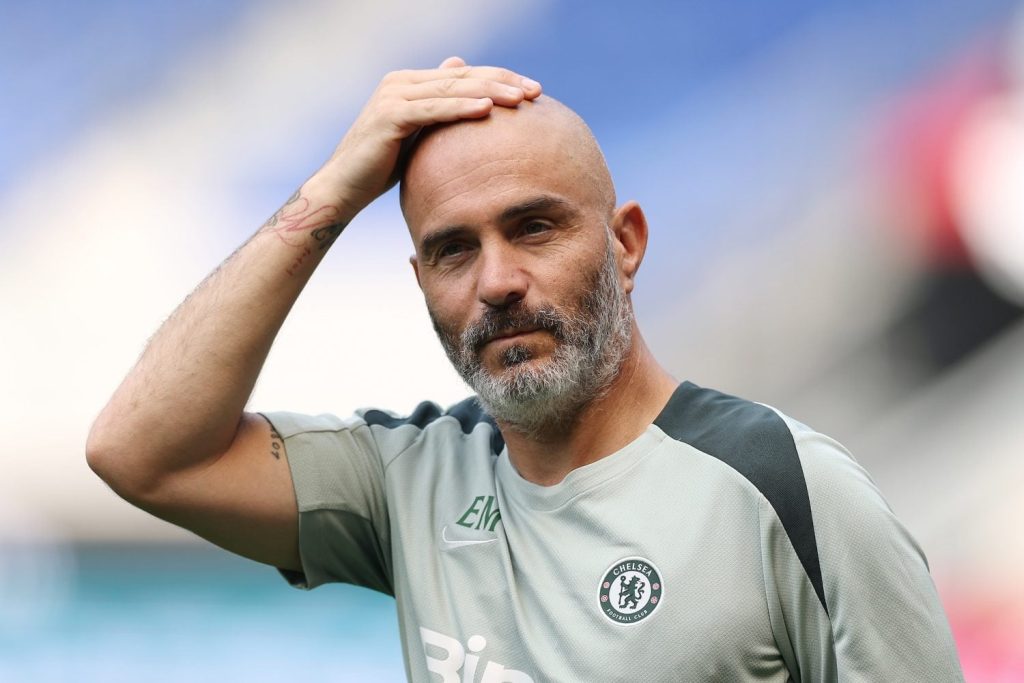
The appointment of Enzo Maresca as Pep Guardiola’s successor at Manchester City sits in that familiar space where football decisions no longer read as discrete choices so much as extensions of a system already in motion, and where even the idea of succession feels slightly misleading because the continuity is already internal to the club’s way of functioning, almost to the point where the name that follows Guardiola is less a break than another modulation of the same language, and Maresca arrives inside that continuity rather than outside it, having already passed through it in different registers, first in the academy structure where results and method tend to overlap in ways that make distinction unnecessary, and then within the first-team environment during the Treble season, where proximity becomes a form of education in itself and where football is experienced less as instruction than as repetition of principles that no longer need to be stated.
The Italian dimension of his trajectory, by contrast, remains comparatively thin, almost incidental in retrospect, a brief passage through Parma in Serie B that dissolves quickly into the background of what follows, thirteen matches that neither consolidate nor interrupt anything in a meaningful way, and it is from there that the asymmetry of his career begins to take shape, because the acceleration happens elsewhere, first in England within Manchester City’s internal ecosystem and then beyond it, and the idea of formation itself shifts location, moving away from the traditional idea of domestic development and into a more distributed space where coaching identity is assembled through proximity, repetition and translation across contexts rather than through a single institutional line.
His playing career, spread across Juventus, Fiorentina, Sampdoria, Palermo and Verona, now reads like a catalogue of places rather than a structure of formation, while as a coach the reference point remains consistently Guardiola, not in the sense of stylistic imitation but as a shared operational grammar that has gradually become widespread across a generation of assistants and former staff members, to the point where it no longer belongs exclusively to its origin, and Leicester becomes the first moment in which that grammar is applied without the original environment, producing immediate promotion but also revealing a tension between method and material, between a positional language and a squad not entirely calibrated to it, which is resolved in results but not entirely in texture, leaving a slightly unresolved impression that follows the team even in success.
Chelsea removes even that residual stability, or rather places it under constant pressure, a club defined in recent seasons by accumulation and turnover at such scale that coherence cannot be assumed at any stage but has to be continually reconstructed, and in that environment Maresca’s work is less about transformation than about maintaining recognisable structure within instability, through repetition of positional rules and controlled occupation of space that persists even as the personnel around it changes, and it is from within that condition that a Club World Cup final emerges, along with a 3–0 victory over Paris Saint-Germain, a result that carries clarity without necessarily resolving the broader uncertainty of the project itself.
From an Italian perspective, the trajectory reads less as exception than as distance, not because the names involved are unfamiliar but because the conditions that produce them increasingly sit elsewhere, while the domestic coaching landscape continues to orbit a relatively stable set of figures, Spalletti, Conte, Sarri, Allegri, Gasperini, Pioli, whose recurrence across the major clubs creates continuity but also limits permeability, and even the occasional deviation, such as Christian Chivu’s emergence at Inter, remains legible precisely because it is not multiplied into a broader pattern, while elsewhere in Europe the pattern has already shifted, with Kompany arriving at Bayern after a short managerial arc that includes relegation at Burnley, Arteta appointed at Arsenal without prior head coach experience, emerging instead from Guardiola’s staff as part of a wider coaching ecosystem that now functions almost as an independent network, and within that same logic Carlos Cuesta at Parma at thirty no longer appears anomalous but consistent with a broader recalibration of what counts as readiness.
What links these cases is not ideology but timing, or rather the compression of experience into shorter cycles where adaptability, technical fluency and institutional compatibility begin to outweigh duration, and Maresca fits comfortably within that shift, shaped as much by Chelsea’s instability as by Manchester City’s structural clarity, moving between environments that differ in surface detail but share an underlying expectation that coaching is less about authorship than about sustaining systems that already exceed the individual, and Chelsea in particular functions as a kind of stress field in which that expectation becomes visible through constant reconstruction rather than stability.
Seen in that light, Manchester City does not represent a departure but a further tightening of the same logic, a space where the system is already given and the task is to inhabit it without distortion, and where continuity is less a philosophical choice than an operational condition, while Italian football remains present mainly as a point of departure, a place from which talent continues to leave earlier and circulate more widely, with Dortmund, Leipzig and London functioning less as destinations than as environments of acceleration, and Baldini’s reference to the “aridity of Italian soil” lingers not as explanation but as atmosphere, describing a condition in which development persists but is increasingly dependent on external exposure rather than internal structure.
Maresca, ultimately, sits inside that circulation without excess emphasis, not as exception and not as symbol, but as one of the more legible instances of a broader movement in which coaching identity is no longer anchored to origin in a stable way, and Manchester City becomes simply the point at which that movement pauses long enough to be named before continuing elsewhere.