
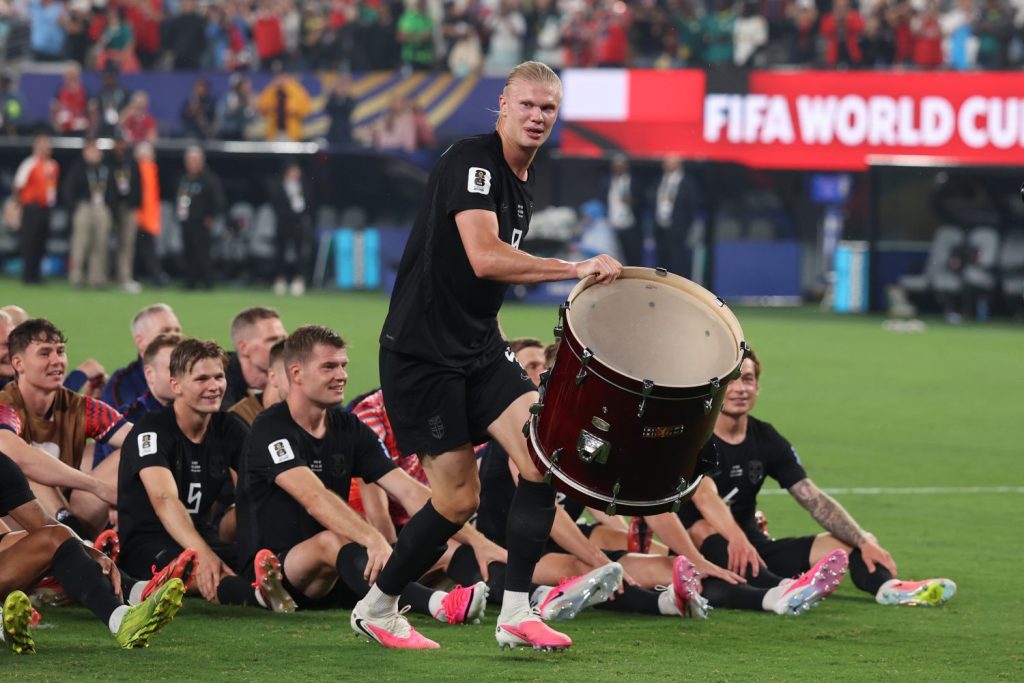
Among the images this World Cup has produced so far, none feels more revealing than the one that followed Norway’s win over Senegal, not one of Erling Haaland’s four goals against Iraq and Senegal, not a finish, a celebration, a statistic, but the Viking Row, the traditional rowing ritual performed beneath the Norwegian end after the 3–2 victory, with Haaland at the front, at times Martin Ødegaard taking his place at the prow of the imaginary ship, alternating in that role, the Manchester City striker setting the rhythm, pulling the others behind him.
A symbolic scene, almost cinematic, more than any statistic could convey, because Haaland is not simply Norway’s goalscorer; he is the face of the generation that brought the country back to the World Cup after 28 years away, a long absence before their number nine dragged Norway back onto football’s biggest stage, and now that he is here there is little sign of restraint.
The win over Senegal offered another reminder, after the brace against Iraq came another against the African side, four goals in two matches but also four different goals, almost a catalogue of ways to hurt opponents, Haaland scoring with either foot, in the air, running beyond defenders, occupying the box, attacking space, embracing contact, with every match revealing a slightly different version of the same player.
Against Iraq he showed how devastating he can be in open field, how ruthless near goal, while against Senegal there was power, positioning, composure, the same qualities but arranged differently.
The numbers have drifted into territory that scarcely requires embellishment, the double against Senegal taking him to 59 goals in 52 appearances for Norway, a return matched by very few forwards in international football, and what stands out even more is the continuity since the start of the World Cup qualifying campaign, where he has scarcely paused, every match another opportunity to leave a mark, every opponent, Italy included, eventually overcome, sometimes overwhelmed.
There had been curiosity about how he would respond to his first World Cup, anticipation enormous, for years Haaland had been one of the tournament’s great absentees, not because of personal shortcomings but because Norway never quite managed the final step, and when the moment finally arrived some wondered whether the scale of the occasion might slow him down, yet the opposite happened as he has approached the tournament with the ease of someone entirely at home in it, no visible tension, no adjustment period, scoring as he had during qualification and continuing as though the World Cup were simply an extension of the same journey.
Around him, meanwhile, something larger has taken shape in the United States, where the tournament has become part sporting event, part travelling spectacle, and Haaland has been adopted quickly by audiences and sponsors alike, the giant from the north, the modern warrior, the superstar whose dominance feels physical but whose appeal extends beyond that, a Viking star.
The label is obvious enough and it fits, not because of celebrity but because of what the image suggests: the navigator, the explorer, someone moving towards territory not yet reached, Haaland rarely giving the impression of satisfaction, each achievement becoming the starting point for the next one.