
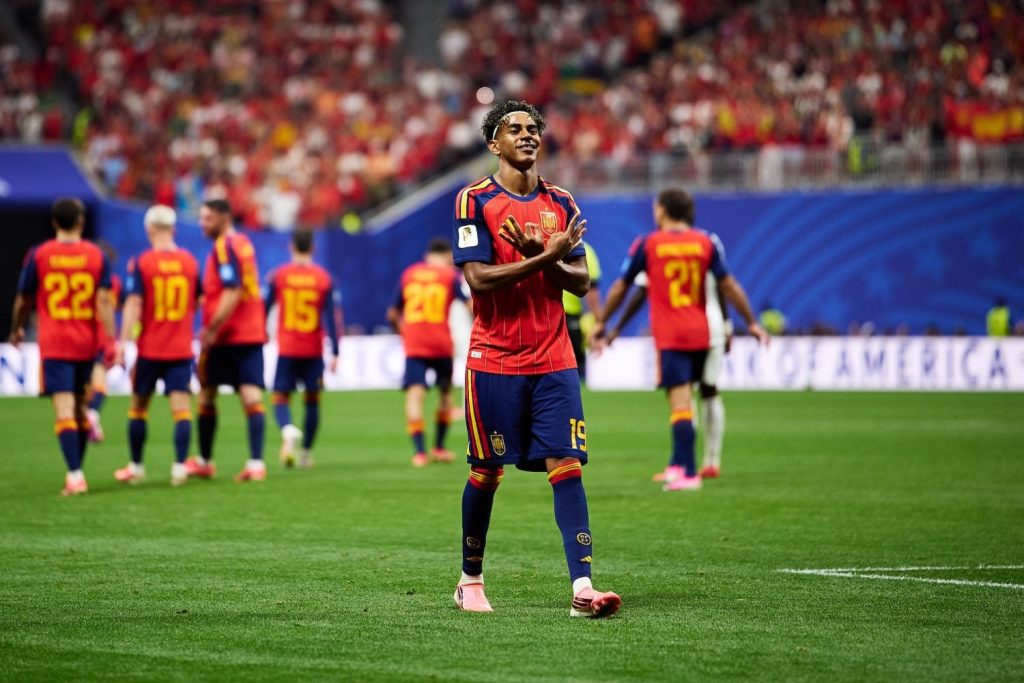
Among the many things that make the World Cup so compelling, matches between football’s established powers and its lesser-known national teams remain near the top of the list. Exotic fixtures, layered with meaning, capable of producing unexpected results. Take Cape Verde: within a week they held first Spain, the reigning European champions, then Uruguay, with Valverde, Darwin Núñez and Bentancur in the squad.
There is something striking about the fact that Cape Verde’s entire squad is worth three and a half times less than Lamine Yamal alone. According to Transfermarkt, Yamal’s market value sits around €200 million; the combined value of Cape Verde’s 26-man squad does not reach €55 million.
The idea that one player can be worth more than 26 professionals sounds absurd. Yet it is already a recurring feature of this World Cup. It happens in eleven different matches.
Spain against Saudi Arabia offers another example. On one side, a squad valued at €1.22 billion, the third-highest figure in the tournament; on the other, a national team whose players are worth a little over €40 million altogether. More striking still, the entire Saudi squad amounts to roughly a fifth of Yamal’s value. He and Manchester City’s Erling Haaland are the most valuable players at the tournament.
The same pattern appears elsewhere. In France–Iraq, Kylian Mbappé, valued at €180 million, is worth eight and a half times more than the entire Iraqi squad, estimated at €20 million. A record? No. That belongs to Norway–Iraq, where Haaland’s market value is ten times higher than the aggregate value of Iraq’s squad. The match finished 4–1 to Norway.
Ahead of Argentina–Jordan, Julián Álvarez alone is worth five times more than the Jordan national team. In England–Panama, Jude Bellingham’s value is four times greater than that of Panama’s entire squad. Vinícius Júnior is worth two and a half times more than Haiti. Belgium’s Jérémy Doku is valued at more than double both Iran and New Zealand. The same goes for João Neves against Uzbekistan and Achraf Hakimi against Haiti.
This World Cup is already heading for the history books for a number of reasons. One of them is the sheer number of matches marked by such pronounced economic imbalances, games in which a single player is worth considerably more than the entire opposing squad.
Part of the explanation lies in the expansion of the tournament to 48 teams, which has brought smaller national sides to Canada, Mexico and the United States, many with relatively modest squad values. But there is another factor too, perhaps the more significant one: the steady rise in the valuations attached to elite players, figures that continue to reach levels not seen before.