
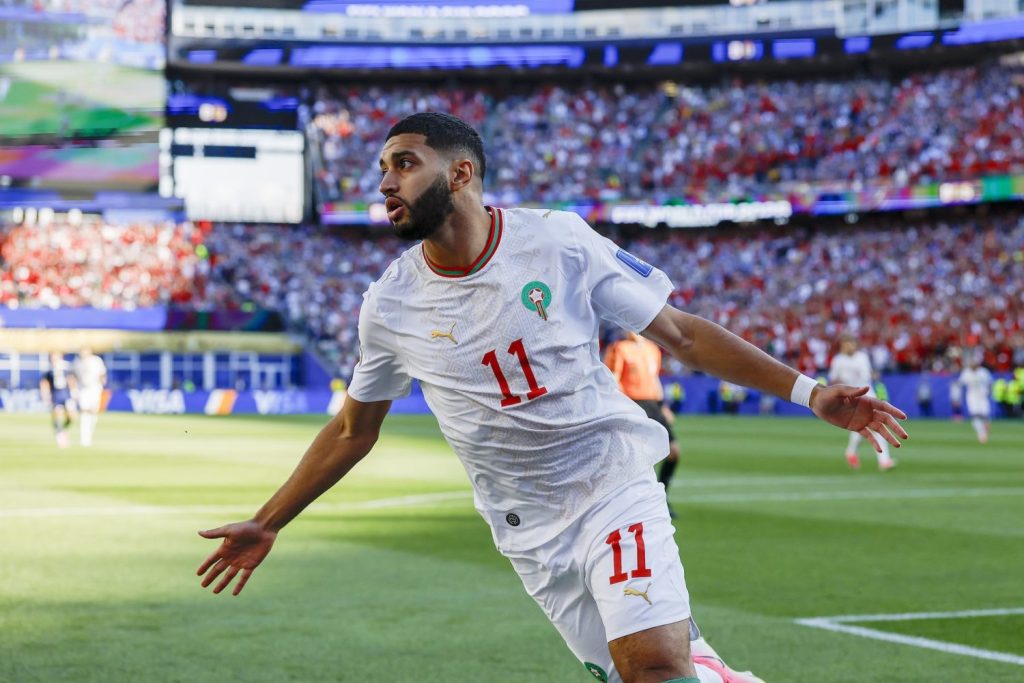
A goal on his World Cup debut against Brazil, lifted over Alisson. A move to Bayern Munich all but complete. The fastest goal Morocco have ever scored at a World Cup finals, after 70 seconds against Scotland.
There have been worse weeks than the one Ismael Saibari is having.
Born in 2001, the former PSV player is one of the leading figures of a Moroccan generation that continues to produce footballers of unusual technical depth. Across the last two Eredivisie seasons he has been involved in 45 goals, appearing as a central midfielder, attacking midfielder, winger and second striker. The position changes, the influence remains.
Achraf Hakimi once described Morocco as “the new Brazil”, and Saibari is one of the reasons that phrase has endured. The technical quality is obvious. So is the physical dimension. When he drives forward, particularly from the left, he does not always seem especially quick. Then a shoulder is won, a passing lane opens, the defender is suddenly behind him.
Only Mohamed Salah, in 2018, had previously scored in each of his first two World Cup appearances for an African national team.
Watching Morocco helps explain Bayern Munich’s decision to spend €55 million. Mohamed Ouahbi may list Saibari as a centre-forward, but the role is mostly theoretical.
Morocco attack through movement. Positions circulate. Spaces open and close. Saibari drifts away from the centre, leaving El Khannouss, Brahim Díaz or Ounahi to arrive there instead. He drops into midfield to connect possession, appears on the left, combines on the right. Few areas of the pitch seem unfamiliar to him. Eventually a defender stops following, and usually that is enough.
The goal against Brazil arrived from one of those movements, finished with a delicate lob over Alisson. The opener against Scotland followed a similar route. Brahim found him between the centre-backs after another run that had briefly taken him elsewhere. A touch with the right foot, almost lifting the ball into his own stride. Then a volley struck so cleanly that it appeared to stick in the net before bouncing back out. Afterwards came the usual celebration, a hand brushed across a closely shaved head.
Against Brazil, according to Opta, Saibari finished the opening round as the tournament leader both for runs in behind (16) and for pressing actions. The physical data points in the same direction. Using FIFA’s figures, only one player recorded more high-intensity runs (20–25 km/h) and more outright sprints (above 25 km/h) during the opening round of matches: Michael Olise. From this summer onwards, both will belong to Bayern Munich.
Kompany inherits a familiar kind of problem. Not whether to use Saibari, but where. Behind Harry Kane, alongside him, occasionally ahead of him.
Bayern moved early. Between last season’s play-offs and this year’s group stage, Saibari troubled both Juventus and Napoli in the Champions League, scoring twice and producing a succession of high-level performances. Yet nobody committed before Bayern did, even when the cost would have been considerably lower.
Discussions began before the World Cup. The deal was effectively completed after the lob over Alisson, before auctions and before competing offers. Now Munich can watch the tournament unfold and watch Saibari with it, without much concern.