
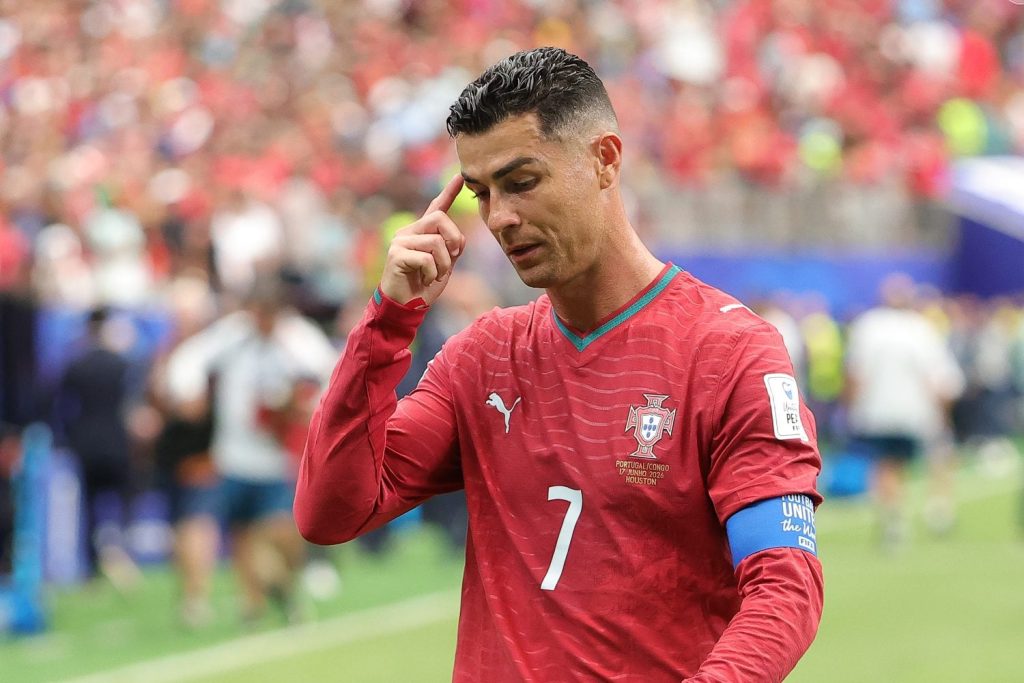
When it comes to Cristiano Ronaldo’s performance against DR Congo, there is not much room for doubt. Personal impressions and footballing intuition aside, there is now a substantial body of evidence — empirical, analytical, statistical — pointing to CR7’s diminishing usefulness within Portugal’s tactical framework. The numbers from this match say enough: zero shots on target, zero successful dribbles, zero key passes. Elsewhere, in publications as established as The Guardian and The Athletic, Ronaldo has been described as “a passenger” and “a shadow of the player he once was”.
After the match, inevitably asked whether Ronaldo should have remained on the pitch for the full ninety minutes, Roberto Martínez answered like this: “It would be absurd to take off the greatest player of all time in a game where we cannot score.”
Nothing needs adding. Those words contain everything. About Ronaldo. About Martínez. About Portugal.
Ronaldo continues to be treated as the best player in the world, despite the fact he has not been that for years. Not because of football alone. Because he is a global brand. An ambassador for a sovereign state. One of the most influential people on the planet.
Portugal’s debt to him appears limitless. As a footballer, and perhaps beyond football, Ronaldo transformed the way the country is perceived abroad. He represents Portugal in a way nobody else ever has. Even the simple act of substituting him in the 80th minute could be read as something larger than a football decision. Commercial. Symbolic. Political.
The last manager who attempted to reduce Ronaldo’s role, Fernando Santos, did not survive long after Qatar 2022. This despite being the coach who delivered the first major trophies in Portuguese football history. Benching Ronaldo during the final two matches of that tournament proved impossible to separate from what followed.
Martínez knows where he is.
Across his 41 matches in charge, Ronaldo has started 32. He has come off the bench once. The eight absences were largely friendlies, plus two minor injuries and a suspension served during Euro 2024 qualifying.
The pattern held at the European Championship. Ronaldo started every match. He was substituted only against Georgia, after Portugal had already secured qualification for the knockout rounds. His return in Germany: no goals, one assist.
How long can this continue?
How much longer must Portugal’s manager — whoever that manager happens to be — live with the obligation, unwritten but unmistakable, of selecting Ronaldo?
There is no easy answer. The stakes extend beyond football. Beyond sponsorship. Even beyond politics.
Ronaldo occupies territory no footballer has occupied before. His attachment to Portugal is genuine. His attachment to the national team is genuine. So too is his attachment to himself, and to the brand that has grown around him.
That is where the tension sits.
At this point, those loyalties no longer seem perfectly aligned.
A choice has to be made.
Ronaldo is 41. He has spent an entire career refusing to give things up.
Which leaves the decision to others.
The Portuguese federation. Roberto Martínez.
The impression, at least from the outside, is that the decision has already been made.
Ronaldo remains.
He will remain for as long as he wishes. If he plays badly. If Portugal draw with DR Congo. If he finishes among the worst performers on the pitch.
It sounds absurd when reduced to football.
Evidently, it is no longer only football.