
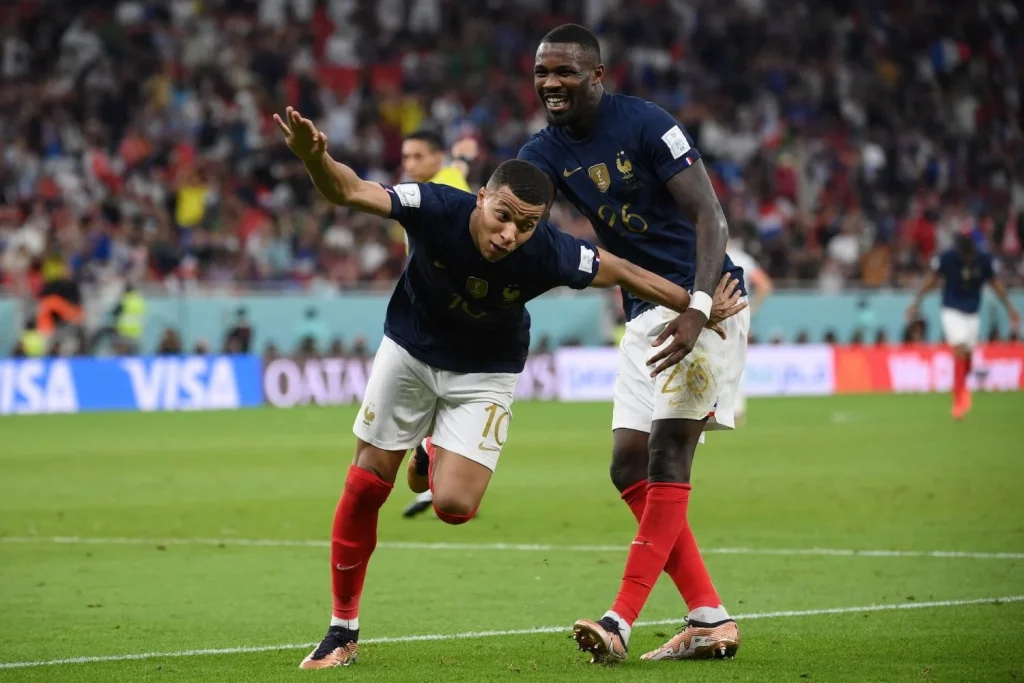
It is an endless story: a superstar of the French national team colliding again with national politics, with its social debates. Déjà vu, almost. Today that superstar is Kylian Mbappé: technical leader of Les Bleus ahead of the 2026 World Cup, the most visible figure across the last two finals editions – including the historic triumph in Russia 2018 – and, perhaps more significantly, an influential reference point for boys like him. Mbappé comes from that ethnic melting pot that defines the Paris banlieues, where football can offer hope – even an exit route – through goals and dribbling.
“You can be a player, you can be an international star, but first of all you are a citizen,” said Kylian Mbappé in a recent interview with Vanity Fair. “We are not disconnected from the world. We are not disconnected from what happens in our country. I know what it means, and what consequences it can have for my nation, when people like that take power.” He is referring, not indirectly and not for the first time, to the far right of Marine Le Pen and Jordan Bardella, whose rise in the national political landscape appears unstoppable. “I know very well what happens when Mbappé leaves PSG: the club wins the Champions League!” Bardella wrote on social media, conveniently omitting that the triumph was driven by Ousmane Dembélé and Désiré Doué, two more sons of a multicultural France now dominating global football.
Kylian Mbappé was born in December 1998. Just months after France’s first World Cup victory, achieved by a group without precedent. Many of the champions of Saint-Denis had roots in Senegal, Morocco, Algeria, New Caledonia. All French, all still slightly out of place in the way they were spoken about. Aimé Jacquet, two years earlier, had already forced a break with convention. Against resistance, against habit, he widened the frame. A team that became something else without ever really announcing it.
Still, the aftershocks of Zinédine Zidane and his teammates were political from the beginning. Both sides. The label Black-Blanc-Beur. Celebration and unease together. Jean-Marie Le Pen called the team “not French enough”. Didier Deschamps, then captain, answered without emphasis: “Mr Le Pen can think what he wants; our only goal is to wear the shirt of our country.”
The debate never really cooled. Just over a decade earlier, Michel Platini had carried France to Euro 1984, alongside Jean Tigana and Marius Trésor (injured, absent). A different country reflected back, or at least a different surface. In a short span, France began to renegotiate its idea of grandeur — political, symbolic, sporting. World Cup hosting and winning as projection of identity. In parallel, the 1990s: migration policy, the contested framework of jus soli, the language of integration applied to deprived urban areas. The same spaces producing the next wave of players, without ever asking permission.
Twenty-five years later, the fault lines remain. Suburbs still marked by ethnic and religious tension, sometimes spilling outward, sometimes not. Integration unfinished, uneven, always reopening in the same places. The rise of the populist right sits inside that landscape, never fully separate from it, even when it pretends to be. Football holds its own continuity. A success story, still visible in fragments. Zidane and Thierry Henry as its peak, but the roots earlier. 1988. Clairefontaine.
The French Football Federation, in transition, opens its national technical centre at Clairefontaine in the Île-de-France region. Paris and its banlieues around it. Density, pressure, constant supply.
A model built quickly, without ornament. Elite facilities. Selection as filter. Coaching authority concentrated. From childhood into early adulthood. Not only the production of players, but something closer to passage, and exit, held together.
The two logics remain side by side, unresolved. Each year, Clairefontaine selects 23 from around 1,600 trialists in Île-de-France. Thirteen years old, more or less. Two years inside. Sunday to Friday: training, school, repetition. Outside still there, visible, slightly out of reach. Names on walls, names returning in person when Les Bleus arrive. Nobody really explains it.
Kylian Mbappé sits at the top of that line. Before him: Marcus Thuram, Blaise Matuidi, Thierry Henry, Nicolas Anelka, William Gallas, Louis Saha.
Île-de-France everywhere in the game. Half of Didier Deschamps’ 2026 World Cup squad comes from there. One fifth of the country, out of proportion, though nobody says it like that. Nearly 60 per cent of French professionals born there. Across Europe’s top five leagues, the region still appears in that 5–10 per cent band of the total pool, more than expected, less than explained.
The centre of gravity is elsewhere. Not the Paris boulevards. Not Paris itself. The edges. The discontinuous city. Where inequality becomes texture rather than description. Crime rates, unemployment, distance from institutions. Inclusion as word rather than condition. In that space, football is not metaphor. It is rhythm.
“Why are we so good at football here? Because there is nothing else here,” Paul Pogba once said.
Bondy. Mbappé and William Saliba. Les Ulis in another direction: Thierry Henry, Patrice Evra, Anthony Martial. Geography fades after a point, or it becomes something softer. Recognition takes over. Shirts, gestures, repetition. Private mythologies of escape that everyone recognises without saying so.
“I knew him,” someone might say. A sentence that carries more than it explains, or less, depending on the day.
Very few versions end in the same place. Most do not end at all. But Mbappé remains visible inside that imbalance. So does the France that produced him. A presence that settles, without needing to resolve itself.