
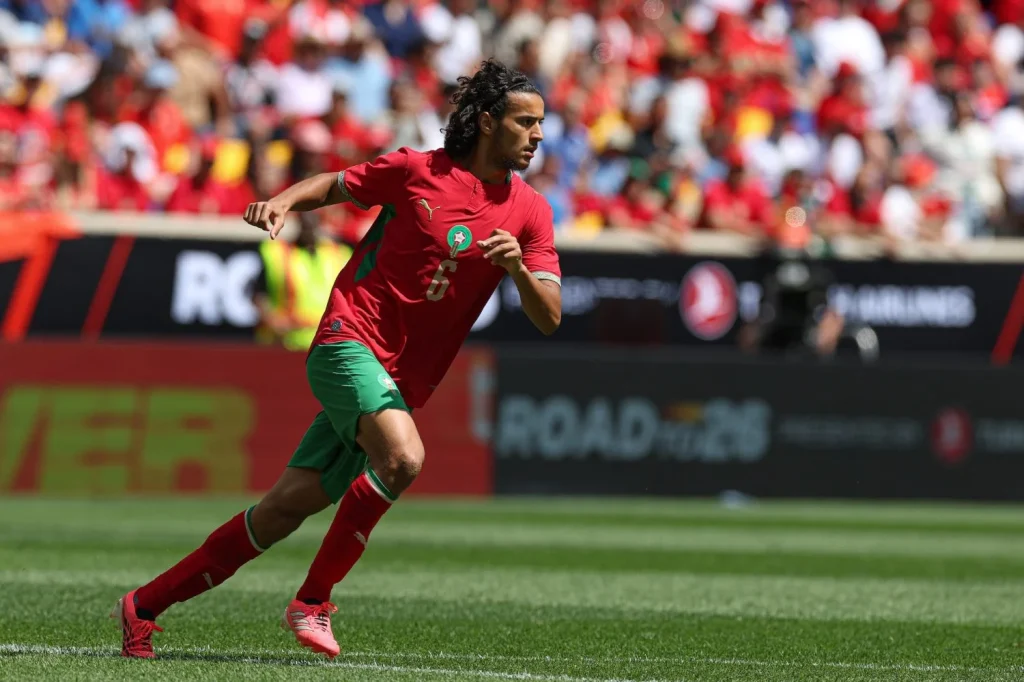
We will remember Brazil–Morocco as the night Ayyoub Bouaddi announced himself on a wider stage.
In a World Cup shaped by the presence of players in their forties — eight in total, more than ever before — and in the most anticipated match of the group stage, it was a player born in 2007 who took control of the evening. At 18, Bouaddi already plays with a maturity that feels out of place for his age.
A month before the tournament, the Lille midfielder chose to represent Morocco despite having come through the French youth system. A decision that fits a broader pattern: many of Morocco’s players are born abroad, in families that left the country in search of opportunity but never really broke ties with it. Fourteen of the 26 players in the Atlas Lions squad were born outside Morocco.
Much of this comes down to the Moroccan federation’s long-term strategy, often described in sporting terms as a form of “decolonisation”. Through sustained scouting, it tracks eligible players developed abroad and works to bring them into the national setup.
“I made my decision: I’m proud to represent my country,” the Lille midfielder said.
Bouaddi studies mathematics at university level and wins public speaking competitions at the Élysée, organised each year among elite French academy players. On occasion, he also quietly dictates the rhythm of Brazil under Ancelotti, in a World Cup debut that felt anything but ordinary.
A life that, on paper, reads as unremarkable — until it doesn’t.
In a match that hinted at a subtle shift in hierarchy, with Achraf Hakimi describing Morocco in the build-up as “the African Brazil” and the game itself producing spells in which Brazil, in red, looked almost secondary in fluency and combinations, Bouaddi’s performance stood out for its clarity.
Composed, almost detached in his control of tempo, he received the ball with his body already open, always a step ahead of pressure. Even under pressure, he rarely looked rushed, often escaping situations with a simple adjustment of his body shape. It’s the kind of detail usually associated with players operating at a different rhythm from everyone else.
With his curly hair and unshaven beard, he has drawn comparisons with an early Adrien Rabiot or, more recently, Matteo Guendouzi — another French-developed talent who broke through early. Bouaddi, though, feels slightly different.
There is a more natural ease to the way he occupies space. A sense of calm authority that doesn’t announce itself. It suggests a player already comfortable at the top level: Real Madrid, PSG, or one of the leading clubs in England. Beyond technique, what stands out is his emotional stillness. He plays without visible tension, never rushed by the moment.
The data — which Bouaddi, a mathematics student, would probably enjoy — helps frame the performance: 91% pass accuracy, three successful dribbles, nine ground duels won, six recoveries. A complete performance, delivered at 18, against Brazil under Ancelotti in a World Cup debut.
Those who follow European football closely were not discovering him for the first time. His professional debut came in October 2023 under Paulo Fonseca. Since then, the trajectory has been steady, marked by significant milestones, including a Champions League debut in a win against Real Madrid, where he again looked completely at home.
His rise fits a familiar pattern: Moroccan talent developed in Europe, shaped by stronger infrastructure and academies, yet still closely tied to its origins. A system in which identity and opportunity move in both directions.
Brazil–Morocco, in the end, was the night that suggested Carlo Ancelotti still has work to do, that Morocco’s ceiling is no longer far from that of the Seleção, and that Ayyoub Bouaddi may already be something more than a prospect.
A midfielder built for the elite.
From New York City, that’s all — and it doesn’t feel like a small thing.