
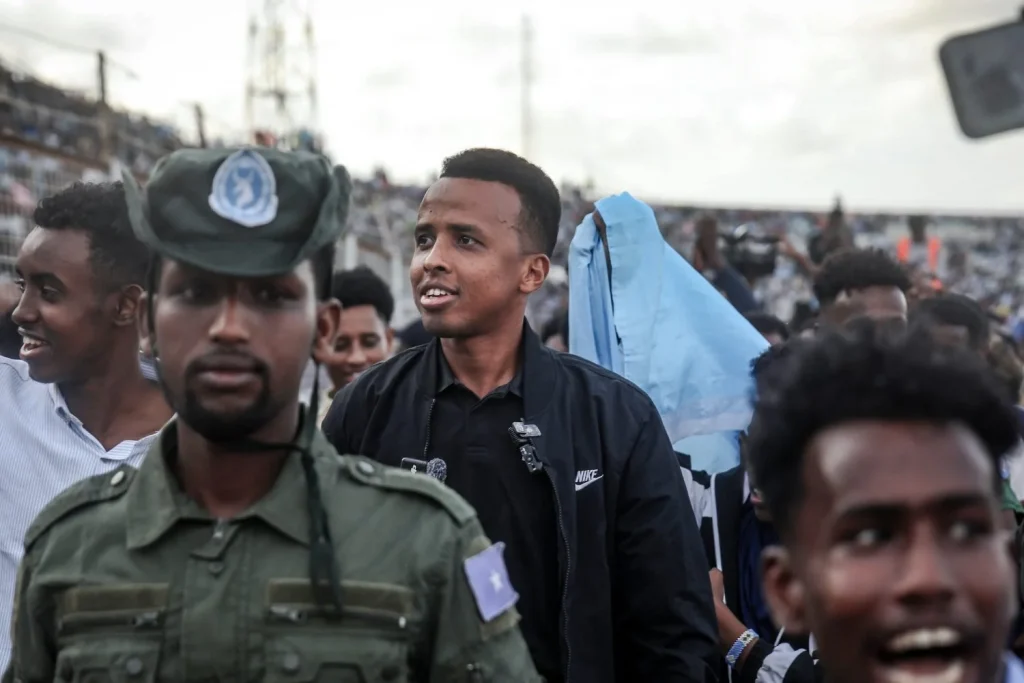
Omar Artan landed in Miami with his documents in order, his visa ready and a dream close to being realised: awarded Best African Referee in 2025, he was set to become the first Somali official in history to referee a World Cup match. His dream, however, collided with United States border policy.
On his return home, Artan was welcomed as a true hero: “I think they have a problem with my country,” he said.
Questioned on the Artan case, the director of the White House Task Force (a body created specifically to coordinate hospitality and all World Cup-related operations), Andrew Giuliani, said the referee was denied entry for “a valid reason”. He added that he wanted to ensure no dangerous individuals enter the United States.
It is clear that Donald Trump’s words last December help frame the episode: “Somalis should go back where they came from. Their country is not in good condition for a reason.”
Once again, the weeks leading up to the start of the World Cup unfold in a sequence of uninterrupted controversy. The anticipation for kick-off has given way to a sense of unease around the many shadows surrounding the event.
It happened in Vladimir Putin’s Russia in 2018; and above all in Qatar in 2022, when the scandal over migrant workers exploited in stadium construction came to light, alongside the host country’s civil rights record.
This year, as expected, debates around Donald Trump’s United States — one of the three host nations — have been no different.
The discussion directly concerns access to the tournament: who will be allowed in, who will be able to cover it, and who will be able to experience it from the stands.
Because Artan’s case is not isolated. The paradox of what is, on the sporting side, the most inclusive and universal World Cup ever, with 48 national teams involved, is that in the stands it risks becoming one of the most exclusive and least representative.
While the conflict with Iran continues and shows no sign of abating, the organisation of Team Melli’s arrival — the national team’s historic nickname — is marked by several uncertainties: players will in fact have to leave the country shortly after each match played in the United States, with an obligation to stay (and train) in Mexico.
AIPS (International Sport Press Association) has written to FIFA to express concern that several Iranian and African journalists have not been granted visas to cover the tournament.
This is a bureaucratic deadlock linked to the tightening of entry controls and verification procedures. In the United States, full entry bans are in place for citizens of four World Cup participating countries: Iran, Haiti, Senegal and Ivory Coast.
In addition, citizens of Algeria, Cape Verde and Tunisia are required to pay a visa deposit.
A few days ago, a video went viral showing Senegalese players, upon arrival at San Antonio airport, subjected to extremely strict and invasive checks on the runway: the footage shows them seated on chairs and searched head to toe.
It inevitably raises the question of whether the same treatment has been applied to other national teams considered “less problematic” by the United States.
Last Friday, a player from Iraq was questioned for seven hours upon arrival at Chicago airport. According to Reuters, the player in question was Aymen Hussein, vice-captain and key figure for the national team. The agency reports that he was interrogated by officers and that his phone was inspected before he was cleared to enter the country.
According to The Athletic, on 2 May 2018, during the bidding process for the World Cup, Trump wrote to Infantino expressing confidence that “all eligible athletes, officials and fans from every country in the world will be able to enter the United States without any discrimination”.
Those promises have since melted away.
A simple online search is enough to see it: beyond the most high-profile cases involving referees and players, numerous fans have found themselves facing highly complicated situations when trying to enter the United States. This applies both to those from countries on the Trump administration’s “black list” and to others from elsewhere in the world — Scotland, for example.
From this perspective, FIFA is clearly constrained: these are non-negotiable policies for Trump, an integral part of his political programme. No football institution can be expected to change them.
Yet the reality of recent weeks has shown how referees, fans, and officials from various countries have effectively seen their World Cup dream slip away in front of them.
In short, the build-up to the tournament is unfolding amid a series of controversies and disputes that inevitably shift attention away from what should be a global celebration for every participating nation, directly or indirectly involved.
The sense is that when the ball starts rolling at the Azteca Stadium, in the opening match between Mexico and South Africa, the world will tend to forget all of it. But once again, the atmosphere in the weeks leading up to it has been marked by a grey tone that is difficult to ignore.
And the real issue is that the tournament risks feeling considerably greyer than usual in the stands as well.