
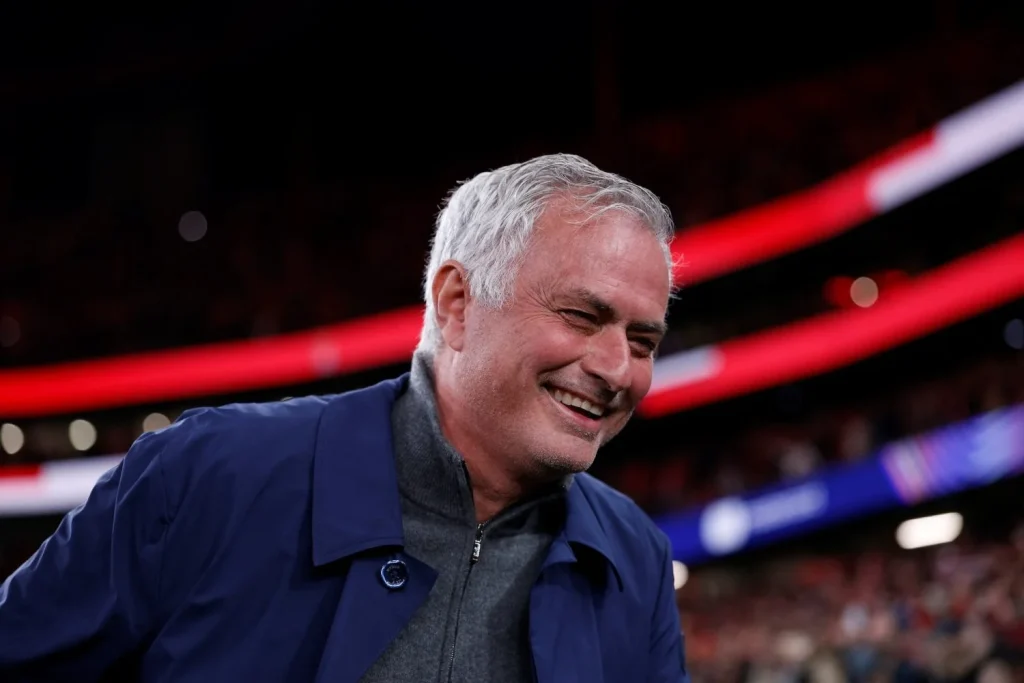
José Mourinho has not won a top-tier title — a league championship or the Champions League — since 2015, when his Chelsea side lifted the Premier League. The most recent trophy in absolute terms dates to 2022, the UEFA Europa Conference League in Tirana with Roma. His last direct qualification into the Champions League goes back to 2017/18, when Manchester United finished second under his management.
There is, of course, nothing unusual in a decline of this kind. No manager sustains victory indefinitely. The question sits elsewhere, in the structure Mourinho has built around himself — what might loosely be called Mourinho-ism. A system grounded in trophies as proof, in the idea that Mourinho arrives and wins, in the supremacy of the result over everything else.
It was Mourinho himself who constructed that figure. Early in his career, he altered training methods in European football, reshaped the idea of the coach as public personality, and changed how a manager could exist inside the media system. Then came the second version: pragmatic, combative, permanently positioned against an external world, a commander defined by confrontation and resolution.
That system, over time, has begun to misfire. Or at least to function differently. His most recent spells — Benfica and Fenerbahçe — sit alongside difficult or incomplete cycles at Manchester United, Tottenham and Roma. Each adds a layer of distance between the idea and its execution.
So the question becomes inevitable. If Mourinho no longer delivers results at the same rhythm, what is he doing at Real Madrid?
And why Florentino Pérez — a president who, regardless of taste, has repeatedly reshaped the logic of elite football — has chosen to bring him back thirteen years after his departure?
There is no single answer. Only fragments that align unevenly, like parts of a mosaic. One of them is reputation, or something close to it: the aura that still surrounds Mourinho, independent of results.
People who have worked with him in recent years describe a figure operating almost like a one-man organisation, dividing his time between the pitch and a continuous reading of media cycles, social platforms, public narratives. A manager who has remained visible even as results have softened.
The tactical Mourinho has changed slowly. The communicative Mourinho has not. He has adapted without shedding form. Even in peripheral jobs, he has remained central to discussion — preserving conflict as a method of presence. The character, in that sense, has outlasted the results.
From there, the line to Madrid becomes shorter.
It is not the first time Florentino Pérez has reconfigured the managerial position through profile as much as through function. Xabi Alonso, despite a different register and a different aura, remains a coach defined by structure and field logic. Not yet a brand in the way Ancelotti, Zidane or Mourinho have become brands.
The president’s logic, in this reading, is that Real Madrid require not only a coach but a figure who exists at the same altitude as the players themselves — in visibility, in narrative weight, in public gravity.
At that level, the market narrows. Ancelotti and Zidane are already elsewhere. Klopp has stepped out of circulation. Guardiola, for reasons that are less technical than structural, is not an option. The list contracts until it becomes almost linear.
Another layer concerns dressing-room dynamics. Recent Madrid cycles have tended to stabilise under managers who build direct, personal bonds rather than intricate systems. In that context, Mourinho still offers a familiar architecture.
There is, however, a cost. Ferran Soriano once described the difference in terms of tension: Barcelona, he suggested, chose Guardiola over Mourinho because Mourinho requires an environment of sustained emotional pressure that eventually becomes difficult to contain.
That pressure, historically, has both organised and strained the spaces he has entered.
At Madrid, a similar diagnosis appears to have formed. Following Ancelotti’s paternal management style, the more system-based approach attempted by Xabi Alonso, and an interim phase that drifted towards player autonomy, the sense inside the club has been of a hierarchy in flux.
The response, in this reading, is not structural refinement but reassertion. A manager capable of restoring a vertical order inside a dressing room of established names, of reintroducing friction as a governing principle.
There is also memory.
Between 2010 and 2013, Mourinho’s Madrid operated in direct confrontation with Guardiola’s Barcelona. Yet it was during that period that the foundations of the later cycle were laid: Khedira, Di María, Varane, Modrić arriving at Valdebebas; Benzema, Xabi Alonso, and Cristiano Ronaldo consolidating roles under Mourinho’s tenure.
The contradiction is part of the archive: the conflict defined the era, but the structure survived it.
Seen from that distance, Mourinho’s Madrid is neither beginning nor ending. It is a previous mechanism reactivated in a different configuration. A memory that has been reinstalled in the present.
The uncertainties remain unaddressed. Whether his football still carries the same competitive edge at the highest level. Whether a more conservative approach will be accepted at the Bernabéu. Whether players of a different generation will tolerate the same internal temperature.
For now, those questions sit in suspension. The decision has already moved past them.
And in that space, Mourinho remains what he has been for much of his career: not only a coach of teams, but a producer of conditions — of attention, of hierarchy, of narrative density.
Even when the results shift, the figure does not.