
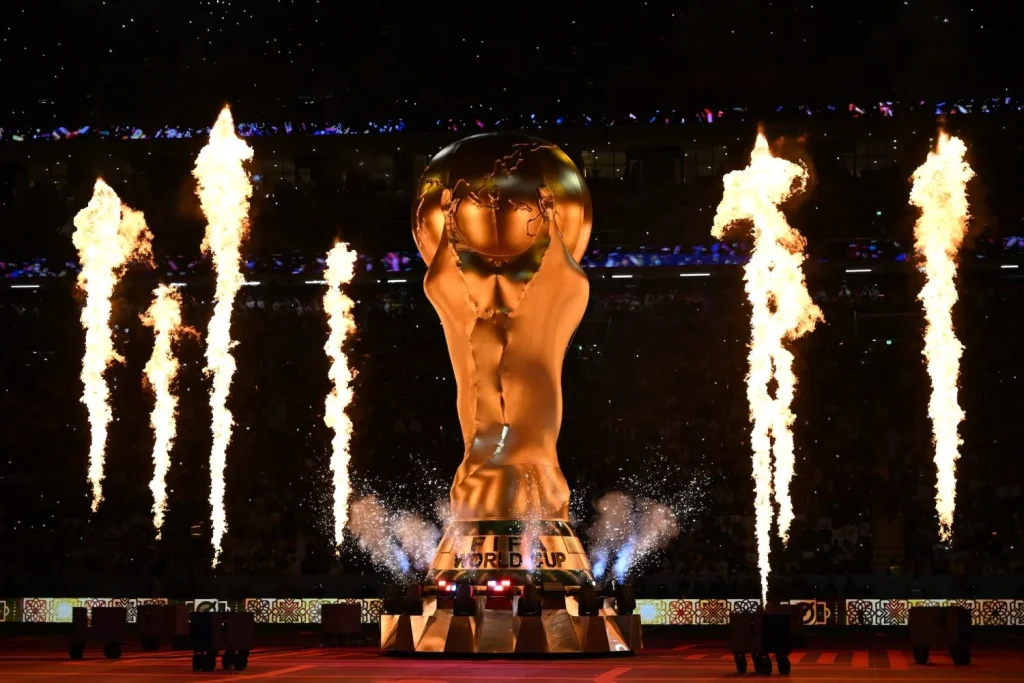
We are almost at the threshold of another World Cup without Italy. The list of those who will still be there, in spite of it, begins to form almost by subtraction.
Carlo Ancelotti will be there, carrying the weight of Brazil’s bench. Vincenzo Montella and Fabio Cannavaro, now at the helm of Turkey and Uzbekistan. Maurizio Mariani, the only Italian referee among the 52 selected for the tournament in North America.
And then there is another Italian name, less immediately visible in the frame. He was there in Qatar in 2022 as well. Marco Balich.
If the name does not immediately register, it is because his work tends to precede recognition. It remains in images rather than faces. Like the Italian tricolour descending over the pitch at San Siro last February, during the opening ceremony of the Milan–Cortina Olympic Games.
Balich is creative director and executive producer of Balich Wonder Studio, a company that builds the architecture of contemporary sporting ceremonies. The kind of work that sits before kick-off, before broadcast, before memory has decided what to keep.
After the Winter Games, his studio has also been tasked with the opening ceremonies of the upcoming World Cup. Plural is not incidental: there will be three of them. Mexico City on Thursday 11 June, then Los Angeles and Toronto, both within twenty-four hours.
An Italian studio designing the opening act of the world’s biggest sporting event, staged across three North American cities, in the heart of global entertainment infrastructure. It is a geography that folds in on itself.
In recent years, Balich Wonder Studio has already worked across the main stages of global sport: Milan–Cortina, the Africa Cup of Nations in Morocco, the Champions League final in Budapest. A consistent presence in moments that sit between ceremony and competition.
“The awareness within FIFA about ceremonies has changed after Qatar 2022,” Balich says in conversation with Undici. “There is a stronger desire to build something with meaning, not just a parade of artists on the pitch.”
The rehearsal, in a sense, came a year earlier in Miami. The 2025 Club World Cup opening ceremony at Hard Rock Stadium became, in his words, “a warm-up, to use a football metaphor.” The word he uses again is liturgy. A structure rather than a show.
“We turned it into a kind of ritual,” he says. “And that is something we will return to for the World Cup ceremonies.”
This will be the first World Cup staged across three countries, the first with 48 teams, and the first to open with three separate ceremonies. Each one calibrated to its own city.
“The idea is to create a shared celebration that still allows each country to recognise itself,” Balich explains. “Mexico, Canada and the United States each in their own language, their own cultural register. Everything has been developed with our director Carlos Navarrete-Patiño, who is himself Mexican-Canadian.”
There is a continuity running through the planning: a year and a half of preparation, and a concept that tries to hold together three different geographies under a single rhythm.
“Ultimately,” he says, “no one remembers who was in government during a sporting event. What remains is the emotion of a match, a gesture, the celebration. That is what stays. We are trying to build ceremonies that become part of that memory.”
The opening act begins in Mexico City, at the Estadio Azteca, ninety minutes before the first match between the hosts and South Africa. The ceremony brings together Latin American performers and indigenous artists, framed by the colours of papel picado suspended across the stadium.
In Toronto, the following day, the narrative turns toward distance itself: a symbolic journey across Canada from coast to coast, with the World Cup trophy reinterpreted as a mosaic of regional identities.
Los Angeles, meanwhile, becomes the pop axis of the sequence. A stage for global performers, designed with the logic of entertainment infrastructure rather than national frame. Music as the only language assumed to be universally legible.
“All three ceremonies,” Balich says, “are connected by a shared heartbeat: the rhythm of the game, and the emotion of millions of fans. Our job is to amplify that. To give shape to something already present.”
The idea returns again: emotion made visible. A stadium not only as venue, but as participant. “We wanted spectators inside the stadium to have an active role,” he adds. Gates will open hours in advance. Activities, installations, immersive moments distributed around the pre-match space.
For now, he does not go further. “There will be surprises,” he says. “But the intention is to set a precedent. Some moments cannot be replaced. That is what makes them unique.”
In Balich’s work, emotion is treated as material. Not interpreted, but constructed. Something that can be staged, layered, extended into time before the event itself begins.
It is here that the ceremonies shift from production to language. Not in what they represent, but in what they allow to happen: anticipation as part of the event, structure as feeling, arrival as already underway.
In the end, it is still a celebration. Only now it stretches across borders, languages and stadiums, unfolding before the tournament has even begun.