
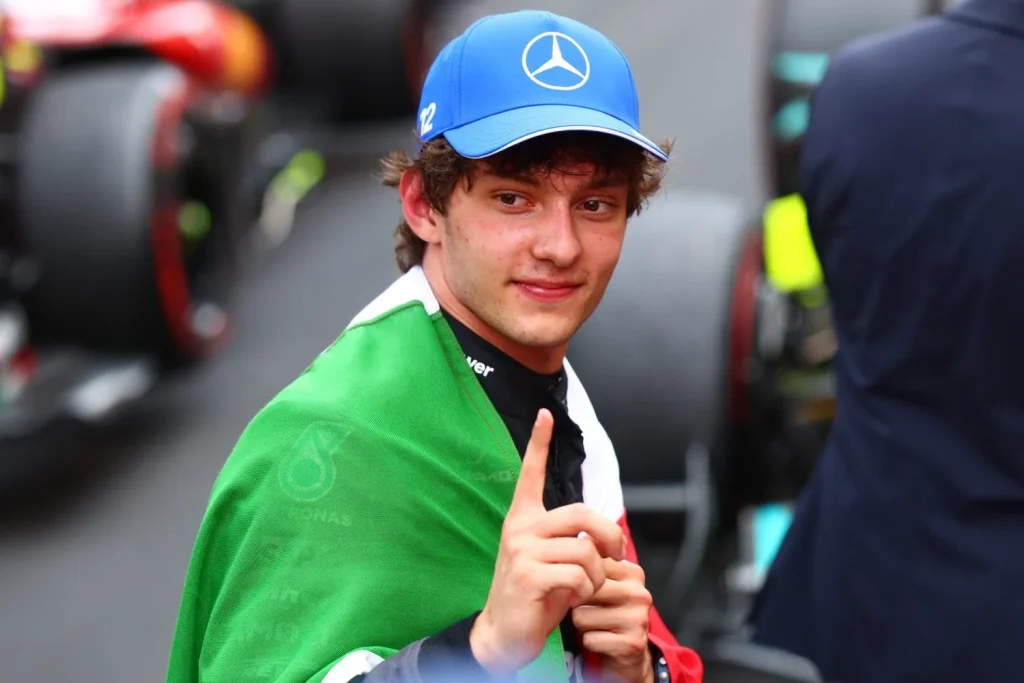
There was something quietly fitting about Andrea Kimi Antonelli winning in Monaco. On the nose of his Mercedes sat the number 12, the same number that became inseparable from Ayrton Senna, the driver Antonelli has always spoken about with a certain reverence. During Thursday’s media sessions in the Principality, the young driver from Bologna had joked about the coincidence. By Sunday evening, it had become part of the image.
After the chequered flag, another scene unfolded in the pit lane. Max Verstappen was waiting. The Dutchman, rarely inclined to linger after a retirement, crossed paths with Antonelli and stopped to congratulate him. Verstappen had spent only a handful of corners in the race before a stalled start left him stranded on the grid and out almost immediately. Even so, he remained long enough to greet the winner.
Monaco was the latest chapter in a season that has quickly settled into an unexpected rhythm. Antonelli arrived at the sixth round of the championship with four victories from five races. He left Monte Carlo with five from six. George Russell, his closest challenger before the weekend, collected two speeding penalties in the pit lane and surrendered further ground. The gap between the Mercedes drivers now stands at 68 points. Lewis Hamilton, second at the finish on Sunday, moves into second place in the standings.
None of it seemed particularly likely on paper. Monaco has never been a circuit that naturally rewards Mercedes’ strengths. The narrow streets, low-speed corners and constant demand for traction reduce many of the advantages offered elsewhere by outright power. Ferrari had been considered among the favourites before the weekend. Similar predictions had surrounded Montreal a few weeks earlier, another track where Antonelli eventually won despite expectations pointing elsewhere.
The race itself unfolded in stages.
Antonelli converted pole position cleanly and immediately established a pace that detached him from the pack behind. Verstappen’s retirement removed one contender from the equation, but the afternoon remained far from straightforward. A Safety Car, triggered by Lance Stroll’s accident, erased the advantage he had built. Later, a red flag followed Charles Leclerc’s collision with the barriers at Turn 19 on lap 66. Each interruption compressed the field. Each restart required Antonelli to create the race again.
He did so without visible urgency.
“We’re doing a great job. Everything feels so natural,” Antonelli said afterwards.
The remark reflected the atmosphere around Mercedes throughout the weekend. There was little sense of improvisation. The pace had arrived gradually over the previous months, race after race, and Monaco offered another example. The victory was the fifth of Antonelli’s Formula One career, and all five have come consecutively from his first. No driver had ever opened a winning record in the category with a sequence of that length.
For Italian motorsport, Monaco carried its own chronology. The last Italian winner in the Principality had been Jarno Trulli in 2004. Twenty-two years later, another Italian stood on the top step of the podium. Behind him, Hamilton secured second place and strengthened his position in the championship. Ferrari left Monte Carlo with rather different images. Leclerc, among the favourites before the start, ended his race against the barriers under Safety Car conditions.
In many ways, the decisive moment had arrived twenty-four hours earlier.
Friday’s practice sessions had exposed several limitations in the Mercedes package around Monaco’s streets. Overnight, Antonelli and his engineers opted for a substantial change of setup. By Saturday afternoon the car looked transformed. Pole position followed, produced by a lap that threaded through the harbour section and the swimming pool complex with barely a visible correction.
Sunday became an exercise in maintaining that advantage.
When the race ended, the statistics assembled themselves. Victory. Pole position. Fastest lap, a 1:13.481. Control of every decisive phase of the weekend. Monaco has traditionally rewarded experience, patience and familiarity with risk. Antonelli won it at twenty years old.
The previous benchmark belonged to Lewis Hamilton, who had taken his first Monaco victory at 23 years, four months and 18 days.
As the evening light settled over Port Hercule and the teams began packing equipment into transporters, Antonelli remained at the centre of the paddock, moving between television crews, engineers and mechanics. Around him, Monaco looked exactly as it always does on a Sunday night: barriers still in place, yachts illuminated along the harbour, the circuit gradually returning to a city.
Only the timing screens suggested that something new had happened there.