
There was a time, not so long ago, when China looked like football’s next frontier.
Money arrived quickly, and in volume. Clubs expanded their spending almost overnight. Contracts followed that logic. Fabio Cannavaro, Marcello Lippi, Graziano Pellè, Stephan El Shaarawy all passed through the league at different moments, alongside Carlos Tevez, Oscar, Paulinho, and others who left established European contexts for Shanghai, Beijing, Guangzhou. Transfers signed off with figures that, for a period, reshaped the market’s reference points.
It resembled something that would later be associated with the Gulf, only earlier, and without the same continuity. The direction was clear for a while: infrastructure, visibility, imported expertise, a national project built through football.
Then the momentum thinned.
The government intervention came gradually, then more decisively. The broader plan — increasing grassroots participation, accelerating the national team’s competitiveness — began to look longer and less certain than initially framed. Qualification for the 2014 and 2018 World Cups did not arrive. The timelines stretched. Expectations were adjusted, not always publicly.
Around the same period, the financial base that had supported much of the expansion began to shift.
Evergrande, the property group whose football arm had powered Guangzhou Evergrande to two AFC Champions League titles under Lippi and Cannavaro, came under pressure. Suning, owners of Inter in Italy, followed a similar trajectory of contraction. The effects filtered through the league structure. Investment slowed. Clubs recalibrated.
The Chinese Super League lost its earlier pull. In the regional hierarchy it was overtaken by Japan’s more stable model and by the accelerating leagues in the Middle East. China sits 94th in the FIFA rankings. World Cup qualification is no longer an immediate reference point in planning cycles.
And yet, for the 2026 edition, there will still be a Chinese presence.
It does not come from the national team.
It comes from Ma Ning.
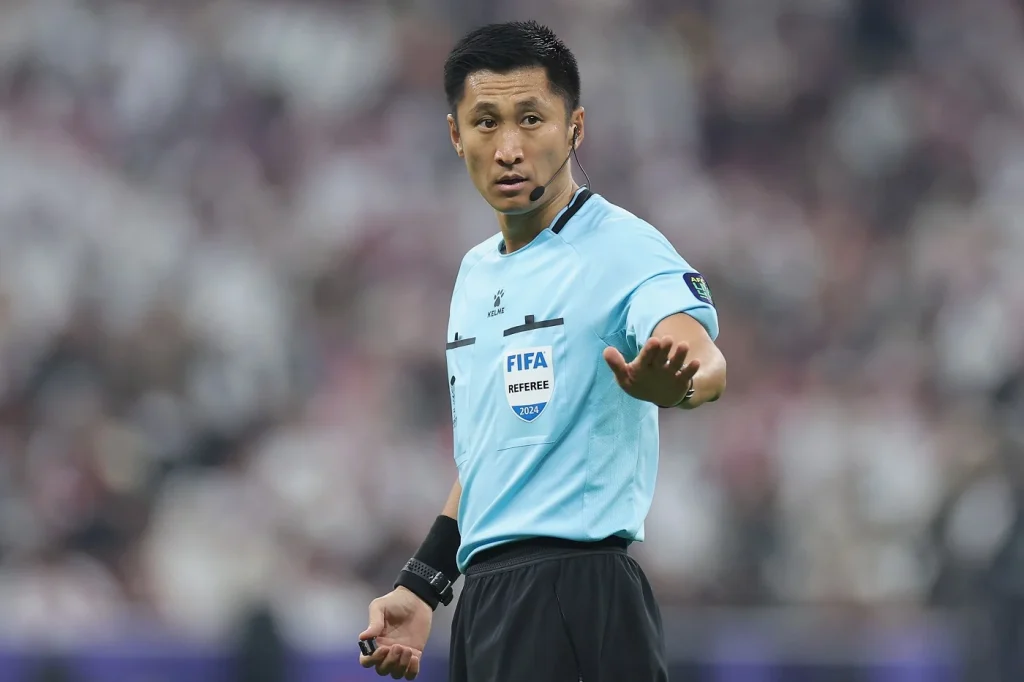
He travels to the United States as one of the selected officials for the tournament in Miami and beyond. At present, he is arguably the most visible figure in Chinese football outside the domestic league.
Born in Liaoning province, in the industrial north-east, Ma has built his reputation around consistency and control. The Economist once referred to him by a nickname used among supporters: “Card Master”, a reference to the frequency with which yellow cards appear in his matches. The description has become part of how he is discussed.
For some, that reflects authority. For others, excess.
In 2015, a single match brought that profile into sharper focus: nine yellow cards, three red cards. Since then, every appointment has carried a degree of scrutiny. Decisions circulate quickly, replayed, dissected.
Last month, during a Shanghai Port fixture, sections of the crowd directed chants at his family. The incident moved onto social media within hours. Ma continued as normal.
In 2024, he became the first Chinese referee to officiate an AFC Asian Cup final, the match between Jordan and Qatar. It marked a milestone for Chinese officiating on the international stage. The national federation publicly backed him during periods of criticism, including disputes over individual decisions.
The 2026 World Cup will be his second consecutive involvement in the tournament. In Qatar, he served as fourth official. This time, he is in contention for on-field appointments.
There is a structural detail that sits alongside his profile. China will not be present as a competing national team. That absence removes a particular layer of pressure that often surrounds referees from participating countries. Ma operates outside that dynamic.
He is 46. Still active, still accumulating appointments. Sponsorship deals have followed in recent years, alongside a growing presence on Chinese social platforms. His visibility now extends beyond refereeing itself, into a broader sporting profile that sits slightly apart from the national team’s trajectory.
Chinese football, in parallel, has moved through cycles of investment, restructuring, and regulatory tightening. High-profile cases of financial mismanagement and corruption have surfaced. Administrative changes have followed. The results on the pitch have not kept pace with earlier spending phases.
Within that landscape, Ma’s position is unusually defined.
When the World Cup begins in North America, the most recognisable Chinese figure involved will not be part of a squad, or a coaching staff.
He will be standing alone at the centre circle, whistle in hand, waiting for the first pass.