
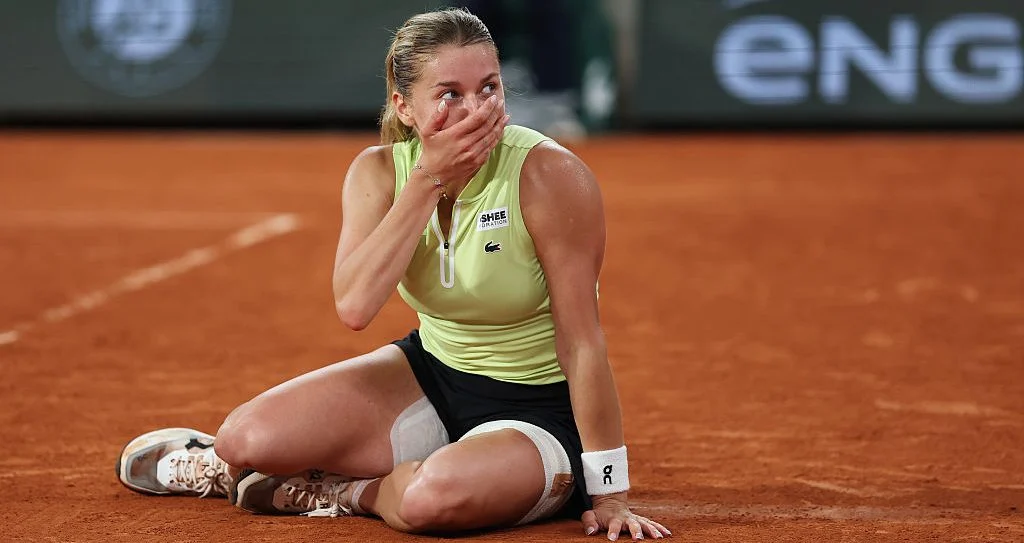
Technically, in the most unlikely route available at Roland Garros, a player can need up to ten matches to win the title, starting from qualifying. Maja Chwalińska has already won nine.
The tenth is the final, against Mirra Andreeva.
Even before that, the story has already slipped into its own category in Paris. One of those runs that gets described, almost automatically, as “the story of the year”. No woman in the Open era had ever reached the Roland Garros final starting from the qualifying draw. Across all four Grand Slams, only Emma Raducanu had done it before, at the 2021 US Open, which she then won.
Chwalińska stands at the net after the semi-final against Diana Shnaider with her hand over her mouth, as if checking whether the point has actually finished. The win arrives inside a larger personal arc that she has spoken about only in fragments, but which has been part of her trajectory for years now.
Before Paris, she was ranked 114 in the world. Whatever happens next, she will leave the tournament inside the top 30. She has not yet faced a top-10 player here. That changes in the final.
The path has been lined with names that, on paper, should have stopped her earlier: Elise Mertens, Maria Sakkari, Anna Kalinskaya. Only one set dropped across the last nine matches. The rest, a straight sequence of controlled exits, one after another.
She arrived in Paris still thinking about accommodation costs. At one point in the past, after an early rise that placed her in the same junior conversations as Iga Świątek, she stepped away from the tour for almost a year in 2021. Stress first. Performance anxiety. Then something closer to inertia, the difficulty of starting the day at all.
The return came through professionals in mental health and through family proximity. And slowly, other routines: running, then boxing for a period. Four months without touching a racket. Later, a gradual return to competition from rank 346.
Since then, the ranking has moved again, but more irregularly than linearly. Form rebuilt in pieces rather than in a straight climb. In Paris, she has played as if the pieces have finally aligned for a stretch.
A small tattoo appeared on the back of her hand during the tournament. One word: free.
She does not elaborate on it. “The meaning stays with me,” she said, smiling after the semi-final. “These days feel like a bubble. I don’t really realise what is happening. Maybe later. I’m just happy.”
From next week, the logistics change as well. Prize money at Roland Garros guarantees at least €1.4 million regardless of the final result. Before this run, even hotel choices had been shaped by budget constraints.
There is still a match to play. One more, the tenth.
Somewhere in the accumulation of opponents, results, and interruptions, the tournament has already shifted her position in the draw and outside it. She walks off court after another win, still covering her mouth, still half in disbelief, the scoreboard behind her already being reset for the next round.