
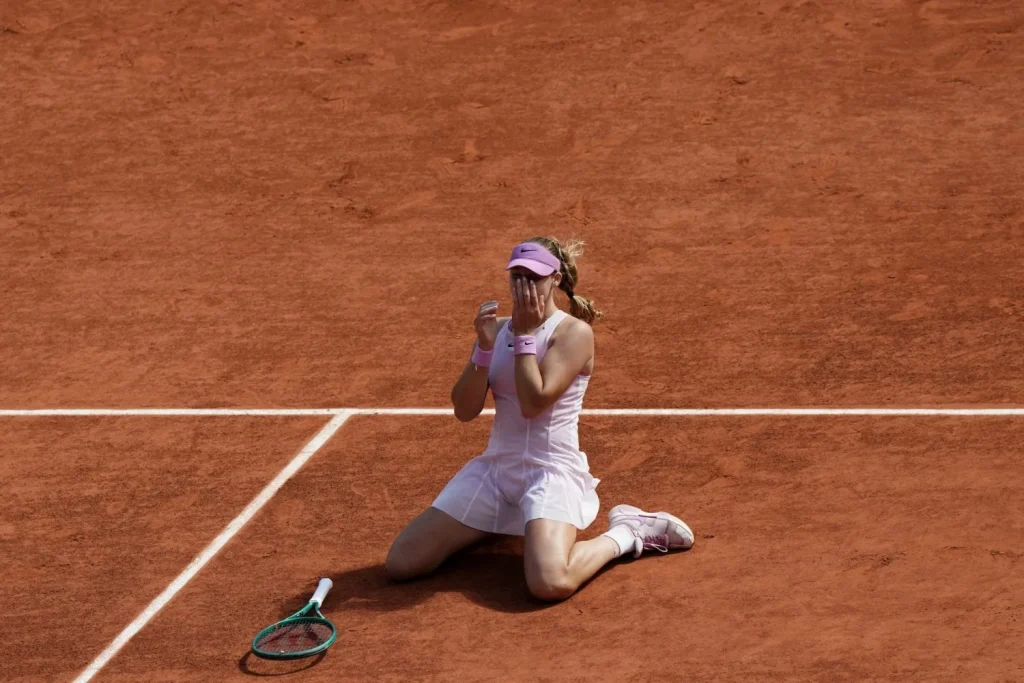
The first instinct was toward her box.
Mirra Andreeva did it as soon as the final point landed at Roland Garros. A short run, contained rather than explosive, then down to her knees on the clay of Court Philippe-Chatrier. It held there for a second, then broke into the people she knows best.
For years she had been told this would come. A Grand Slam, sooner or later. The line never really changed in public, even when the results did.
In 2024 she reached a semi-final on this same court and finished the season inside the top 20, ranked 16th in the world. After that, the following season did not travel in a straight line. The serve, in particular, slipped in and out. Matches turned too quickly. Confidence lost its shape.
“Before, if I lost a service game, my match was basically over,” she said a few days earlier in press conference. “Now, after a lot of work, I understand how to manage a match.”
The work, she added, came from her mother, from her sister Eva, from the people around her. That is where the run was always pointing.
She arrived in Paris seeded, with expectation. The two rarely sit together comfortably. Over the past months she had carried both without much distance between them.
The final, against Maja Chwalinska, began in a wind that moved across Philippe-Chatrier in uneven bursts. Tosses adjusted. Timing slightly off between points, then again.
Chwalinska started by stretching the court. High forehands into the Andreeva backhand, then openings to the other side. Repetition, almost. It had carried her through qualifying, then the draw, then into the final.
Five games in, nothing settled. Decisions coming early. Double faults cutting through the pattern. Trying to finish points before they existed.
At 3–2 Chwalinska, the match shifted without announcing itself. Andreeva stayed longer in the rally, especially on the backhand side. Less urgency. Waiting for the shorter ball that eventually came.
The serve came with her. The forehand too, heavier, more angled, less fixed. Small moments inside it — a lob in the seventh game, a stretched backhand at 30–15 in the eighth — nothing isolated.
From 3–2, 16 of the next 20 points. 6–3.
The second set opened where the first had ended. Chwalinska’s errors arriving early in the second game, a forehand wide at 40–all, then the break. From there, the court felt smaller.
Andreeva stayed on the baseline, taking time rather than pace. The pressure arrived in clusters. Chwalinska’s patterns thinning, then disappearing, almost in front of her.
Nine points in a row bridging sets and start of set two. At 0–5 Chwalinska held twice, briefly, more interruption than change. No shift in weight. Next game, Andreeva served it out.
Chwalinska leaves Paris having reached the final from qualifying, with sponsorships arriving after her quarter-final against Perry. Before the tournament, no clothing deal.
Andreeva leaves with number one in the Race, and a title spoken about before it existed.
On Court Philippe-Chatrier, the wind had already dropped when she stood again.