On the edge of Borgo Panigale, Ducati does not feel like a company built to sit still.
The factory sits just outside Bologna, spread across the landscape with a quiet certainty that comes from having long since outgrown its origins. Ducati has always been oriented towards what comes next. In the 1950s, Fabio Taglioni helped redefine the technical language of its motorcycles. In the decades that followed, design became identity, and Ducati machines moved into the space between engineering and desire. Today, that instinct is carried through technology—most visibly in its partnership with Lenovo, Ducati’s technology partner since 2018 and title sponsor of its MotoGP team.
From the outside, the site looks like an industrial campus folded into the hills. Inside, it moves like a system that is always in motion.
Parts flow through corridors. Autonomous vehicles cut across production lines. Screens track every stage of assembly. But the dominant rhythm is still human: around 1,700 people building the full Ducati range, from Panigale to Monster, from Scrambler to the legacy of the 916.
There is a continuity here that runs underneath everything else. Much of this area was destroyed during the Second World War. What exists now is not just rebuilt industry, but a form of it that has been recalibrated over time—faster, more precise, but still reliant on human judgement in key moments.
That balance is deliberate. The factory is heavily automated, though not defined by automation. Machines move components; people step in where decisions matter. The system is designed to support craft, not smooth it away.
Still, that balance is not always stable.
There are moments when the logic of the system moves faster than the people inside it can comfortably follow. A component arrives too early. A calibration changes overnight. An update in simulation feeds back into production before everyone on the line has fully adapted to it. Nothing breaks—but something briefly misaligns.
That tension never disappears completely.
It becomes clearest inside Ducati Corse.
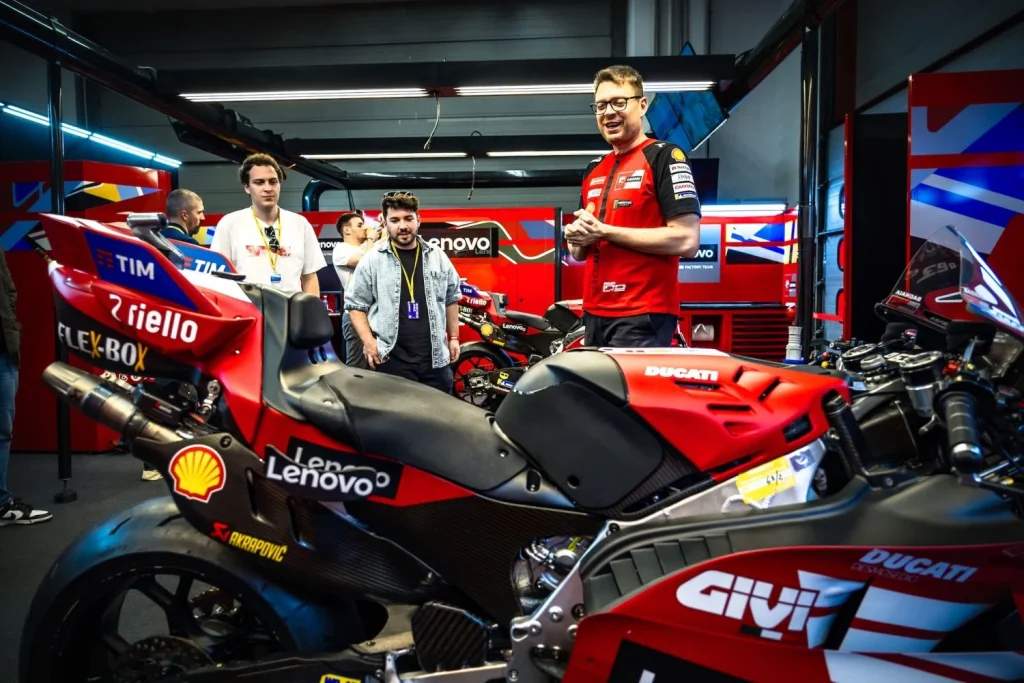
The division responsible for the MotoGP machines of Francesco Bagnaia and Marc Márquez operates in a different register altogether. The noise drops. Access tightens. The pace feels slightly removed from the rest of the building.
If the main factory is industrial, Ducati Corse is closer to a workshop scaled up rather than down—built around precision more than throughput. The logic of production lines disappears. A single technician takes responsibility for an engine and builds it from start to finish. Nothing is divided. Nothing is passed on.
At least, in theory.
Because in reality, even here, the separation is not absolute. Data moves between people, systems, and machines continuously. What looks like individual craftsmanship is increasingly shaped by collective computation.
That ambiguity is part of the job now.
This approach follows the team from Borgo Panigale to every circuit on the calendar.
At Mugello, Nicolò Mancinelli describes what that looks like once the racing begins.
As Vehicle Development Manager at Ducati Corse, he works at the point where mechanical engineering meets digital infrastructure, and where MotoGP has increasingly become a contest shaped as much by computation as by riding.
“Typically,” he says, “we have six bikes on track producing around 100 gigabytes of data.”
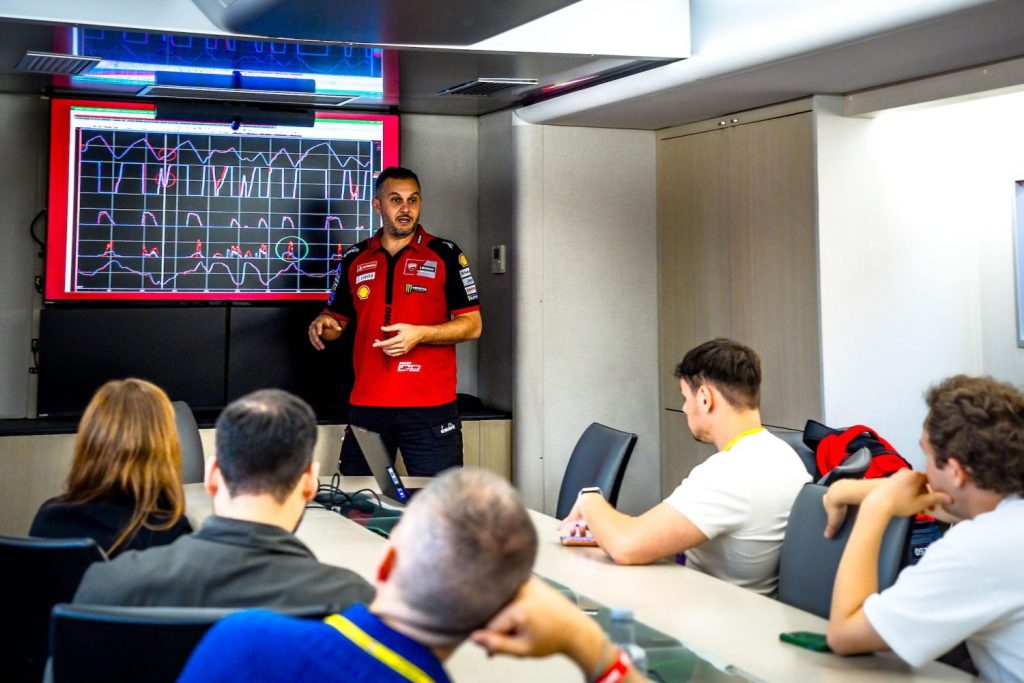
Each motorcycle carries roughly fifty sensors, generating a constant stream of information across a race weekend. A few metres from the garage sits Ducati’s mobile operations unit—a truck converted into a temporary data centre, filled with screens and servers, where engineers work through incoming telemetry during every session.
MotoGP imposes a constraint that changes the way all of this works.
“There is no live telemetry,” Mancinelli says. “The data isn’t transmitted from the bike to the garage in real time.”
Once the riders leave pit lane, the team loses visibility. No mid-race adjustments. No remote intervention. Everything has to be prepared in advance and locked in before the start.
In a sport decided by margins measured in thousandths of a second, that absence of feedback turns prediction into part of performance. Track temperature, grip evolution, tyre behaviour, wind—variables have to be anticipated rather than corrected.
This is where simulation has become central.
Lenovo’s computing infrastructure allows Ducati to run models that extend what engineers can test before the race even begins. One of the most important developments is virtual sensing.
“We run algorithms that simulate sensors,” Mancinelli explains, “to estimate values we can’t measure directly on the bike.”
It is less a replacement for measurement than a way of extending it—bridging gaps where physical data stops.
From there, analysis moves into imagery.
Using trackside cameras, Ducati builds what it calls ghosting systems—overlaying rider trajectories within the same visual frame.
“The algorithms can place two riders in the same scene,” Mancinelli says. “You can see exactly where each one is braking, turning, accelerating.”
What was once abstract data becomes something immediate and visual. Lines through corners, braking points, throttle application—compressed into a comparison that can be read in seconds rather than minutes.
But even this system has its limits.
There are still decisions in MotoGP that no model can fully account for. A rider who changes rhythm mid-race. A tyre that behaves differently under stress that was not fully replicated in simulation. A moment where experience overrides prediction. The system gets close—but not complete.
For Bagnaia and Márquez, the value is straightforward enough.
In that sense, MotoGP has become a laboratory for a form of racing where marginal gains are increasingly constructed before the bikes ever leave the garage.
And it is here that the partnership between Ducati and Lenovo takes its shape.
MotoGP remains one of the most demanding environments in global sport: a travelling system under constant mechanical and logistical pressure. Ducati uses it as a testing ground. Lenovo uses it as an extreme-use environment.
As Lara Rodini, Lenovo’s Global Sponsorships and Activation Director, puts it, the value lies in working under conditions that push infrastructure to its limits.
The relationship is not defined by visibility on race weekends, but by what those weekends generate behind the scenes: faster models, more robust systems, tighter loops between simulation and reality.
Back in Borgo Panigale, that logic feels continuous rather than declared.
Different contexts, different tools, same direction of travel.
To understand earlier.
To reduce uncertainty.
To stay ahead.