
One of the most often retold stories about Cristiano Ronaldo’s professionalism centres on what he did after matches. Following long away trips, he would return in the early hours and head straight to the training ground rather than home, spending time in ice baths designed to accelerate the recovery of what has frequently been described as his near-bionic physique.
That Ronaldo is now 41 and still operating as one of the most decisive athletes in world football says something about the value of those habits—and, more broadly, about how recovery has moved to the centre of the modern elite athlete’s routine.
But what do we actually mean by recovery?
It is the phase in which the body regenerates and adapts to physical stress: a period in which the right decisions can reduce injury risk, extend performance ceilings through what is known as supercompensation, and improve output in the next training session or match.
In short, for anyone operating at the highest level, recovery is no longer a supporting detail; it is part of the structure of performance itself.
And it goes far beyond the ice bath. Sleep, nutrition, mental wellbeing, and the management of cumulative load all determine how effectively the body absorbs effort and prepares for what comes next.
Like Cristiano Ronaldo, today’s top athletes are fully aware of how decisive these details have become.
In an interview with Undici, Alberto Bartali—former fitness coach at clubs including Zenit Saint Petersburg, Sampdoria and Catania—put it this way: “Today’s top players tend to build a rigorous, multi-layered professionalism that goes beyond natural talent or technical and physical development. They live healthily, study the limits and potential of the human body, and understand the differences between the various types of food they consume. In short, they try to acquire knowledge and identify the best ways to extend their careers.”
Alongside this growing awareness among athletes, an entire industry has been developing around the same question: how to extend—and improve—the careers of elite sports professionals.
One of the companies working in this space is Starpool, which has been innovating in wellness for more than fifty years and has developed two integrated formats dedicated to psycho-physical recovery and performance enhancement.
The idea is built around a multidisciplinary approach that brings together physiology, recovery science and mental performance, shaped around the extreme demands of elite sport in terms of both physical load and time efficiency.
As a result, both formats have been designed to be installed either inside training centres or within athletes’ private homes.
Recovery Lab and Recovery Room are structured around three key phases of an athlete’s schedule: pre-activity, post-activity, and recovery or load-management days.
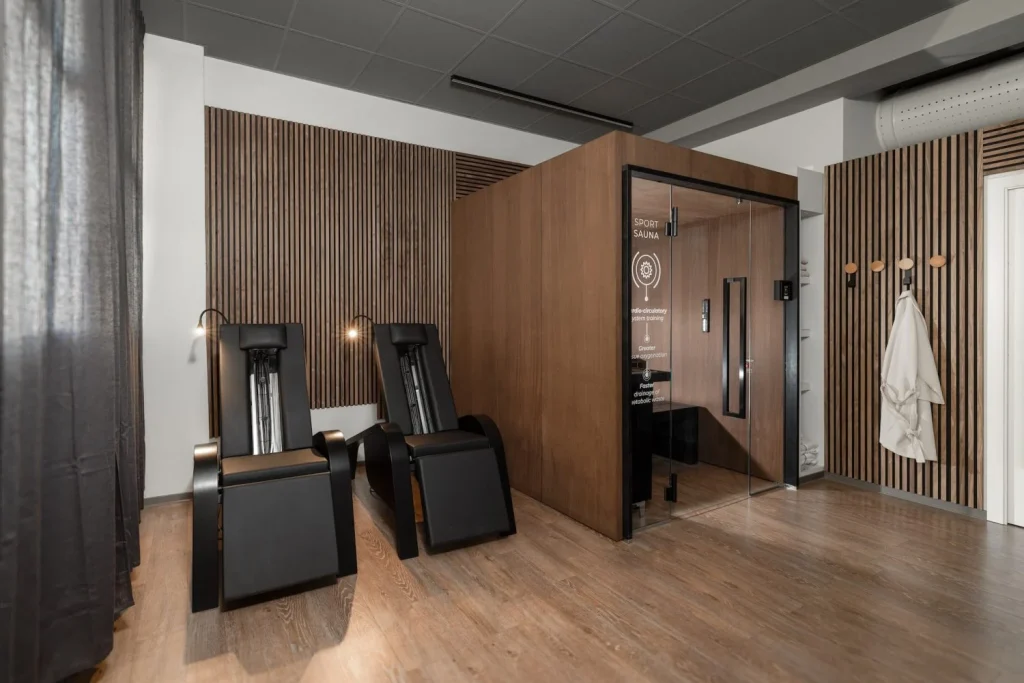
Recovery Lab, in particular, is a flexible environment designed to embed recovery directly into performance centres, combining advanced equipment with contemporary methodologies.
These include dry floating therapy, infrared treatment, cold exposure—ring a bell?—and the high heat of Finnish saunas.
Together, technologies such as Sport Sauna, Sport Infrared Cabin, Zerobody Cryo and Zerobody Dry Float form an integrated system designed to reduce muscle soreness and injury risk, improve sleep quality, support psycho-physical resilience, and assist in the management of acute injury when required.
Infrared therapy uses deep heat to promote relaxation and muscular activation, while the dry heat of the Finnish sauna can support passive cardiovascular conditioning on recovery days, helping restore physical readiness after exertion.
Dry floating and cryotherapy also play a central role in muscle recovery.
Zerobody Dry Float replicates the effects of microgravity by allowing the body to float on 400 litres of water at a neutral temperature, without direct contact with liquid. The reduction in body weight sensation induces deep physical and mental relaxation, supporting both muscular recovery and cognitive reset.
Alongside this, Zerobody Cryo delivers the effects of cryotherapy in a dry, controlled environment, using an enveloping membrane operating at temperatures between 4 and 6°C.
Starpool has applied the same philosophy to Recovery Room, an at-home environment designed for athletes who continue their recovery work outside the training ground.
In practice, this combination of technologies and tailored programmes allows athletes to support passive recovery, manage minor injuries when training is not possible, maintain mental focus before returning to training or competition, and recover after exertion.
It is no coincidence that many leading clubs have chosen Starpool as their wellness partner.
In Italy, these include Atalanta, Napoli, Como, Fiorentina, Aquila Basket Trento and Hockey Foxes Bolzano. Internationally, partners include the Cleveland Cavaliers, Minnesota Vikings, Los Angeles Rams, Carolina Panthers, New York Mets and San Francisco 49ers.
Elite individual athletes have followed the same path, including Olympic champions such as Marcell Jacobs, Dorothea Wierer and Federico Pellegrino.
The pattern is consistent: at the very top level, marginal gains are no longer marginal.
And in an era defined by relentless competition and heightened physical awareness, recovery has become one of the defining battlegrounds of elite sport.
At that level, every detail counts.