
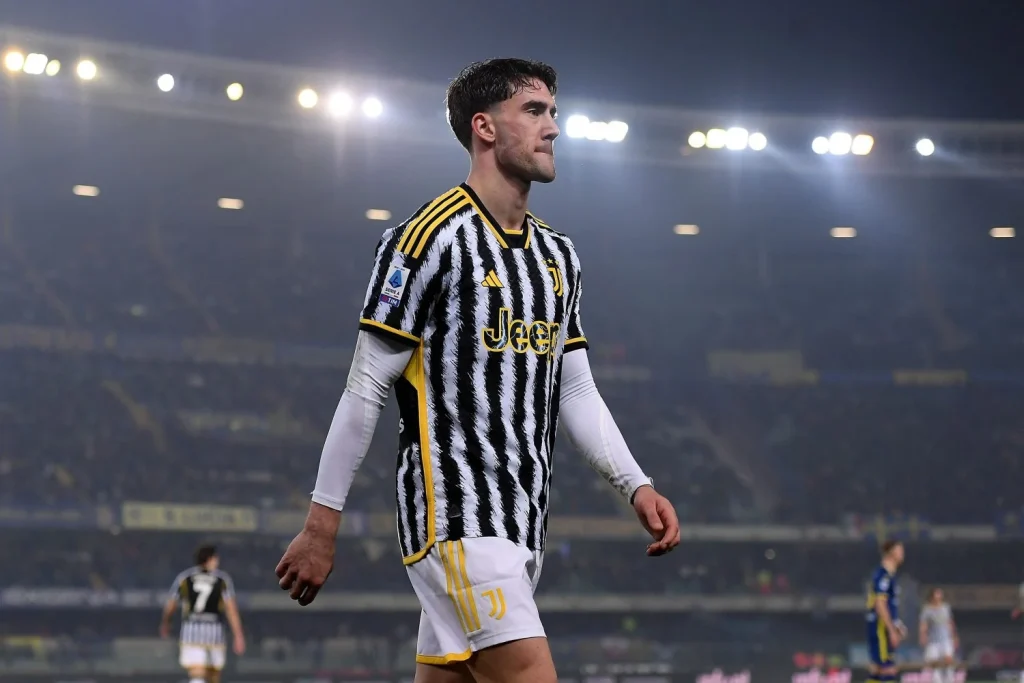
It couldn’t have ended any other way.
A quiet, almost inevitable farewell for a striker who arrived in January 2022 for €70 million plus €10 million in bonuses. Dusan Vlahovic and Juventus part ways as mutual disappointments — not a failure in strict terms, but never a functioning partnership either, never the chemistry either side expected would eventually arrive.
So much was placed on his shoulders from the start. He arrived in Turin as the striker meant to complete the project, the forward who would settle everything — almost the player Juventus believed they were buying, rather than the one he was at the time.
In turn, Juventus convinced themselves they were building a technical rebirth around him, a structure capable of taking him to the top tier of European football. The connection never quite took.
At 22, with only his Fiorentina experience behind him, however impressive, he was asked to step into Cristiano Ronaldo’s shadow — a role that, in hindsight, was never truly there to be filled.
The early signs in Turin were encouraging enough in terms of output. But injuries, interruptions and growing uncertainty gradually eroded the idea. Over time, player and club drifted towards the same conclusion: Vlahovic not fully suited to Juventus’ instability; Juventus not the environment he needed to develop.
What followed was a cycle of constant change — coaches, squads and expensive signings that never settled long enough to form anything coherent, especially in attack.
Individually, Vlahovic remained a difficult tactical fit: limited in link play, occasionally wasteful, and inconsistent over extended periods.
His Juventus record ends at 68 goals in 168 appearances — around 0.4 per game. Respectable on paper, but never enough to define matches or shape seasons.
During his spell as leading striker, Juventus never finished higher than third in Serie A. Their last Scudetto had already come a year and a half before his arrival.
By early 2025, his future had become a permanent feature of transfer speculation — less rumour than reflection of a relationship that had cooled beyond repair. It is almost ironic that some of his best form came when he was already considered expendable.
At one stage, he was effectively outside the project entirely, behind David and Openda in the hierarchy, closer to the exit than the pitch. A player waiting for the door to open.
Instead, helped in part by the underwhelming impact of new arrivals, he re-emerged late in the season as Juventus’ most reliable attacking outlet.
As Spalletti put it: “You cannot play football without someone like him — a physical reference point who can score goals.”
And, somewhat unexpectedly, Vlahovic finished as Juventus’ most efficient forward of the campaign: ten goals in 23 appearances, many from the bench, including a forceful double in the final derby.
That late resurgence briefly reopened the door to a last-minute renewal. The conversations were real, but ultimately collapsed: Vlahovic wanted at least €8 million; Juventus offered €6 million plus bonuses.
So he leaves on a free transfer, as expected, closing a relationship defined more by distance than connection, and by occasional alignment rather than continuity.
Chiellini defended him until the end: “Up to the last day, Dusan showed how much he cares about Juventus.”
At those figures, a continuation in Italy was always unlikely. What remains is a striker with clear strengths, moving on in search of the context that Turin never quite provided.