
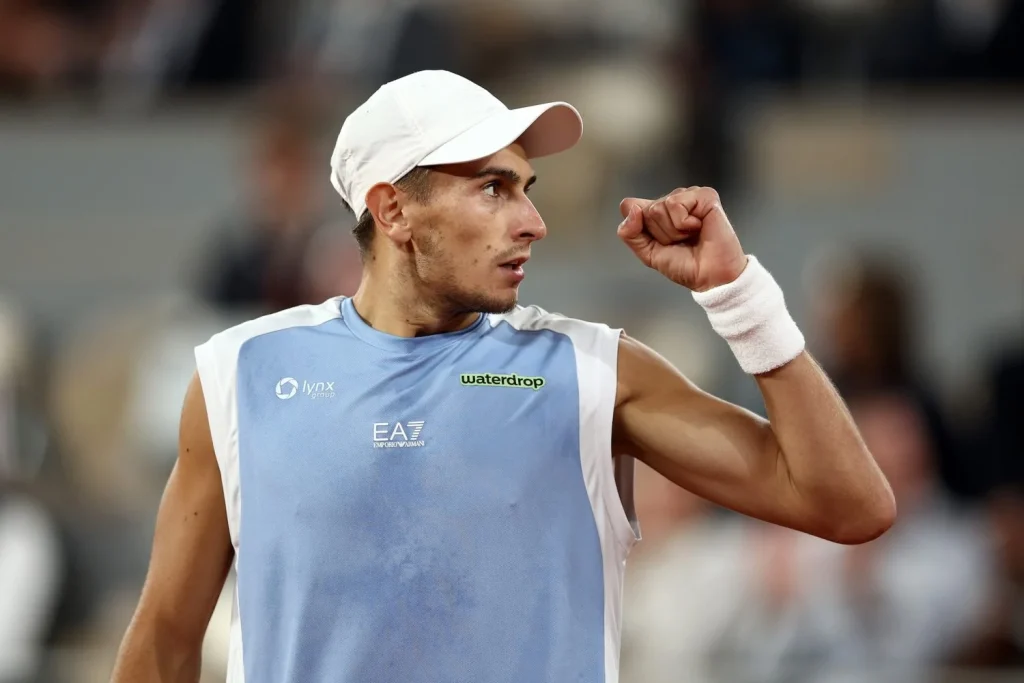
There is a distinctly Italian storyline unfolding at Roland Garros 2026, and it carries Matteo Arnaldi’s name.
The player from Liguria arrived in Paris with a ranking that, until a few weeks ago, still placed him outside the top 100. He leaves the impression, match after match, of someone no longer aligned with that position. Now he is into his first Grand Slam semi-final. Waiting there is Flavio Cobolli, an all-Italian meeting that guarantees one thing already: an Italian player will be in the Roland Garros final for the second year running, after Jannik Sinner last season.
The quarter-final came through a derby against Matteo Berrettini. It ended with Berrettini retiring due to physical issues. The scoreline at that point, though, already belonged to Arnaldi: 7-5, 5-2 up, and a set-and-a-half of increasingly stable control.
Berrettini had started faster, taking the ball early, pressing the forehand. Arnaldi stayed in the rallies. The first set tilted gradually, not abruptly, until it closed 7-5. In the second, the pattern widened. Arnaldi readjusted, took a step inside the baseline, and began to hold the centre of the court more consistently. The break came early, then another gap opened. By 5-2, the match had settled into a rhythm that was already his.
The retirement arrived before the formal conclusion, but not before Arnaldi had already spent long passages of the match dictating tempo from the baseline, absorbing pressure rather than reacting to it. There were moments early on where Berrettini looked in charge; that phase did not last long.
What follows Arnaldi through this Roland Garros, though, is not a single match but the accumulation of them.
He has been on court more than most. Long sets, five-set matches, repeated physical tests across two weeks. Nothing particularly linear about the route. Wins have come through extended exchanges, often against opponents ranked higher or more established. The kind of matches that do not leave much space for rhythm, only survival and then adaptation.
The most recent reference point before the semi-final was Frances Tiafoe in the round of 16. A match that stretched across momentum shifts and longer rallies, ending with Arnaldi still there at the end, holding his level in the final games rather than collapsing into them.
Across the tournament, there is a pattern that repeats itself without becoming mechanical. Early tension, some uneven service games, a search for timing. Then something shifts. Not suddenly, more like a gradual settling of decisions. Fewer rushed forehands. Longer exchanges accepted rather than avoided. The scoreboard starts to reflect it.
By the second week, the match identity changes. The same player, but with less hesitation between shots.
There are players who arrive in semi-finals through a single dominant week. Arnaldi’s path has been different. Each round has added time in the legs and something less visible in the responses between points. The match load is not incidental; it is part of the trajectory.
Cobolli waits on the other side of the draw, also in the middle of a run that has reshaped expectations around him. One of the two will reach a Roland Garros final that, a fortnight ago, would not have carried this exact pairing.
A few weeks earlier, Arnaldi was ranked 102 in the world, spending more time on Challenger circuits than on main stadium courts. The shift in results has been recent, and visible in its speed rather than its announcement.
The coaching change to Fabio Colangelo, previously linked with Lorenzo Sonego, sits somewhere in that timeline. Results began to arrive with more consistency shortly after. Not in a straight line, but in a sequence that now leads to Paris and a semi-final scheduled on Court Philippe-Chatrier, or one of its adjacent stages depending on the day.
In the present, though, there is only the court he just left. Another win, another stage crossed. A scoreboard that shows progress more clearly than any explanation around it.
Cobolli next. A semi-final between two Italians, and a place in the final that will belong to one of them.