
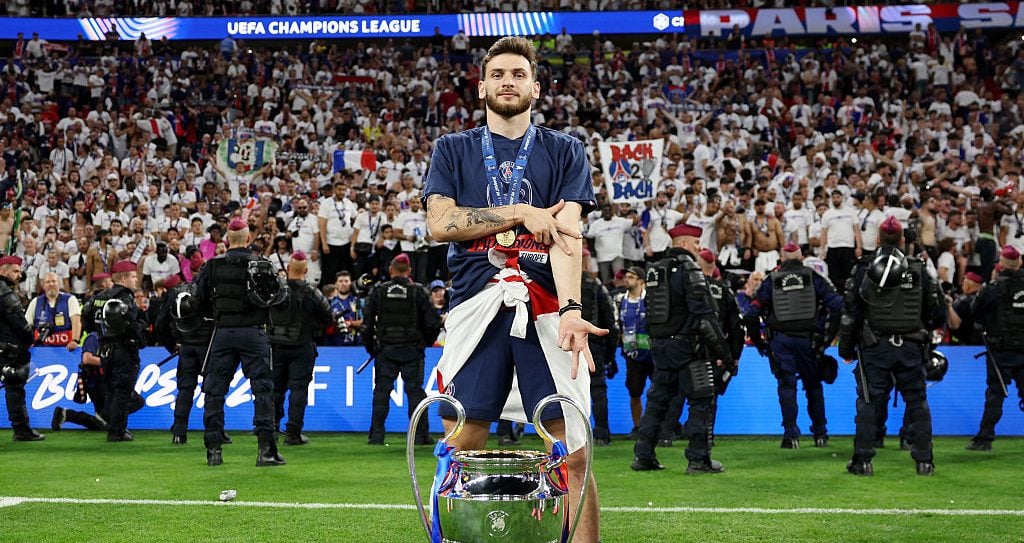
There are triumphs, and then there are triumphs.
Winning a major trophy is difficult enough. Defending it a year later is the sort of achievement reserved for only a select few in football history.
Paris Saint-Germain managed it through a quality that has come to define this team as much as its talent: an unshakeable belief in its own ability. If dismantling Inter in last year’s final had been made easier by the Italians’ physical and emotional collapse, overcoming Arsenal demanded something altogether different. Luis Enrique’s side were pushed into unfamiliar territory. They suffered. They spent an hour behind. They struggled to find the spaces that usually allow their attacking players to take control of a match.
And yet they never looked unsettled. Patiently, almost methodically, they worked their way back into the contest. More importantly, they never stopped believing they would.
The picture that has emerged in the days since comes from inside the club itself. “We knew exactly how important this final was, and we knew exactly how dangerous it could be,” a PSG source told L’Équipe.
Even after Kai Havertz had given Arsenal the lead, there was no sense of alarm in the dressing room at half-time. The message circulating among the players was remarkably simple: we’ll get there, we just have to keep doing what we’re doing. Once we get the equaliser, we’ll win it.
In many respects, the match unfolded exactly as Luis Enrique had anticipated. The concession of the opening goal aside, PSG had prepared thoroughly for Arsenal’s approach. Dembélé and his teammates adapted to a rhythm that did not naturally suit them, a contest shaped by patience rather than momentum. It bore little resemblance to the breathless chaos of the 5-4 semi-final against Bayern Munich, where the game seemed to reinvent itself every few minutes.
Throughout it all, Luis Enrique remained strikingly calm. He never raised his voice. He never altered the message. His instructions were constant: trust the process, stay patient, remain faithful to the team’s identity. Even as the prospect of extra time and penalties edged closer.
If PSG never drifted into panic across 120 minutes, much of that composure had been built long before kick-off.
According to L’Équipe, the weeks leading up to the final were characterised by clarity rather than overload. Luis Enrique and his staff kept instructions concise. The workload was carefully managed, demanding without becoming excessive. During one of the most intense stretches of the season, players were even given two separate two-day breaks—a calculated decision designed to relieve pressure without sacrificing focus.
Equally important was the team’s preparation for precisely the kind of match Arsenal eventually produced. Over the past three years, PSG’s coaching staff have devoted considerable time to scenarios in which opponents refuse to engage, retreat into a compact defensive block and force the game into a battle of patience.
In other words, they had spent years preparing for a night like this.
“We knew Arsenal were the best team in the world at what they do,” members of the club’s staff told the French newspaper. “We also knew there was no need to play the same kind of game we played against Bayern, with constant transitions and attacks at both ends. Against this type of defence, if we stayed calm, our quality would eventually create opportunities.”
That proved to be enough.
One opening. One sequence. One penalty, converted by Dembélé, to bring PSG level.
Even when fatigue threatened to take over, the holders never lost their shape. Nuno Mendes was running on empty. Vitinha and Dembélé both succumbed to cramp. It was, as one member of staff described it, “a reflection of our season”: long, demanding and repeatedly interrupted by injuries.
Still, as the match moved towards its decisive moments, confidence remained intact. Even when substitutes were required to step forward and take penalties, there was little trace of tension.
“We were very calm,” those inside the club later recalled. “We knew we had the best penalty takers.”
They were right.
The most revealing aspect of PSG’s triumph may not be their technical superiority, tactical flexibility or squad depth. It may be the certainty with which they now navigate adversity. This is a team that no longer seems surprised by difficulty, nor intimidated by it. And when a side reaches that point—when belief becomes instinct—it begins to play with a rare kind of freedom.
These days, PSG carry themselves as though they know the game will eventually bend in their favour. More often than not, it does.