
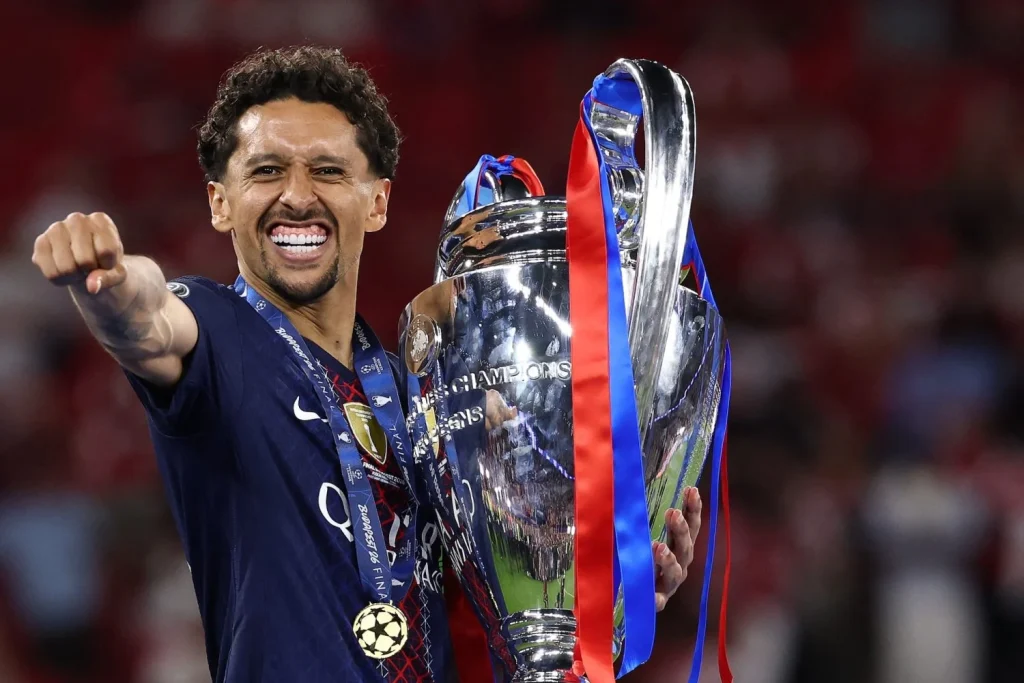
Whenever a Champions League final — or a World Cup final, a Europa League final, or any major football final, really — is decided on penalties, there is always a lingering sense of injustice. Even more so when, as was the case throughout PSG versus Arsenal, neither side truly managed to impose itself on the other.
Of course, the statistics that flashed across television screens around the world suggested otherwise. Dembélé, Kvaratskhelia and their teammates enjoyed more possession, created more chances and dictated the tempo for long stretches of the match.
But the numbers only tell part of the story.
First, Arsenal scored within the opening minutes.
Second, Arteta’s Arsenal are built to play this way: compact, disciplined and patient without the ball.
Third, for all of PSG’s possession and territorial dominance, their clearest chances only arrived after the equaliser — an equaliser that, incidentally, came from the penalty spot.
In other words, Arsenal’s compact and conservative game plan worked. It limited PSG, or at least blunted them.
This was no ordinary opponent. This was the most technically gifted and entertaining team in world football; the side that won last year’s final 5–0; the team that eliminated Chelsea, Liverpool and Bayern Munich in succession on its way through this Champions League campaign, producing one outstanding performance after another.
And yet Arsenal held them in check.
Until one moment.
A moment of inspiration between Kvaratskhelia and Dembélé suddenly dismantled Arsenal’s impeccable organisation — and with it, their concentration and defensive structure. Dembélé then converted the penalty with complete composure.
After PSG’s second goal, the final in Budapest opened up. Arsenal moved beyond the defensive blueprint that had carried them through much of the evening and began constructing attacks of their own. Their set pieces remained a constant threat, and for stretches they managed to put PSG under genuine pressure.
Even so, the clearest opportunities continued to fall to Luis Enrique’s side. Kvaratskhelia struck the post with a deflected effort. Vitinha sent a curling shot narrowly over the bar.
Gradually, almost inevitably, PSG’s superior quality began to assert itself.
Beyond the statistics and the tactical context, Luis Enrique’s lethal formula — a finely tuned system executed at extraordinary speed by extraordinary players — slowly overwhelmed Arsenal. The London side retreated further into survival mode, increasingly focused on stretching the game first into extra time and then into penalties.
There is nothing wrong with that. Arteta had few realistic alternatives.
And, in fairness, this is a type of match Arsenal know how to play. They thrive in it, in fact.
Football has a way of letting talent decide the biggest moments.
That is what happened in Budapest.
When the shootout arrived, the missed penalties from Eze and Gabriel Magalhães — one of the outstanding performers of the entire Champions League season — handed the trophy to the team that had pursued it in the most ambitious way possible: by playing a brand of football built not on isolated moments or opportunism, but on talent, collective structure, fluidity and relentless intensity.
A team coached by Luis Enrique and built around players such as Achraf Hakimi, Nuno Mendes, Vitinha, Fabián Ruiz, Kvaratskhelia, Dembélé, Doué, Barcola and Warren Zaïre-Emery.
Listing those names is enough to make the point.
PSG are an extraordinary side.
The strongest team in Europe over the last two seasons, without question.
Arsenal are an outstanding side too, led by an outstanding coach, and it is easy to imagine them closing the gap in the years ahead. But for now, that gap still exists. And it remained visible even in a final as evenly contested as this one.
So yes, penalties were cruel once again. Perhaps even unfair.
But they rewarded the team that deserved to win the Champions League.
For the second consecutive year.
At a certain point, that stops being coincidence.