
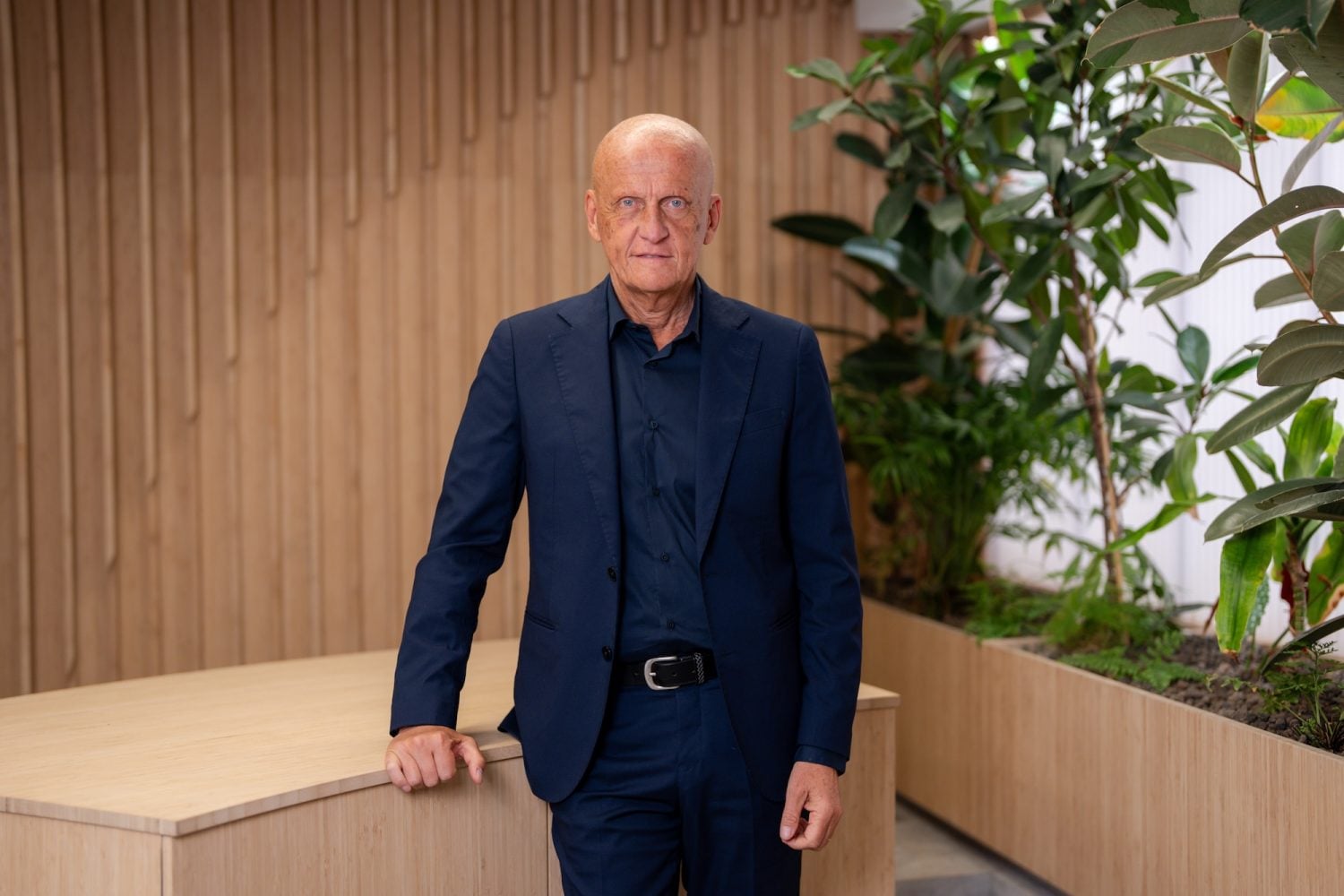
For two or three generations of human beings, not only of fans or mere enthusiasts, the football referee – understood as an absolute figure, on a global level – had the unmistakable features of Pierluigi Collina. With Collina, thanks to Collina, the match official underwent a true change of state, became a protagonist of the game. But be careful: Collina was not a referee eager to be seen, to be central to matches, or at least he did not do it deliberately. The fact is that his appeal – commercial too – was tied to an undeniable talent, to a perceptible charisma, to an evident ability to relate to the players. All qualities that led the IFFHS (the International Federation of Football History and Statistics) to elect him six consecutive times as the best referee in the world, and naturally this is an absolute record. All qualities that then, subsequently, determined the beginning of his managerial career: today Collina, after having been the referee designator of Italy’s Serie A and Serie B and then president of the UEFA Refereeing Committee, is president of FIFA’s Refereeing Committee.
Precisely by virtue of this role, and of his personal and professional history, we can consider him as the most authoritative man in the world on the subject of referees. Therefore it is practically obligatory to turn to him to understand how the role and the approach of match officials have changed in recent years, to understand the impact that technology has had on football. All the more so now that we are on the eve of a World Cup that will revolutionise the game: that of 2026, in fact, will be the first edition of the tournament in which artificial intelligence will be systematically integrated into the refereeing processes, from pre-match analyses to decisions on the field, by way of the review of the most complex incidents.
In particular, thanks to Lenovo’s technology based on artificial intelligence, all the players called up for the final phase of the tournament will be represented by their 3D avatars within the animated replays used by the match officials, and by the VAR staff, to make their decisions. First of all for those that will involve the use of semi-automatic offside. «It will be a most important innovation», says Collina, «and not only for its aesthetic impact. Previously the decisions of referees and assistants, when technology came into play, were taken on the basis of a standardised image, of avatars that were more or less all the same as one another. Now, thanks also to artificial intelligence, we have scanned all the players and we will have absolute precision. What we are building together with Lenovo, however, is not just a technological evolution: it is a different way of supporting the decision-making process, which makes everything more precise, more transparent and also more understandable for those watching». For Collina, then, there is also another aspect linked to entertainment: «Seeing the exact digital reproduction of a player gives a different perception to those who watch the matches on television. After all this is the direction that football and this World Cup have taken: we want to make what we broadcast even more spectacular, more and more so».
And are there other new things in store for this World Cup?
A year ago, for the Club World Cup, we used for the first time the referee View, a camera positioned on the referee’s ear. This device allows those who watch the match to enjoy images shot from absolutely unique angles. Ahead of the 2026 World Cup, again thanks to Lenovo, this technology has been perfected and now the images today are much more stabilised. It will be truly spectacular.
So we can say it: technology and artificial intelligence are becoming ever more central, for referees too.
I am convinced that technology must be a tool to be used to improve the things around us. Including refereeing. After that, it is always and in any case a tool, so there is a need for someone who knows how to use it well. And it is on this that we must always work, so as to be able to improve the integration between man and machine.
With what approach have you referees lived through, and are you still living through, this technological revolution?
I refereed, throughout my whole career, with the idea of having to defend my decision in the face of everything and everyone. Now instead technology offers match officials the possibility of reviewing or reassessing your choice. It is clear that if you as a referee approach the use of technology with the mentality of the past, you find yourself looking for a small detail that allows you to say “No, no, I was right”. Instead the approach must be completely different, it must be open minded: faced with the images, today, a referee can reassess what happened, can try to compare what you perceived on the field with what the images show. Afterwards he can make a decision and perhaps you can even confirm the initial choice, but he must be ready to call it into question. For me, transmitting this change of mentality was not and is not at all easy.
And so now Collina, when he trains referees, has this task to fulfil as well. Amid so many other responsibilities…
I find myself reasoning a bit like a coach: I can prepare the referees as much as I want, but in the end I don’t go onto the field. Accepting this condition is hard, especially for someone like me, but I like the role I hold very much. Because it allows me to continue doing what I liked doing, that is refereeing – albeit in a different way, unfortunately I can no longer go onto the field. And then it allows me to experience from the inside the emotion of the great tournaments, the men’s and women’s World Cup, the Club World Cup. Finally, since I am actually also Chief Referee Officer, I also have less political and more executive tasks, more everyday ones, in the management and training of match officials. Together with my great staff, we try to make a contribution to the preparation of referees from all over the world. And it is a truly gratifying thing.
Technology, the constant relationships with referees who come from all over the world, a central role in the great FIFA tournaments: Collina’s is a privileged vantage point for understanding how the way of officiating matches has changed.
In this sense, I must say that the world has completely changed compared to when I refereed. If I think of the three-year cycles that we do in preparation for the World Cup, today we try to offer complete support to the match officials of all the Federations, the most structured ones and those that have fewer resources. Let’s say that we try to bridge the gap, as far as we can. And then we have instructors and medical staff who constantly follow the referees of all the confederations; in the USA, in Canada and in Mexico we will have nutritionists who will help us find the right dietary balance in a complex climatic context. We have our own match analysis team that provides tactical information on the teams, so as to give the referees elements to be able to anticipate what can happen during the course of a match. I am talking about real coaches, equipped with licences that would allow them to coach professional teams, coaches who in turn will also have access to another great innovation by Lenovo: the analytical platform FIFA Football AI PRO, where there will be databases, maps and animated clips that reproduce exactly the development of the matches.
This is the technical part, so to speak. And if we talk about the approach to refereeing? How does the match official who has to manage an important match prepare, today?
Here too I must say that we are completely on another planet. Once, for a referee, it was enough to know the rules and to be a little bit trained: his performance was defined essentially by these two factors. Today it is no longer like this, today a match official must understand football, must know how to read how the match develops. His assessments are based on rigid codes, naturally, but also on knowledge. There are situations that involve the interpretation of the incident and these cannot be done solely on the basis of the written rules, and we try to work as much as possible in this direction. In this sense the contribution of our match analysts becomes fundamental, because it allows match officials to already imagine what will happen. After all, someone on the outside never thinks about it, but referees live a paradox: it is not possible to officiate a match every day, so we are talking about people who, in fact, can only train from a physical point of view. It is for this reason that, with my staff, we have invented a sort of simulated football in which players recreate complex situations in which the referee has to make a decision in a few seconds. We will do this at the World Cup too, at our base camp in Miami, with local teams.
There, let’s talk precisely about complex situations. According to Collina, beyond technology and the approach of referees, is there some rule of football that should be further clarified? What are you working on, ahead of the World Cup and in an absolute sense?
The objective we have set ourselves is that of making the game more and more spectacular. And one of the critical points on which we have intervened concerns the dead time. We estimated that goalkeepers, very often, held the ball in their hands for 20-25 seconds: an eternity. The referees did not apply a rule that already existed because the consequences were too disproportionate compared to what the foul committed had been: awarding and having a free kick taken in the area was and remains complicated, and so the match officials preferred to ignore it. So we thought and said: “six seconds aren’t enough to put the ball back into play? Very well: we’ll give you eight!”. Once those eight seconds have expired, however, there are no more excuses and a corner kick is awarded. Well, the deterrent effect has been very effective. And the same thing, a few years ago, happened with penalty kicks, again with the goalkeepers: before they would save them while standing a metre and a half off their line, now they are careful about where they put their feet, they keep them both on the line. The idea is to follow this logic with throw-ins and goal kicks too: we want to limit the time it takes to take them, and this will certainly give a greater boost to the entertainment of the matches. After all I think that no one wants to pay for a ticket or a TV subscription and then watch a match in which the ball rolls for 45 minutes out of 90. It’s a little bit too little.
How did Collina-the-referee approach complex situations? What was his best quality?
I am convinced that talent is indispensable for reaching any objective, but on its own it is not enough. Work is the means that allows talent to become excellence. This is how I tried to behave throughout my whole career, and still today this is the message I try to give to the referees with whom I work. Then, if I really must recognise a quality in myself, I think I must say that I have a cool head. I remember that already at university, before exams, I was not particularly agitated, just as I was not agitated before the great matches that I then refereed. I always slept peacefully on the previous night, then before kick-off I tried to keep my attention high, more than my tension. It always worked.
Is it for this reason that Collina became a star referee? Did he realise that he had reached this status, in the course of his career?
Well, I would be falsely modest if I said no, after all I officiated great matches, I had the honour of taking part in advertising campaigns of very important companies. What I feel I can say is that it was not a matter of chance, but the fruit of continuous work, done with the same commitment and the same rigour for every match, whether it was a Champions League semi-final or an early Serie B fixture: it happened to me to do one after the other within an interval of three days, and I tried to always keep the same approach.
Which are the matches that Collina remembers with the most fondness, among those he refereed?
Certainly the two finals: that of the 2002 World Cup between Brazil and Germany and that of the Champions League in 1999 between Manchester United and Bayern Munich. The first makes a referee enter history, the second went down in history for what happened in the final minutes: still today it is remembered as THE final in the history of the Champions League. Then there are many others that I remember with pleasure: I who love football was very moved during a Manchester United-Real Madrid, when the whole of Old Trafford gave a standing ovation to Ronaldo the Phenomenon. To see and experience from the inside a thing like that makes you say “Wow!”.
Collina was talked about as a referee who was strict towards the players, but those who followed him over the course of his career also remember moments of great empathy, even amusing things. How is the relationship with those who go onto the field built?
I believe that every match must be lived moment by moment, because every moment is different. The referee must not play a part, there are moments in which you can even smile. I remember once, during a Chelsea match, I received a pat on the backside from the then captain of the Blues. It is a gesture that a player can hardly make, but perhaps on that occasion it was justified, in the sense that something had happened on the field that had changed the moment.
Does an heir to Collina exist?
I was not the heir of anyone, so I do not wish for there to be an heir of mine. But it is nice to think that Collina, in the course of his career, was able to inspire someone. I remember that, after the World Cup final, I went to a section and a young man told me that he had decided to start the referee course after seeing me. It was a very beautiful satisfaction, for me. When Collina went onto the field, the referee had to be immovable.
Was there a match in which, then, he regretted having been so?
Forgetting the error committed is a sine qua non condition for a referee to be able to make good decisions. If you keep thinking about the errors you have committed, even if you have realised that you actually got it wrong, the match becomes truly a hell. I remember an old Inter-Juventus in which I validated a somewhat contested goal, then I heard my assistant speak and I understood that he had seen something that cast doubt on my decision. The ball was already at midfield, two minutes had passed and I decided to retrace my steps and to disallow the goal. In the end, reviewing the images, I understood that I had made the right choice. The path, however, was a bit complicated. With today’s technology, everything would have been much quicker, everything much simpler.