
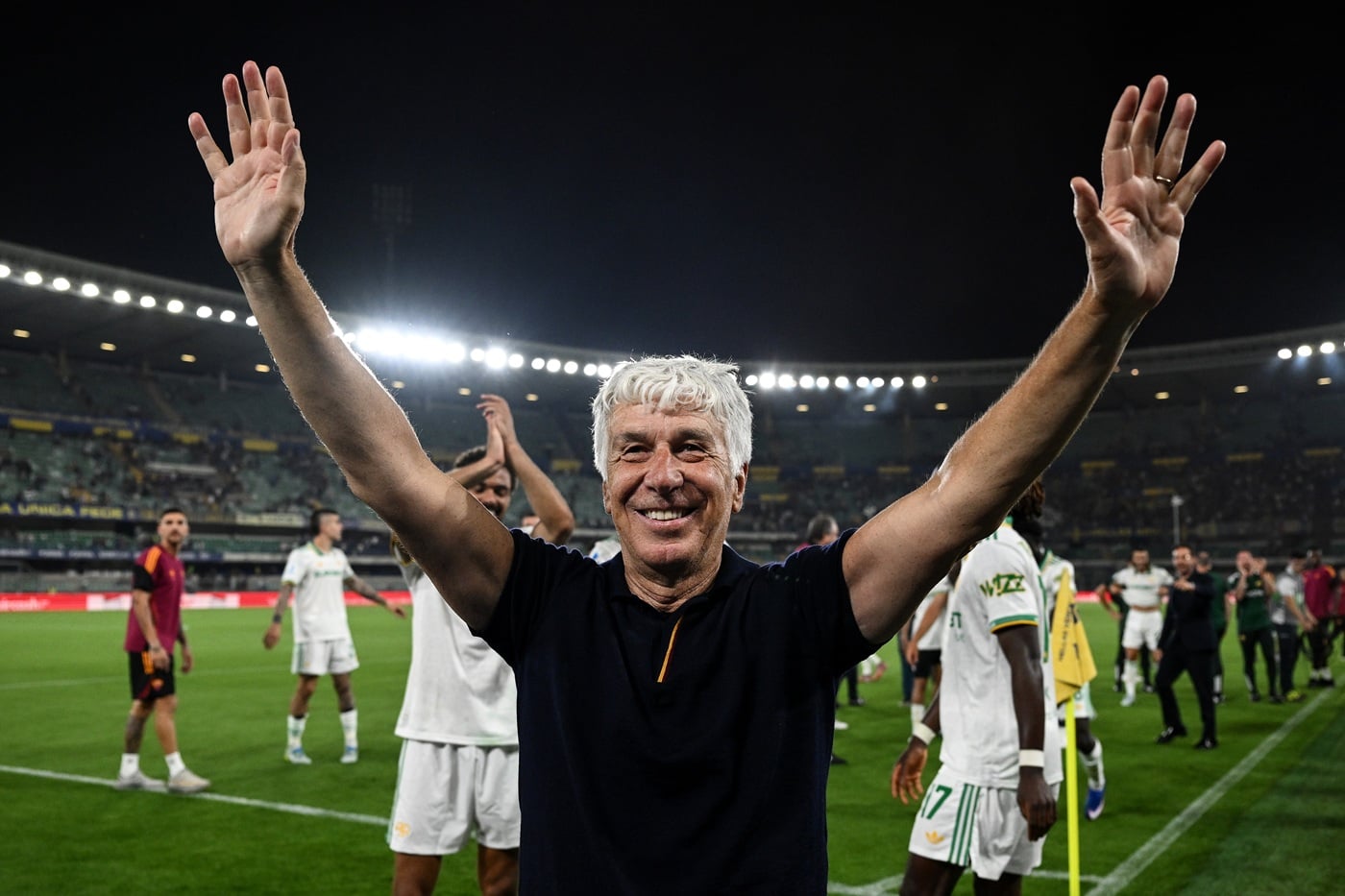
Seven years after the last time, Roma has returned to the Champions League. It did so at the end of a long, intense season, full of obstacles, but above all led by a man who has changed the face of the team and of the environment: Gian Piero Gasperini. The Piedmontese coach took on a Roma coming off complicated seasons, off continuous changes of technical guidance and off a sensation of incompleteness that was by now chronic, managing instead to transform it into a credible and competitive reality from the very first matchday.
The great strength of this Roma was precisely continuity. Not only in the results, but in the ideas. The club, at least initially, decided to rely totally on Gasperini, handing him in effect the keys of the technical project. A strong choice, almost inevitable for a coach who has always demanded control, autonomy and total sharing of his own footballing vision. From the summer it was immediately seen that Roma was changing its skin: a different intensity, a higher centre of gravity, the constant pursuit of the one-on-one, ferocious pressing and above all a team that seemed to know what to do on the pitch.
Naturally it was not all simple. A season like this cannot be linear, especially in a complex place like Rome. In the course of the year there were moments of tension with the club and in particular with the senior advisor Claudio Ranieri, a central figure within the club and a man who has always been much listened to by the giallorosso environment. Differences of views, heated confrontations, some technical choices that did not immediately find full sharing: normal episodes within a year lived always under high pressure. In the end the coach managed to “win” the confrontation at a distance with Ranieri, and in that moment Roma “handed itself over” definitively to its coach.
In the end, as always happens, the fact and the figure that really count are those that concern the pitch: Roma was in the running for the Champions League right from the beginning of the championship. And it closed in third place in the table: a result that was anything but taken for granted. In the summer many saw the giallorossi behind at least four or five teams in the starting grid. There were doubts about the technical and mental resilience, about the squad’s capacity to withstand Gasperini’s football and even about the compatibility of some players with his system.
The answer came right from the first months: Roma showed personality and continuity, the 3-1 victory at Cremona, in November, represented perhaps the first great manifesto of the giallorosso season. Not so much for the result in itself, as for what it meant: after that match Roma found itself in first place in the table no less. A very strong signal launched to the championship and above all a confirmation of the quality of the coach’s work. That team did not live off episodes, but off clear principles. Gasperini built a Roma that was ferocious in transitions, capable of winning the ball back high and of occupying the field with courage. Even the players most criticised in the previous seasons suddenly seemed regenerated.
The decisive turning point of the season, however, came in the January transfer window. The signing of Malen turned out to be decisive in the Champions League race and represents Gasperini’s personal victory. The coach had asked for him forcefully, he considered him the ideal profile for his offensive system: fast, vertical, aggressive in the spaces and perfect for attacking the depth. Many had doubts about the investment, but Gasperini insisted until the last because he was convinced that the Dutchman could change the offensive level of the team. From January onwards Malen scored 14 goals, becoming Roma’s offensive driving force and even conquering second place in the championship’s scorers’ table. The former Aston Villa man gave Roma something that had been missing for years: unpredictability. The capacity to create numerical superiority, to break matches open with an individual play, but also to interpret perfectly the movements required by Gasperini’s system.
In the final matchday too, at Verona, Malen was decisive. The match that officially sanctioned Roma’s return to the Champions League inevitably bore his signature. Once again present in the most important moment, once again the cover man of a team that found in him the ideal offensive terminal. And yet it would be reductive to explain Roma’s season only through Malen’s goals, because Gasperini’s true masterpiece was collective. From the March break onwards Roma changed gear in a definitive manner. Excluding the very harsh defeat in Milan against Inter, the giallorossi got practically nothing wrong. Six victories and a single draw, the one against Atalanta, in a phase of the season in which the pressure risked crushing a team that was not used to playing for objectives so important. Instead Roma reacted precisely in the most difficult moments. After the loss against Inter one could have thought of a heavy psychological backlash. Gasperini, on the contrary, managed to immediately pull the group back together. He protected the players, he lowered the external tension and he put the team back on track within a few days. The same “magic” had also succeeded after the night of the first of March, the 3-3 at home against Juventus with a goal by Gatti in the minutes of stoppage time.
It is in those moments that all the greatness of Gasperini’s work emerged. The former Atalanta coach did not only give a tactical identity to Roma: he built a new mentality. He convinced the team that it could really compete for the Champions League and, above all, he brought the environment together around himself. For years Roma had lived off intermittent enthusiasm, off emotional flare-ups that were never really consolidated – except in the days of Mourinho’s Conference. This time something similar to that two-year period was created: an authentic bond between team, coach and fans. The images of the night-time welcome at Fiumicino after qualification recount perfectly the atmosphere that was created around Gasperini and his team. Thousands of fans waited for the return of the giallorossi in the heart of the night, transforming the airport into a venue for parties. It was not only the enthusiasm for a sporting milestone: it was the recognition for a group that gave back pride and belonging.
Gasperini managed to bring the whole environment onto his side; even those who initially looked with scepticism at his arrival ended up recognising the quality of the work carried out. Because this Roma never gave the sensation of being accidental. It involved everyone, making every player feel important within the project. Some elements who seemed on the margins found space, trust and performance again. The perfect symbol of this work is to be sought in the goal by Stephan El Shaarawy at Verona: a weighty goal, with an enormous emotional impact, that came on an evening that handed the Champions League to Roma, even more significant because it was scored by a player who next year will no longer be part of the giallorosso squad. In this goal there is all of Roma’s season, the sense of belonging rebuilt by Gasperini, the capacity to keep everyone involved until the last minute, the idea of a true group even before a simple team. Seven years later, Roma is back among the top four. It did so through the work, the ideas and the courage of a coach who for the umpteenth time has shown that he knows how to transform teams. Gasperini took a fragile Roma and made it ambitious. In some ways the most important result is not even the European qualification, but the having given back to the giallorosso team a clear direction, a strong identity and above all the sensation that this is the beginning of a cycle.