
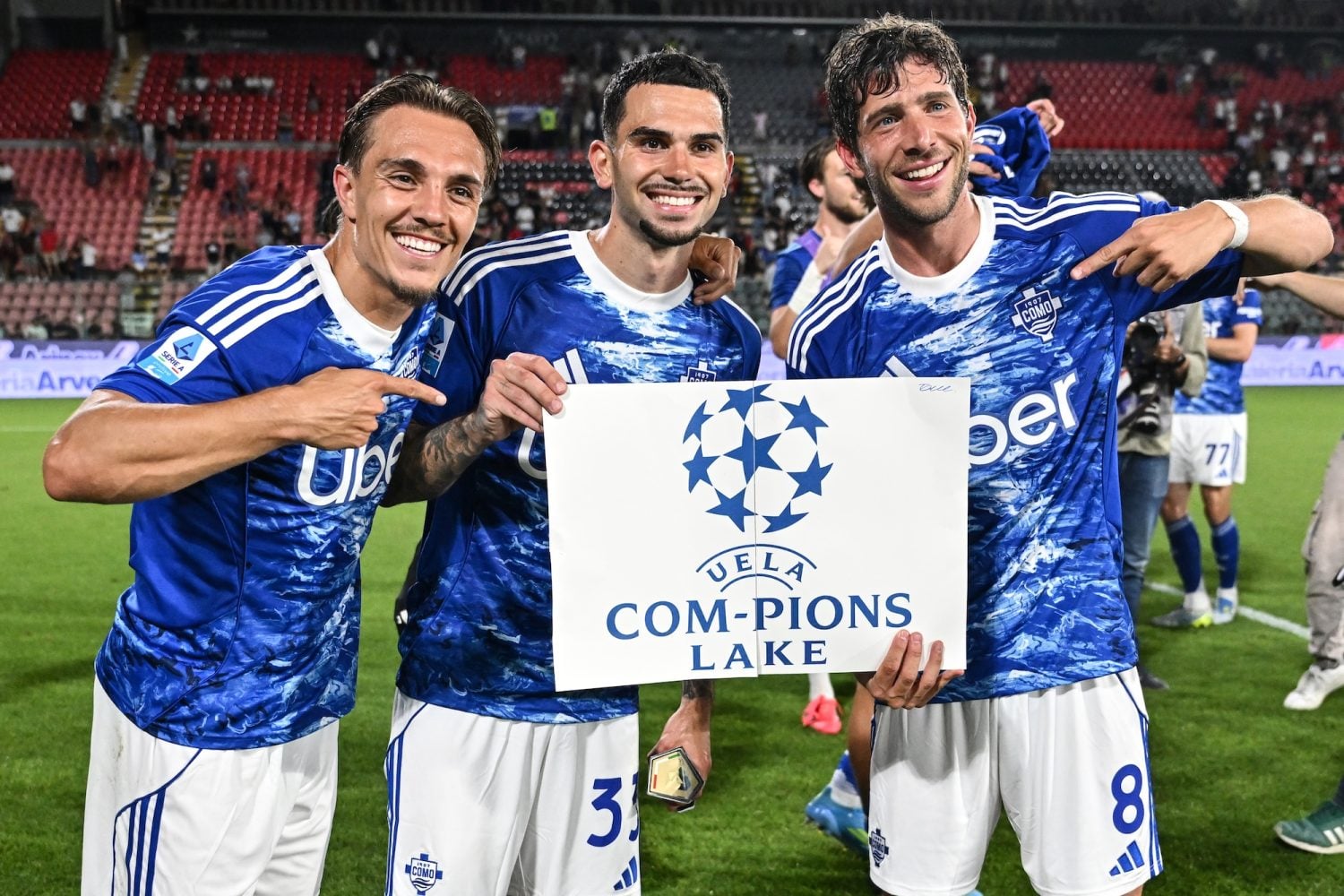
In an interview given to Undici a few weeks ago, Como’s president Mirwan Suwarso had said that «the team’s results leave me completely indifferent». Whether you like it or not, it is a true statement: this way of experiencing football serves to explain the most important part of the Como project, that is to say the one that concerns the exploitation of the city as a brand, of the lake as a tourist and commercial attraction, of football as a driver for another type of core business – Suwarso himself defined it as the «Disney model». The point, however, is that these visionary ideas have an absolute, total correspondence with the strategies and the choices of the sporting directors, of the coaches, of the sporting director Ludi, of the Head of Development Roberts, of the coach Fàbregas.
A little rewind to last summer, the second after the promotion to Serie A (2024) and the tenth place (2025) achieved in the first season in the top division: Como holds on to Cesc Fàbregas, openly courted by Inter, and does a transfer market in full Football Manager style. No, in this definition there is no rhetoric, it is not a cliché: the Lombard club takes Jesús Rodríguez, Martin Baturina, Jacobo Ramón, Jayden Addai, Álex Valle; in the two previous sessions it had already taken Maxence Caqueret, Ignace van der Brempt, Assane Diao, Nico Paz, Alieu Fadera, Maxi Perrone, Yannik Engelhartd, Anastasios Douvikas. At the moment of their arrival, all these players were no older than 24 – indeed, Addai, Diao, Rodríguez and Paz had arrived at Como even before turning 20. The only exceptions had been the one relating to Nicolas Kuhn, who arrived from Celtic at 26 years yet to turn, and the one relating to the 32-year-old Diego Carlos.
For many, naturally, Como was able to afford certain coups (Jesús Rodríguez was paid 22 million, Baturina arrived for 18 million, Kuhn himself cost 19 million) because it is a rich club, the richest in Serie A. True, all true. At the same time, however, it must also be underlined how Fàbregas managed the number 11 squad in Serie A, if we look at the wage bill (a little over 45 million per year). In short: it was the ideas, much more than the money, that made the difference. And the ideas in question were, in order: that of taking young if not very young talents; that of putting these talents at the disposal of a coach with a clear, defined approach, founded on pressing, on sophistication; that of not letting itself be blackmailed nor even seduced by the transfer market, in the sense that Fàbregas and all the jewels who arrived in the latest seasons (starting obviously from Nico Paz) stayed at Como, believed in Como. And in the end they conquered a qualification for the Champions League that turns out to be incredible, absurd, only if one looks at the name – and therefore at the history – of the team that obtained it. For the rest, there is nothing to be surprised about.
The fact is that we are in Italy, and so there is a certain reticence – let us even say “cultural resistance” – towards the idea that young players can achieve results. There, Como has completely dismantled this conviction, to the point of hitting the big target at the first real attempt – and in the meantime it also came close to qualification for the Coppa Italia final. It is here that the concept of a project comes in useful, indeed very useful: the club and Fàbregas began to work as had never been worked in Serie A, at least at certain levels of the table, and they demonstrated that there exists, that there can exist, another way of winning. And it is not a question of aesthetics or tactical ideology, because in reality it is enough to take the table to realise how the spectacular Como has the best defence, not the best attack, in the championship (29 goals conceded).
The crux of the matter, in short, lies in the way in which Como approaches the market and the matches: it would have – it has – the funds to buy anyone and instead it relies on only potential superstars; it takes the field to dominate the matches and in the end it is the team that concedes the fewest goals of all. And so it can be said that all the rhetoric around the wealth of the Indonesian ownership, around Fàbregas’s audacity and fundamentalism, ends up crumbling, disappearing in the face of the value around which the entire Como system holds up: competence, long-term vision. To put it in a few words: you also have to know how to spend money, it is not enough to spend it; you also have to make the players perform, it is not enough to send them onto the pitch. From this point of view, Como represents a brand-new model, one that had never been seen in Italy. A model that works, that can be worth even fourth place. The Disney model, president Suwarso calls it. For a few hours now it can also be called the Champions League model, even if it seems incredible – but in reality, as we have seen, there is nothing at all to be surprised about.