
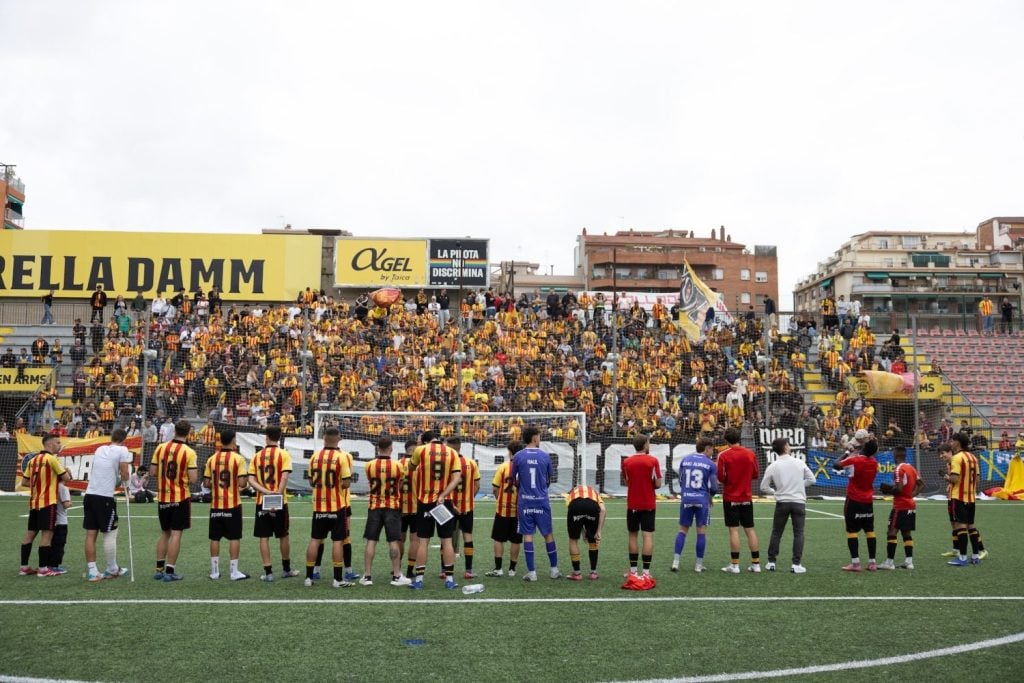
On a warm evening in early May, a small corner of Barcelona erupted into a huge celebration. Thousands of fans filled the streets, waving flags and lighting flares. Entire families marched side by side, teenagers climbed traffic lights to get a better view, and stadium chants went on throughout the night. All of this happened because the local football team had just won the league. But it was not Barcelona, who in the meantime had won and celebrated their latest national title. At the heart of this chaos was Unió Esportiva Sant Andreu. In other words, the club of a working-class neighborhood in the northern part of Barcelona, a team that, until recently, was virtually unknown outside its own community.
Today, however, Sant Andreu has become one of the most fascinating stories in Spanish football. Also because it is a neighborhood club experiencing an explosion in popularity, one that represents everything modern football struggles even to evoke. In an era of billionaire owners, €150 tickets and stadiums filled with tourists, Sant Andreu seems almost radical in its simplicity. It represents football stripped down and brought back to its roots: a strong identity, cross-generational support and a rare intimacy between players and fans. Its rise on the pitch is also a story worth telling: after winning the league this season, the club secured its second promotion in four years and will compete in the Spanish third division.
But things have not always been so rosy. Founded in 1909, the club emerged from Sant Andreu de Palomar, once a town in its own right before being absorbed by Barcelona’s urban expansion. Today, the neighborhood retains a clear, well-defined identity, more like that of a town than an offshoot of a metropolis. That territorial bond has become the club’s driving force: for decades, in fact, Sant Andreu fluctuated between modest successes and very steep declines, alternating periods in Spain’s second tier with dizzying falls that brought it close to amateur football, trapped in the grip of financial difficulties. Between the late twentieth century and the early 2000s, attendances had fallen to just a few hundred people. Like many historic lower-league clubs across Europe, Sant Andreu seemed condemned to irrelevance.
Then came the 2022/23 season. A heated derby against city rivals CE Europa captured unexpected media attention, not least because both clubs were fighting for promotion. In the end, Sant Andreu went up after a chaotic playoff against Salamanca, in the longest match ever played in Spanish football. The effect was immediate: the number of registered members, which at the start of that season stood at one thousand, almost tripled within a year and today is close to 5,500 — the highest figure recorded by the club in more than half a century. Families and children returned to the stadium, while young people discovered the team through word of mouth and social media, leading to the formation of new fan groups. The Narcís Sala started selling out again.
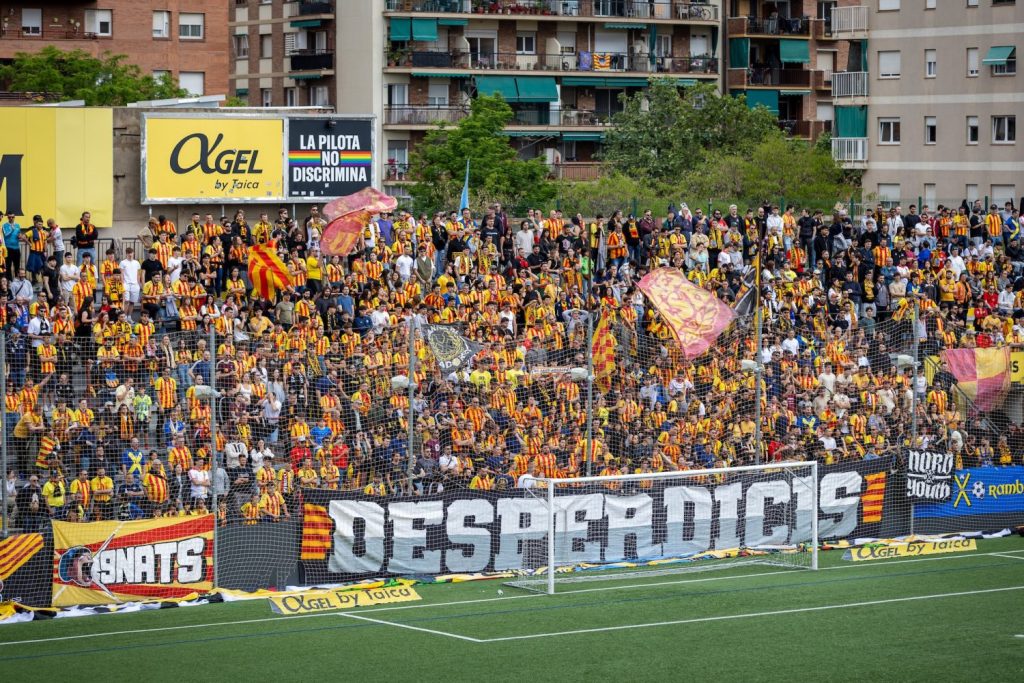
For many fans, this new attraction to Sant Andreu is not about what happens on the pitch. In the sense that it goes far beyond results: Ian, one of the fans who fell in love with the club only a few years ago, says he lost interest in elite football years ago: «It no longer gives me anything», he explains while waiting to enter the Gol Nord, the section where the club’s ultras gather, for the final match of this season. «I feel no emotion watching football on television». His friend Oriol believes it is the atmosphere that makes Sant Andreu so special: «I like the emotional energy collectively created by the stand». The club’s growth has gone well beyond the boundaries of the neighborhood itself, and many new fans live in other areas of Barcelona. Some of them, like Oriol, are disillusioned Barça supporters, worn down by the commercialization of top-level football: «The other day I went to the Camp Nou because I had been invited», he says. «I kept thinking: what am I doing here? The atmosphere was icy».
Even some international fans are drawn to Sant Andreu rather than Barcelona. Marco and Alberto, two Italians living in the city, describe the club as more authentic: «Watching this is more fun than going to the Camp Nou», they say. «That is a show. This has a genuine, local flavor». They were also struck by the inclusiveness of the ultras: «In Italy, usually, organized groups do not let outsiders in. Here, even though we were new, they welcomed us with hugs». What is perhaps most surprising is that the long-standing fans from the neighborhood seem happy to welcome the influx of new faces, as long as the club does not lose its identity: «The more of us there are, the more we will support the team», say Rafael and Dolors, lifelong residents, both in their sixties. «As long as Sant Andreu remains a neighborhood club, everyone will be welcome».
Sant Andreu’s identity is not only local, but also regional. During matches, fans sing chants in Catalan, while the club’s yellow-and-red striped shirt reflects the Senyera, the flag of Catalonia. During Franco’s dictatorship, when regional languages and symbols were harshly repressed, the club was forced to change both its name and the colors of its crest and shirt. The neighborhood’s working-class roots have also forged a solid anti-fascist culture around the team. Banners denouncing fascism and racism are permanently displayed in the stands, while one of the main sponsors on the shirt is Open Arms, the humanitarian NGO that rescues migrants in the Mediterranean. For many supporters, these values are at the heart of the club’s appeal: «This identity represents me enormously», says Ian. «It is what gives the club its magic».
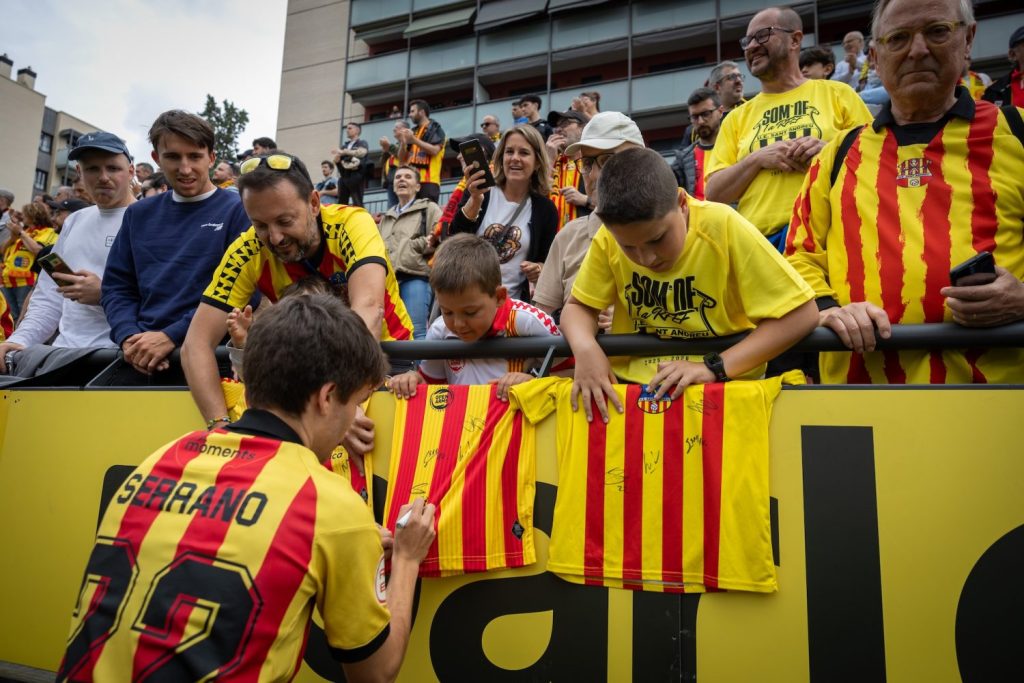
The closeness between the club and its community is equally crucial. At Sant Andreu, the distance between players and fans almost does not exist. Esther, who regularly attends matches with her two children, argues that this intimacy offers something modern football cannot match: «They love seeing the players up close, high-fiving them after the match or meeting them at the supermarket. That is what makes a true neighborhood team special». That bond recently proved decisive, when fans pressured Barcelona’s city council to replace the stadium’s artificial turf pitch with a natural-grass one, allowing the club to remain at the Narcís Sala after promotion to the third division. For most fans, staying in the neighborhood was a non-negotiable condition: «Leaving Sant Andreu would have destroyed everything we have built», says club spokesperson Gerard Álvarez.
The club’s rapid rise has not come without consequences. In 2024, Japanese entrepreneur Taito Suzuki took control of the club during a period of financial fragility. For many clubs, an acquisition of this kind would immediately trigger fears of excessive commercialization, possible rebranding, and the gradual loss of identity. Initially, Sant Andreu fans had the same fear. But, at least so far, those concerns have largely dissipated. Álvarez insists that the new ownership quickly understood that the club’s DNA was untouchable. «His arrival does not mean losing our essence», he explains. «It was about resolving a difficult economic situation. As long as the club’s values and its fans are respected, everything will be fine».
Even the club’s supporters’ federation, initially skeptical about this change at the top of the club, now acknowledges that the relationship has worked better than expected. «It is not our ideal ownership model, but we have been lucky», says president Xavi Miralles. «He has been very respectful toward the club and the fanbase and has not tried to impose any changes. I think he understood that this team works precisely because of its identity».
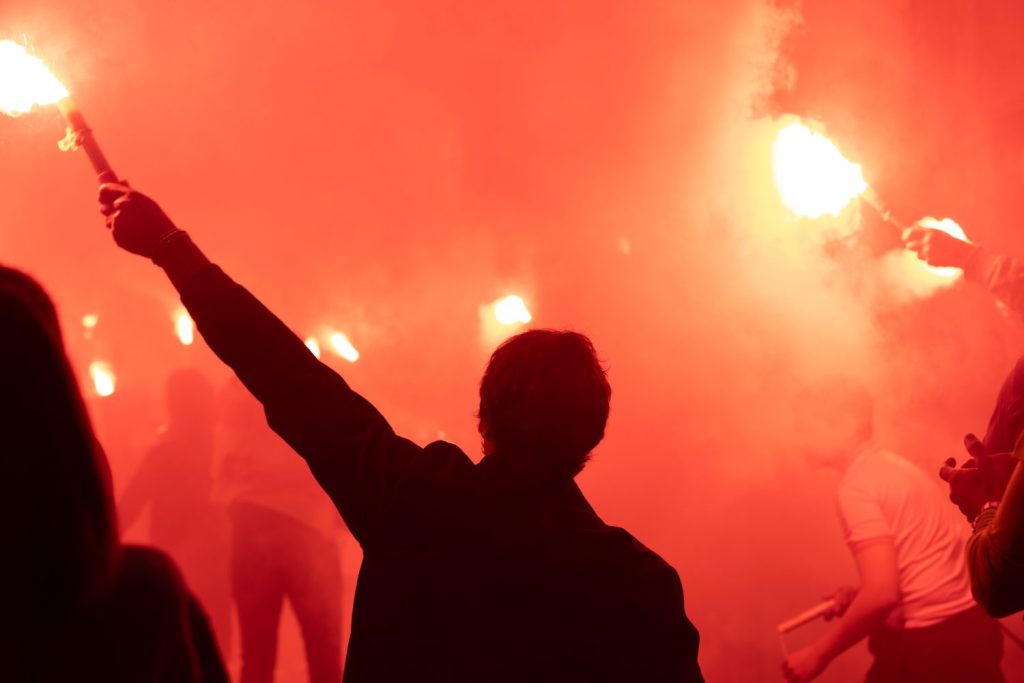
Despite the change of ownership, Sant Andreu continues to offer a rare countermodel to modern football. The club remains ambitious — the dream is to reach, sooner or later, the Spanish top flight — but rejects the idea that success must come at the expense of identity. «If reaching La Liga means denying who we are, then we would rather stay in amateur football», Miralles declares. The challenge will be to preserve this balance: rapid growth always risks transforming the very culture that originally makes a club special. For now, Sant Andreu remains remarkably intact. Before matches, the bars around the Narcís Sala fill with local residents sharing a beer while waiting for kick-off, children run freely through the stands under the gaze of older fans sitting in their usual seats, and Catalan chants echo around the stadium for all ninety minutes. In this corner of Barcelona, you can still breathe the air of a football that belongs to its people.