
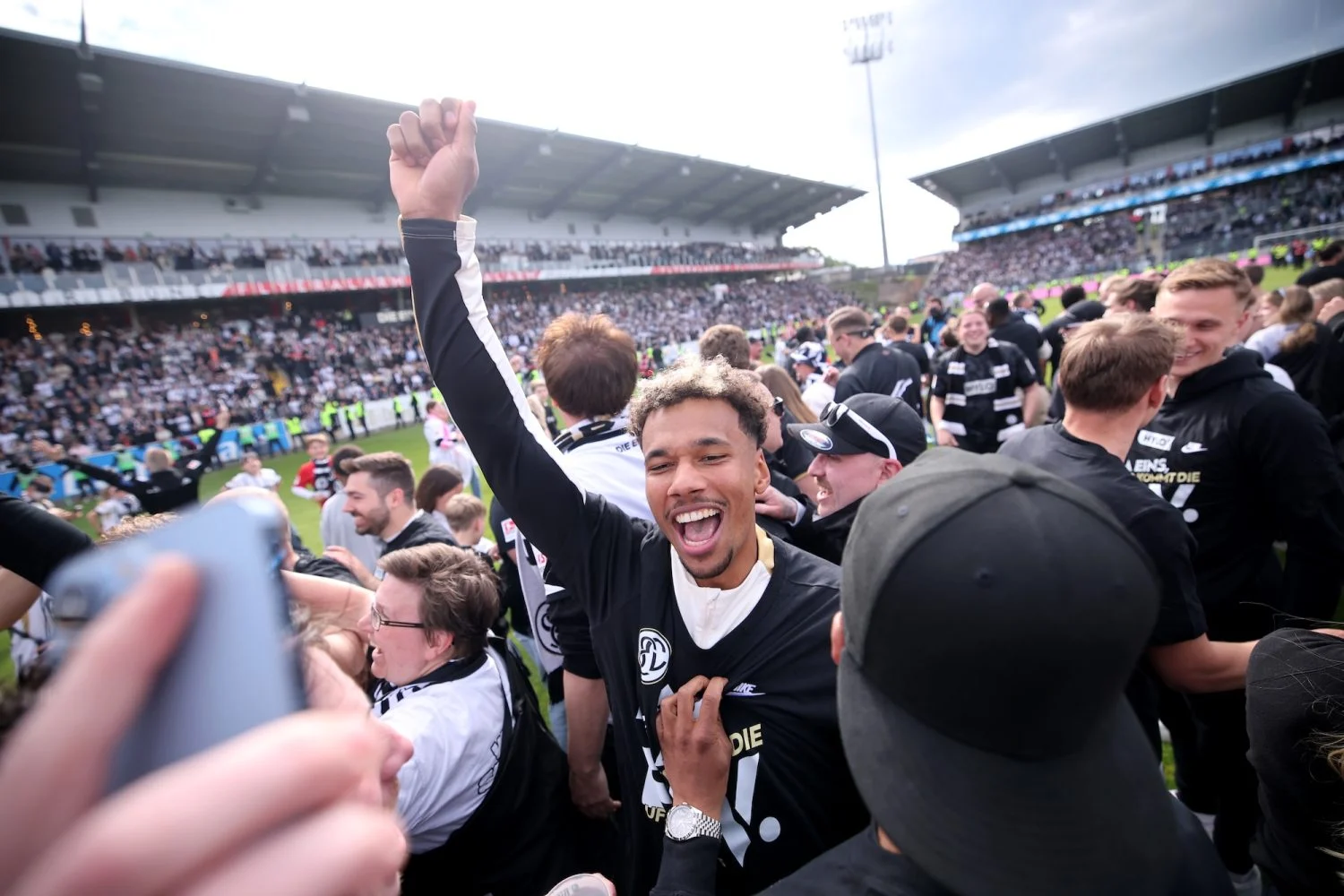
For the first time in its history, Elversberg will play in the Bundesliga. And it is big news, enormous even. But it is also inversely proportional to the size of Elversberg, a town with fewer than 13,000 inhabitants, located in south-west Germany, in the state of Saarland, a few kilometres from the border with Belgium and France. Just to give a sense of the real dimensions of this place: in Spiesen-Elversberg, the full name of this town, there is no railway station, no cinema, no theatre, no shopping centre and no medium-to-large hotel. And yet, and yet, now there is a club that has reached the top division of German football.
Although, as mentioned, it represents a tiny community, Elversberg is the manifesto of a clear and ambitious sporting project. Let’s start with its institutional structure: the club is, in fact, an association of 7500 members who democratically elect its representative leadership. The club is currently led by Dominik Holzer, whose father owns Ursapharm Srl, a pharmaceutical company based in Spiesen-Elversberg and the team’s sponsor. Elversberg, founded in 1907, has been the protagonist of an impressive sporting rise: three promotions in the last five seasons. And last year it had already come within a step of the Bundesliga: after losing the playout against Heidenheim, the team started again with consistency, eventually claiming a deserved second place behind Schalke 04 – whose Veltins Arena could host the entire population of Spiesen-Elversberg multiplied by five.
The seal came on the final matchday, with a clear 3-0 win over Preußen Münster, already relegated to 3. Liga. At the end of the match, the party began, with fans invading the pitch at the Waldstadion an der Kaiserlinde. The beautiful thing is that Elversberg, in reality, could have played in France rather than Germany: after the First World War, in fact, the state of Saarland was placed under the administration of the League of Nations for 15 years, then became a German land under Nazism (as a province of Westmark). And, finally, it was a French protectorate between 1947 and 1956, a period during which a football championship was created and an autonomous representative team was also founded, affiliated to FIFA and even taking part in qualifying for the 1954 World Cup. From 1957 onwards, Saar became one of the federal states of West Germany (and then, from 1990, of reunified Germany).
Elversberg will therefore be the 59th different team to play a Bundesliga season, as well as the second from Saarland (after Saarbrücken, which represents the state capital of the same name and is currently in the third division). To do so, however, it will have to meet certain minimum standards: the DFL (Deutsche Fußball Liga) requires a 15,000-seat stadium to grant registration, while at present the Waldstadion holds just over 10.000. Work has already begun, and so, starting next spring, Elversberg will have a facility with more seats than people living in the town. For Elversberg and its inhabitants, then, next season will go down in the history books. A space-age achievement, as the club’s coach Vincent Wagner also said: «Before the decisive match», he explained, «a friend of mine told me that Elversberg’s promotion would be like going to the moon. Well, we have made the moon landing».