
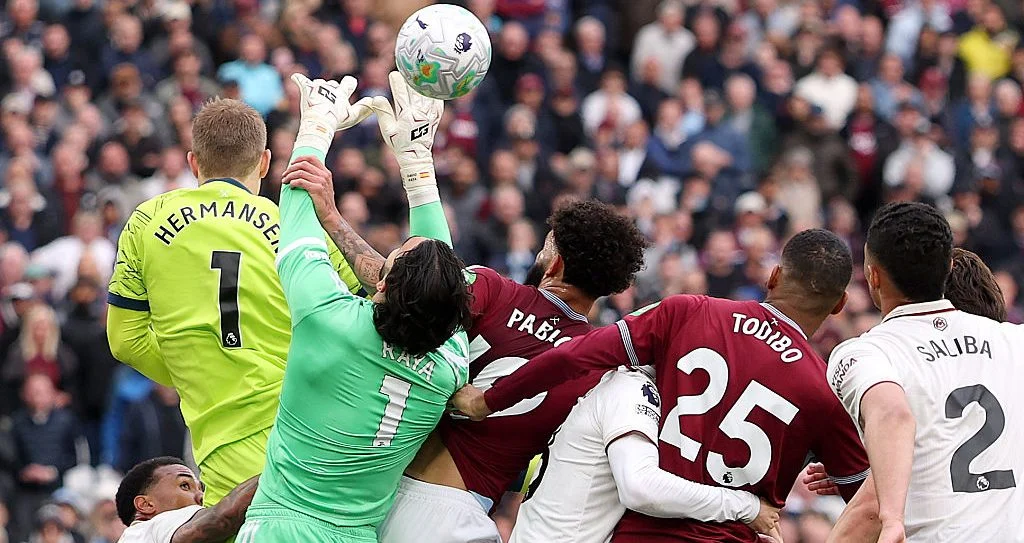
A decision that could change the future of football, after a whistle that could decide the future of the Premier League. On Sunday, West Ham and Arsenal were playing for a large part of their season, between ambitions of survival and of winning the league. The Gunners broke the deadlock in the 83rd minute with a goal from Trossard, then deep into stoppage time Callum Wilson found the equalizer in a scramble from a free kick. Actually, no: the referee was called over by VAR and, after an off-field review, decided to disallow the goal for a foul on the goalkeeper, with Jean-Clair Todibo obstructing David Raya. The league leaders thus won the contest — putting one hand on the Premier League — and the controversy flared up. Because before the set piece was taken, that is, when the decisive contact occurred, Arsenal’s area looked like a lawless scrum. And it was objectively difficult to punish one foul more than all the others, as instead happened.
Also because of this incident, the latest in a long series this season, the following day the lawmakers of the game announced that they wanted to take action for the future: “We will examine these situations carefully over the coming months, because by now it is a recurring and high-impact dynamic,” International Football Association Board officials explained to The Times. “We had already talked about it just before our annual meeting in March, but it was too late to put this issue on the agenda with all the necessary in-depth analysis. We have decided to do it now.”
In the Premier League above all, the issue has become recurring and has thrown the consistency of refereeing into chaos. Goal-scoring opportunities from set pieces are increasingly tempting, they are built with obsessive attention to detail and exploited by taking position in the area — literally — at the expense of opponents. By fair means and foul, until the referee blows the whistle. The problem is that, especially close to the goal, there is such a sequence of tackles, shirt-pulls and shoves that, logically, the referee should often punish everything or nothing — and it is precisely the inconsistency even within the same move that is being challenged, as the West Ham-Arsenal case shows.
Todibo’s foul, in short, is destined to set a precedent, because this is where IFAB members will begin their discussions. And the widespread feeling is that today’s football has gone well beyond the limit in these kinds of circumstances. How could the regulations be changed? At present, if a player turns himself into a wrestler against a direct opponent, he can receive a verbal warning, but he cannot be punished with a free kick or penalty when this happens before the ball is put into play. So it is technically possible to exploit these borderline-prohibited moves — especially if everyone is doing it, and the referee no longer intervenes — to gain a decisive advantage in the marking phase. By now even insiders, including former referees, admit that “football has lost control of these circumstances: referees think that if the holding is mutual, it is right to let play continue. Also counting on a possible VAR intervention.”
The alternative, then, is to give the green light to awarding free kicks and penalties even when the clock is stopped. A circumstance that would profoundly overturn the way teams defend and attack set pieces. And indeed, while IFAB’s leaders are convinced that something must be done, the method of intervention will have to be discussed with caution: otherwise we move from the frying pan into the fire, risking a new inflation of penalties after those introduced by the strictness of VAR. And that would not be a solution either.