
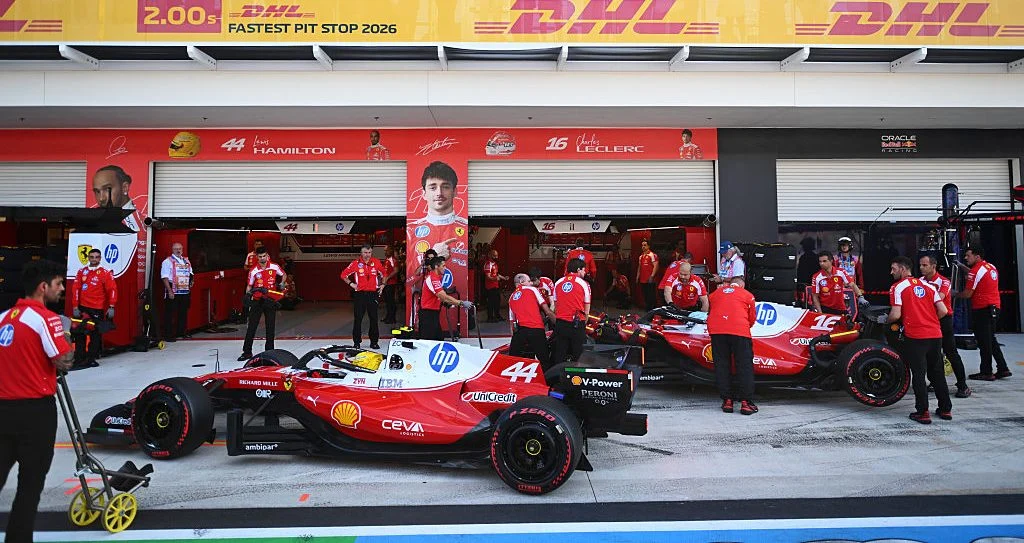
In motorsport, everything can come down to fractions of a second — enough time to decide a pole position, a Grand Prix, or a constructors’ championship. In hospitals, those same fractions of a second can mean something very different: a human life. The connection between two worlds that appear, at first sight, entirely unrelated lies in a shared principle: high-performance teamwork under pressure. Coordination, clear division of roles, and precise communication. In Formula One, these elements have been refined for decades, allowing teams and drivers to operate at the very limit of human and mechanical capability. And it was precisely this logic that, in the early 1990s, two British doctors believed could be translated into medicine.
The idea was simple, but its implications were profound. It emerged from a problem that, at the time, affected many neonatal intensive care units across Europe: the treatment of critically ill newborns. Martin Elliott and Allan Goldman, specialists at London’s Great Ormond Street Hospital, observed that mortality rates in these cases remained too high, even in well-equipped hospitals. In other words, too many deaths were still preventable. The most fragile moment was the transfer of newborns from the operating theatre to intensive care. These transitions were often highly complex, with medical teams required to keep multiple life-support systems perfectly synchronised while moving the patient. Too often, that synchronisation failed.
This is where Formula One — and in particular Ferrari — entered the story. The doctors began studying pit stops in detail: those seconds in which a car is brought in, tyres are changed, and everything is executed with near-mechanical precision. Moments that, in many cases, decide races and championships. According to reporting by the National Catholic Register, Elliott and Goldman eventually contacted Ferrari in Maranello, where they were given full access and support by the team’s engineers.
They travelled to Italy, observed the process firsthand, and presented their clinical challenges to the engineers and mechanics responsible for pit stop operations. The diagnosis was immediate and unsentimental: hospital procedures were structurally inefficient. Too many people working without clear coordination, and communication breakdowns that made synchronisation extremely difficult. From there, an unusual collaboration took shape. Engineers and mechanics worked alongside medical staff to redesign the process, borrowing principles from the pit lane and adapting them to a clinical environment under extreme pressure.
Over time, the results became measurable. The introduction of clearly defined roles and improved communication protocols led to a 67% reduction in errors between operating theatres and neonatal intensive care units at Great Ormond Street Hospital by 2007, according to published research. A figure that is difficult to translate into anything other than its most direct consequence: lives saved. And the collaboration did not stop in London. In the years that followed, other hospitals began working with Formula One teams — from Williams to McLaren — applying the same principles to the transfer of critically ill newborns. In the end, some of the most important results are never measured in lap times or trophies. They are measured in something far more absolute.