
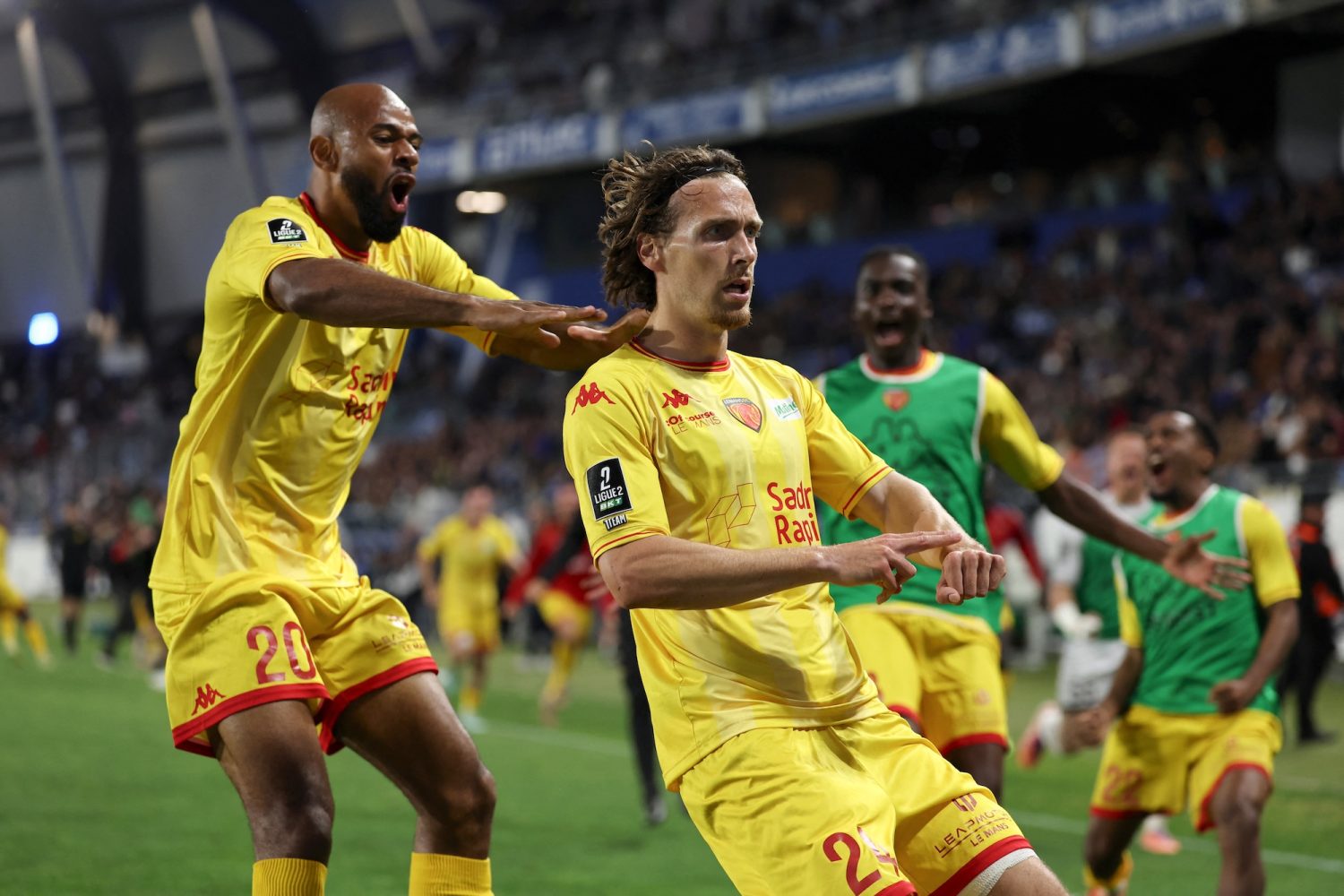
Imagine one of the most important motoring cities in Europe, which has a football team that plays inside the circuit and gets promoted to the top national division thanks to a project that involves a series of sporting stars from all over the world. It is the incredible story of Le Mans, the club of the French city of the same name, famous at least until a few days ago for being the heart of transalpine motoring culture. There one of the most iconic races in the world is run, the 24 Hours, the MotoGP, engaged precisely this weekend, the Superbike, and Formula One too has held some rounds of the world championship there over the course of its history.
And yet in these days in Le Mans people do nothing but talk about football. The club, in fact, is back in Ligue 1 after 16 years. The last participation in the top division had been in 2009/10, a championship closed in 18th place. Three seasons later, because of a corporate bankruptcy, Le Mans had to start again from the sixth division. A shock for a club that only six years earlier had placed ninth in Ligue 1 with Rudi Garcia on the bench. A deep fall, from which the club managed slowly to pick itself up, right up to the two promotions in the last two years that have allowed it to see Ligue 1 again.
Much of the credit goes to Patrick Videira, a practically semi-unknown coach who before arriving in the Loire had been only at AS Furiani, a small club in Corsica that has never seen anything other than the Championnat National 2, the fourth division. The rest was put in by the club, which wanted to take as a reference model a reality that in Italy in 2018 was in Serie D and now is playing in the Champions League, Como. As analysed by the BBC, Le Mans in 2025 changed ownership. Leading the project is OutField, a group of Brazilian investors that has brought with it names of great appeal such as Novak Djokovic, the two Formula One drivers Felipe Massa and Kevin Magnussen and, at a second moment, also Thibaut Courtois, goalkeeper of Real Madrid and of the Belgian national team.
«We wanted to involve very high-profile personalities to strengthen the project from the point of view of image and branding» explained Pedro Oliveira to the English broadcaster. The choice of Massa and Magnussen appears natural considering the motoring tradition of the city. Acting as a bridge was Georgios Frangulis, founder and CEO of the healthy food franchise Oakberry, an investor and operating partner of the club. Frangulis, already close to Massa through his own business affairs, is also the husband of the world number one in tennis Aryna Sabalenka, a detail that favoured the contact with Djokovic.
«We had been told that Djokovic was a big football enthusiast. We presented the project to him, he liked it and he decided to invest» recounted Oliveira. Courtois too, won over by the club’s vision, joined the initiative last February. President Thierry Gomez, at the helm of Le Mans since 2016 and a protagonist of the reconstruction after the bankruptcy, considers fundamental the presence of figures who know the world of professional sport: «It is important to have investors who understand the dynamics of this environment». The new project is born, however, from solid economic foundations. When OutField entered the club, Le Mans had no debts and already had infrastructure considered to be of a high level. «There was no economic urgency – underlined Gomez – the club did not need to be saved, but it wanted to grow».
The geographical position was decisive in the choice of the investors. After having acquired Coritiba in Brazil in 2023, OutField looked for a European reality to integrate into its own project, focusing above all on the formation of young talents. «The two most fertile areas in the world for the development of footballers are the State of São Paulo and the outskirts of Paris» explained Oliveira. «For this we narrowed the search to clubs situated within 250 kilometres of the French capital». The youth sector will in fact be the heart of the project. The academy, closed in 2013 after the bankruptcy, should reopen as early as July. «Buying great players and paying high salaries does not fall within our plans today» clarified Gomez. «Our objective is to develop young players».
The philosophy is clear: the club does not aim to imitate financial models like that of Paris FC, recently acquired by the Arnault family, but wants to build value through the youth sector. «Being able to buy a great player of 24 or 25 is impossible for us» admitted the president. «But discovering the Mbappé of tomorrow when he is 14 or 15, that yes». A strategy coherent with the history of the club, which in the past contributed to the growth of champions like Didier Drogba and Gervinho. The ambition, however, is quite big. «In seven years we want to be stably in Ligue 1, to have one of the ten best academies in France and to build a brand that is recognisable at an international level» affirmed Oliveira.
For commercial and image growth, the reference model is Como, indicated by the investors as a virtuous example of brand development. More distant, instead, the idea of the big multi-club networks like those of Chelsea FC or of the City Football Group. «We do not want a pyramidal structure where everyone works for the main club» explained Oliveira. The important thing, however, is to preserve Le Mans’s identity: «An investor must first of all understand the history and the territory of the club, staying close to the fans, to the local businesses and to the community» clarified Gomez. The challenge remains complex. Just in its own area alone there are very well-established realities at a youth level like Rennes, perhaps the best academy in France, Nantes, Angers, Lorient and Brest. The objective, however, is set: to ensure that the name Le Mans is not associated only with motors and to build, exploiting precisely that tradition, a project destined to last over time.