
Some winning streaks demand attention.
Especially when they belong to a teenager.
Andrea Kimi Antonelli arrived in Formula 1 carrying more expectation than most rookies could reasonably be expected to handle. Three races into the season, he has done little except justify it.
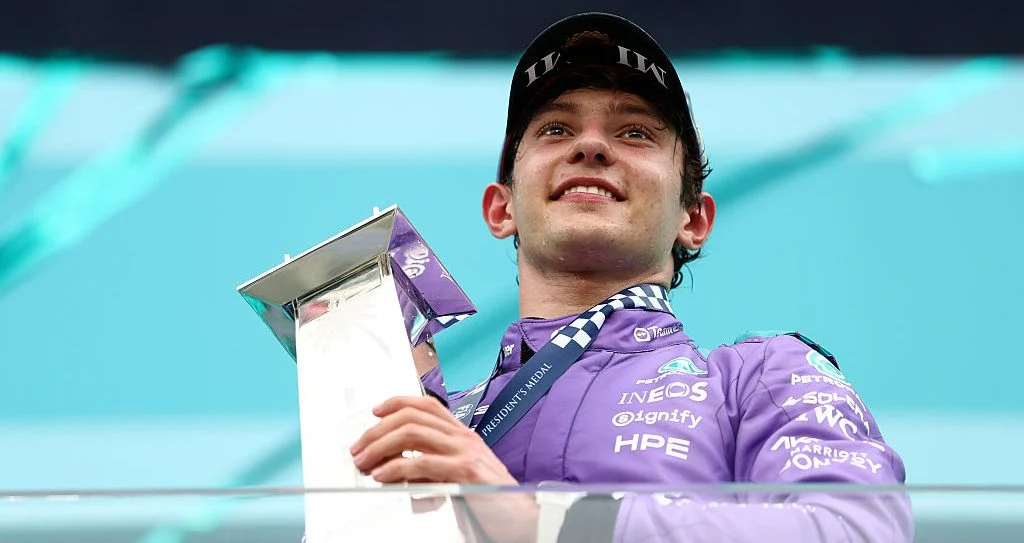
The Mercedes driver has now won three consecutive Grands Prix and leads the Drivers’ Championship, becoming the youngest driver ever to top the standings. Yet if victory in China felt like a breakthrough and Japan like a record-setting moment, Miami carried a different significance.
It felt convincing.
For much of the weekend, Antonelli looked less like a prodigious newcomer and more like a driver who had already spent years operating at the front of Formula 1. Nothing came easily. The race itself was awkward and demanding, shaped by changing conditions and the threat of rain. The start was untidy. Progress had to be earned rather than inherited.
What followed was perhaps the most impressive part of the afternoon.
There was no desperation in his overtaking, no sense of forcing the issue. He picked his moments, controlled the race when it mattered and absorbed pressure without appearing rushed. By the chequered flag he was three seconds clear of the field—a comfortable margin in a Grand Prix that never entirely settled.
It was the kind of performance that leaves little room for caveats.
At this point, the rest of the sport has stopped asking whether Antonelli belongs in Formula 1. The conversation has shifted to how far he can go.
Several British outlets have already cast him as Italy’s next great sporting hope. Mercedes team principal Toto Wolff compared Antonelli’s emergence to the impact Jannik Sinner has had on tennis in Italy.
“In these first races he’s been fantastic,” Wolff said. “He doesn’t make mistakes and he handles pressure extremely well. I don’t think any of us expected a start like this.”
Mercedes always believed it had handed Antonelli a competitive car. What has surprised even those closest to him is how consistently he has extracted its potential.
“We knew we were giving him a strong package,” Wolff added. “But the fact he’s been able to maximise it every weekend is something special.”
The challenge now, Wolff suggested, lies elsewhere.
“The important thing is that he stays grounded. His parents will play an important role in that. The biggest challenge, honestly, is probably the Italian public.”
It is an observation that speaks to the scale of anticipation building around Antonelli’s rise.
Italy has produced world champions, but generations of fans have grown up without seeing an Italian driver consistently fight at the front of Formula 1. Success inevitably changes the atmosphere.
“With the national football team missing out on the World Cup, everything revolves around Sinner and Antonelli,” Wolff said. “Sinner won in Madrid this weekend. Kimi won in Miami. They’re both exceptional talents.”
The comparison is difficult to avoid.
Like Jannik Sinner, Antonelli has arrived at the highest level unusually early and appears remarkably comfortable there. The attention has followed naturally.
So have the records.
No driver in Formula 1 history had previously converted their first three consecutive pole positions into three consecutive Grand Prix victories. For a sport built on statistics, it is the kind of achievement that forces even the skeptics to pay attention.
France’s L’Équipe was unequivocal in its assessment. Antonelli, it argued, already belongs among the elite. The newspaper highlighted his ability to keep reigning world champion Lando Norris behind him, beat Max Verstappen on merit and finish comfortably ahead of his far more experienced team-mate George Russell.
Even publications not known for hyperbole have begun to adjust their tone. The Times has already noted how naturally Antonelli appears to belong at the front of the grid.
Across the Atlantic, The Athletic framed Miami as the clearest indication yet of his championship credentials.
The historical context only adds to the fascination.
Before Antonelli, Italy had not celebrated a Formula 1 race winner since Giancarlo Fisichella in 2006. To find an Italian driver winning consecutive Grands Prix requires going back even further, to Alberto Ascari in 1953.
Antonelli, however, seems largely uninterested in the growing mythology surrounding him.
“I’m aware of what’s happening,” he said afterwards. “But I try not to focus too much on these milestones or on the expectations that come with them.”
For now, that restraint may be one of his most valuable qualities.
“There are still a lot of races left,” he said. “I just need to keep improving. I have a team-mate who’s incredibly strong and incredibly fast. And everyone else will keep getting closer.”
Championship leads have a way of feeling heavier as the season progresses.
The scrutiny intensifies. Every result carries greater significance. Every mistake becomes more expensive.
Antonelli knows that as well as anyone.
What he has shown so far, though, is an unusual ability to absorb pressure without allowing it to alter the way he drives. That may ultimately prove just as important as raw speed.
Formula 1 has always produced gifted young drivers. Far fewer have demonstrated the composure required to sustain success once expectations arrive.
Three victories do not guarantee greatness.
But they can reveal the outline of it.
Right now, Antonelli looks less like a teenager enjoying an extraordinary run of form and more like a driver settling into his natural place near the front of the grid.
That, more than any statistic, may be what has the rest of Formula 1 paying such close attention.