
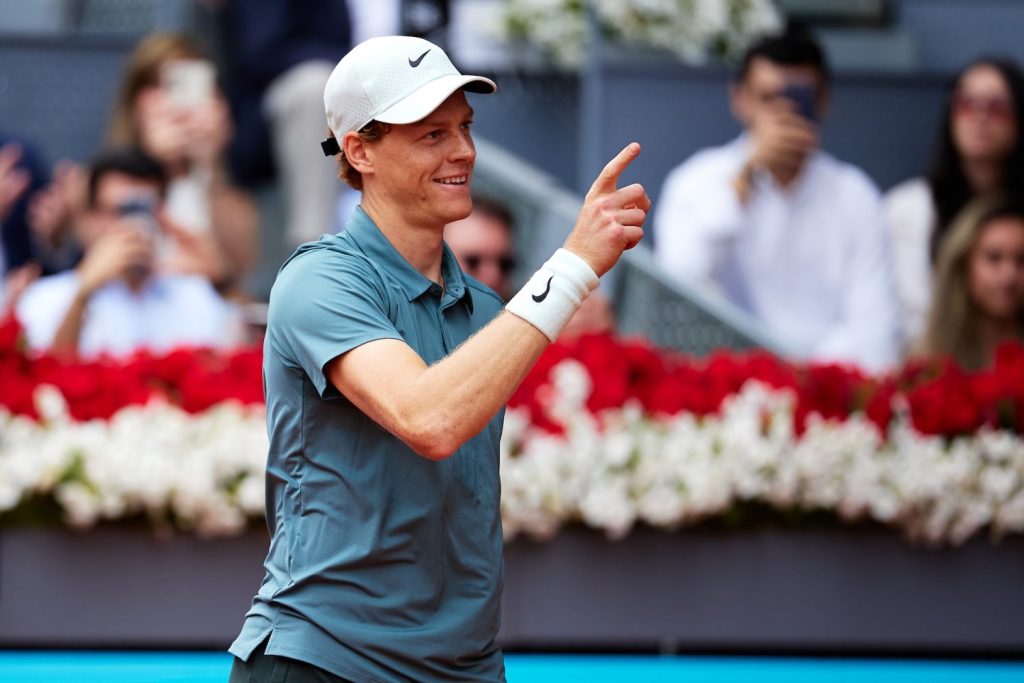
More than the five consecutive Masters 1000, more than the 28th title on the major circuit, the fourth of the year after Indian Wells, Miami, and Monte Carlo, more than the victory in Madrid that he still needed to complete all the tournaments (now only Rome and Roland-Garros are “left”), more than being number one in the ranking, the most significant thing about Jannik Sinner’s afternoon is a face. That desperate face of Alexander Zverev, completely stunned in the final of the Spanish master. If the world number three leaves frustrated, emptied, and crushed from a 1000 final, it means that Jannik, at this moment, is living on another planet. And so, with an Alcaraz dealing with wrist problems that will keep him out again in Rome and Paris, Jannik can really think about arriving at the grass season with a full sweep.
The final in Madrid, in this sense, is a disturbing hint (for the others, for all the others). In the first set, Sinner started strong, immediately finding great consistency with his first serve. Just to clarify the situation, the first 15 came with the 36th ace of the tournament and the second with a powerful out-wide serve. Three consecutive first serves directed the 1-0 followed by the break that set the match on course, shattering Zverev’s hopes right from the start. “I will have to play my best tennis to have a chance. I hope I can do it,” the German had said after the semifinal finished in two sets against the Belgian Blockx. Well, he didn’t manage it, crushed by the pressure, frustration, and nerves that led him to make several errors: three in a row that put him down by two games and four unforced errors that made him lose the fourth game.
The world number one continued to hammer away, leaving nothing behind, controlling every single service game and imposing a frantic pace that turned the first set into a 25-minute monologue: 81% of first serves in and only five points conceded in service games, these numbers alone explain Jannik’s dominance. In the second set, the trend changed little, very little: Zverev started better, holding his service game to love and finding the help of his serve, but Sinner continued to control his service games, closing the second game with another ace.
Then came the third game, the one in which the match turned (or rather: ended) : Sinner went up to 15-40 taking the initiative from the baseline, Zverev’s backhand error, visibly frustrated, did the rest. In the fourth and sixth games, Jannik held serve calmly, playing better and better, point by point, and even allowing himself some forays to the net – a fundamental aspect of his game perfected right in Madrid. In the end, the 6-1 6-2 was wrapped up in a total of 57 minutes: 57 minutes that framed a simply perfect performance.
There are no other adjectives to define a match like this. Extraordinary, in particular, was Sinner’s effectiveness on serve: the world number one reached 93% of points won on the first serve and did not concede a single break point. In a 1000 final, well, numbers and a performance like that must be considered rare, very rare. And yet Sinner has made them routine, normality. Of course, all these evaluations/assessments are clearly influenced by Alcaraz’s absence. But it must also be recognized that Jannik has made incredible strides in absolute terms, especially on that clay court that had never really suited him (the two titles won in Monte Carlo and Madrid were the second and third of his career on red). Now it is up to the others to understand when and especially how they can intrude on a now consolidated dominance, in a monocratic dictatorship that seems incredibly difficult to even crack, let alone overturn. On the horizon are Rome and especially Paris, the last two pieces missing from Jannik’s collection. He has already made history by becoming, the first tennis player ever, the winner of five consecutive Masters 1000. And he has everything he needs, truly everything, to enter legend and “complete” tennis. At not yet 25 years old.