
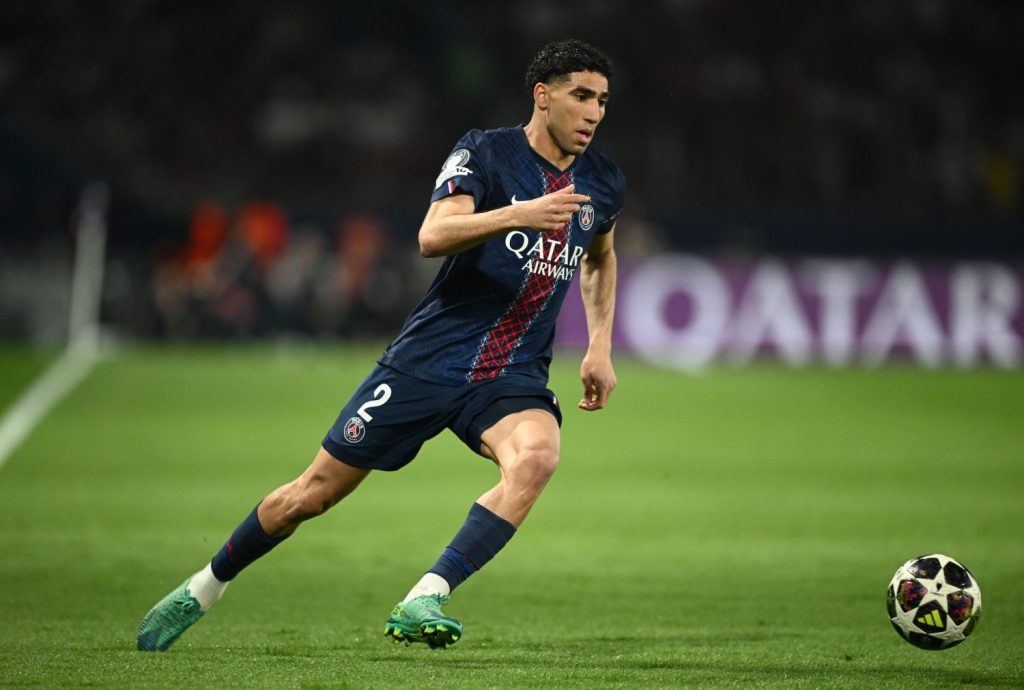
In one of the most spectacular matches in Champions League history, it becomes difficult to find a single aspect that made that small difference in favor of PSG. Beyond the result, a 5-4 full of plays worthy of such a dazzling stage, the match at the Parc des Princes was a manifesto of the football that will be. For some time now, positional play has been surpassed, that of continuous passing to which defenses have adapted by proposing low blocks. Even functional play, where roles no longer exist but tasks on the field matter, is beginning to creak, overwhelmed by constant pressing spread over all 90 minutes. And so, in a context of balance, we have reached the paradox of going back to the football of origins, where those who beat their man count, create numerical superiority, and force opponents to chase. Duels all over the field and incessant dribbling, with deep runs becoming fundamental. Especially if they come from behind.
Here, therefore, having someone like Achraf Hakimi shifts things. There is an image that best tells his performance in PSG-Bayern. It is not a defensive closure, it is not a progression in open field, it is not even the assist for Kvaratskhelia’s 4-2. It is the way in which, every time his teammates lifted their heads in construction, the immediate reference was always him, on the right. A constant trace, a permanent solution, almost a living tactical principle. Hakimi played a match that reaffirmed what has become evident for years: Hakimi is no longer just one of the best full-backs in the world, but a decisive player who has transcended the boundaries of the role. In this semifinal, it was seen clearly, almost didactically. Formally starting low, but in reality moving on the field as an added winger, as a pure attacking wide player, with the license to receive wide, take on opponents, accelerate, and above all finish the action.
There is a statistic that does not emerge from the numbers but defines the weight of a performance: how much a team seeks a player. And Paris sought Hakimi continuously. When the first build-up needed an outlet, the ball ended up on his side. When it was necessary to gain meters, they looked for his side. When they wanted to attack depth or consolidate high possession, he was still the reference. This happens because Hakimi does not only provide width, but guarantees a passing line that is always alive. It is almost impossible to see him still. He offers support, attacks the space behind the full-back, and moves inside when it is necessary to create internal superiority. He plays as a total winger.
Against Bayern, his reading of transitions was devastating. Every recovery by Paris seemed to automatically activate his run. His strength, however, is not only in pure speed, a distinctive trait of his game for years, but in the quality with which he reads and attacks space. Starting from behind, often from the halfway line, Hakimi had the ideal ground to attack in front of him. And when a player with that progression can run towards the goal, it becomes almost impossible to contain. Bayern tried to screen him, keeping Luis Diaz high, but he hardly cared.
Because Hakimi does not interpret running as a mechanical gesture, but as a natural consequence of a reasoned action. He carries the ball to attract, accelerates to break lines, then decides. And it is in this last step that the most important evolution is seen. Once, the Moroccan winger could be considered a highly effective raider, but less clean in the final choice. Not today. Today he almost always finishes the action well. The assist for the 4-2 is the perfect synthesis: progression, right timing, clarity in the final third, and the ball served to Kvaratskhelia with surgical precision. Not an extemporaneous play, but the epilogue of a match built on the superiority constantly created on the right.
For years, the great debate surrounding Hakimi revolved around the defensive phase. His attacking qualities were beyond question, but there remained the suspicion that he was an adapted attacking player rather than a complete defender. Throughout his career at PSG, and also in this year’s semifinal against Bayern, this view seems to have been definitively erased. Facing him was a very uncomfortable customer like Luis Díaz, who often stayed very high to stress his position and prevent him from breaking free continuously. Hakimi responded by excelling in both phases. He continued to attack without compromising too much on readings, recoveries, and defensive interventions. In open-field duels, he was clean, in preventive coverages almost impeccable, especially in controlling depth.
And perhaps this is the most impressive statistic: he defended for ninety minutes without real moments of suffering. The goal scored by Luis Díaz, in fact, does not arise from a lapse in concentration or a lost duel, but from a situation where the Colombian remains isolated against Marquinhos. It is an episode that rather confirms Hakimi’s work, not the opposite. He was not dragged back by the fear of losing one-on-one, he did not stop being aggressive in his exits, and he never gave the impression of needing protection. And this changes the perception of his performance. And the fact that he is so decisive going forward justifies some of his “absences” in defense: PSG plays this way, Hakimi plays this way, it may be liked or not, but this is where their greatness lies.
Many attacking wide players receive the ball in the last thirty meters. Hakimi, on the other hand, often creates an advantage fifty meters earlier. It is a huge detail. Because receiving from behind allows him to use the field as a runway. He can choose whether to lead, combine, overlap, or attack the inside corridor. Against Bayern, this was especially evident: the ability to turn every attack into depth into a potential opportunity. Not simply for the speed he guarantees, but for the continuity of the threat he brings. Even when he did not arrive at the assist or the final touch, he forced the German block to slide, deform, and lower. And this constant pressure impacted as much as the decisive plays. Great modern wide players do not just produce numbers; they produce systemic effects. Hakimi does. Defining him as an “attacking full-back” is now reductive. It is a formula that no longer explains his football. If for years Hakimi has been perceived as an extraordinary interpreter of an evolving role, today he seems something different: a player who redefines the role itself. And perhaps the most impressive thing is that he does it with naturalness.