
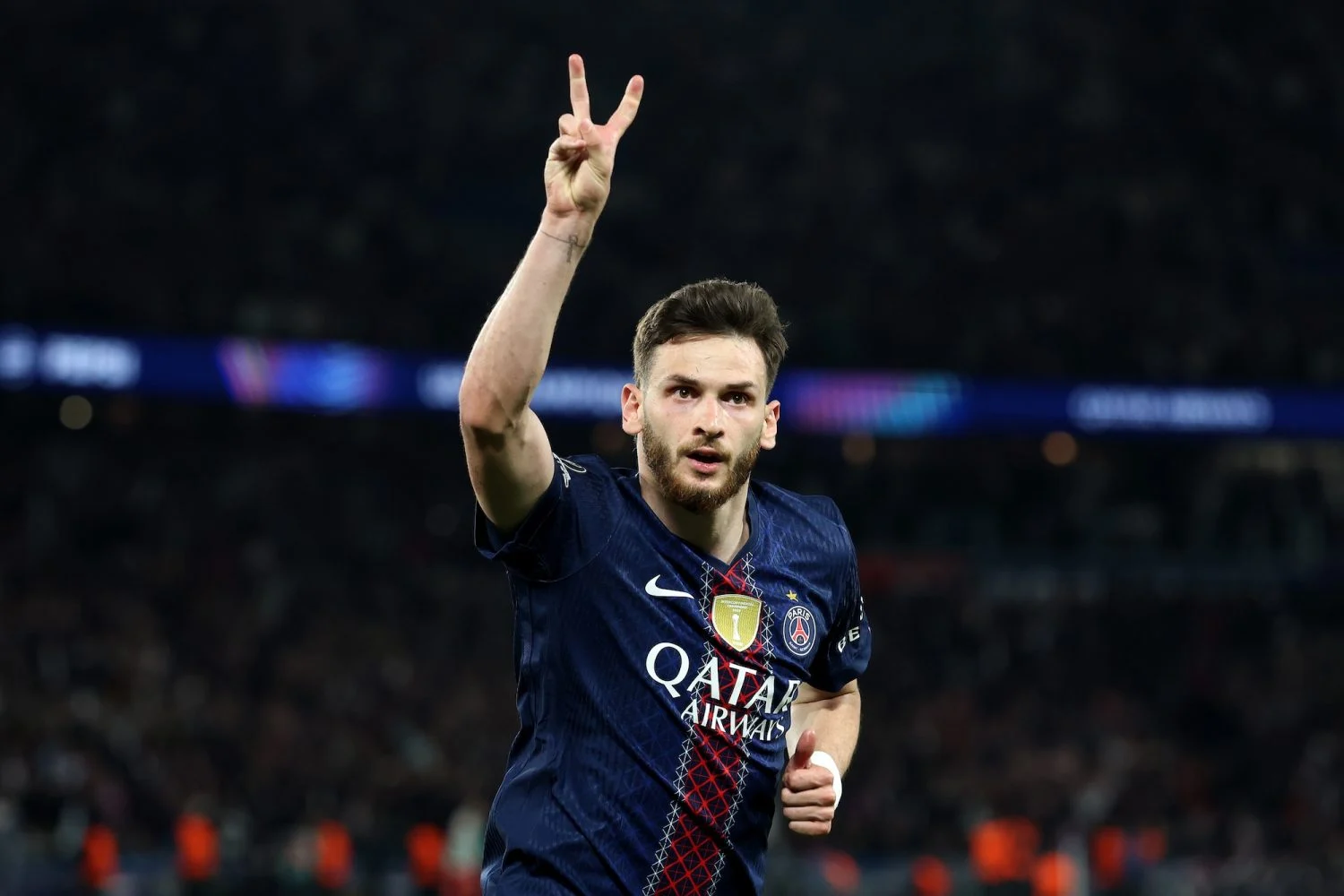
Even one of the most authoritative and caustic sports outlets in the world, L’Équipe, fell into the “narrative trap” of PSG-Bayern 5-4: on one side the French journalists praised the spectacular play, the adrenaline, the almost brazen lightness that was seen on the bright green grass of the Parc des Princes; on the other, however, the same journalists gave rather low marks to the goalkeepers and the defenders of both teams: 3 to Nuno Mendes, Pacho, Marquinhos, Neuer, Stanisic and Davies, 4 to Tah and Lainer, 5 to Upamecano, Safonov, Hakimi. These are readings and positions that in no other case and in no other sport would be reconcilable, in the sense that the satisfaction felt by those who watched PSG-Bayern 5-4 is inextricably linked to the difficulties of the defenders who took the field. Who, just to be clear, are absolutely not poor. On the contrary: they are among the best in the world in their role. And in the same way one cannot think that Luis Enrique and Kompany did not work on the defensive phase or on the negative transitions of their teams. Simply, much more simply, the quality of the attackers on the pitch got the better of the quality of the defenders, of their tactical organisation. And there is nothing to be indignant about, or to be surprised about: today elite football is a purely, declaredly, evidently offensive game.
To understand what we mean, it is enough to go back to 2014, to an article that Gary Neville – former symbol-defender of Manchester United and then a coach of little fortune – wrote for the Telegraph. An article in which there were these words here: «It is not the players’ fault if a certain type of marking or of containment is no longer part of their way of playing. The point is that today the speed is much higher, the technical level is fantastic, it is all so electrifying. We are heading towards an era of bold football, like in the Forties and Fifties of the 20th century. Evidently, the game went into hibernation from the Seventies to the Nineties, when defensive organisation and structure prevailed. Today we are seeing again football as it had been thought of and envisaged, perhaps».
There, to explain and to recount PSG-Bayern 5-4 one must start from these phrases. From these incontrovertible pieces of evidence. From Hakimi’s performance, devastating in attack and effective in the defensive phase, yes, but only when he was actually present (that is on many fewer occasions compared to a full-back of the past). The fact is that Luis Enrique, Kompany and the vast majority of the other top coaches, to put it briefly, have bolder ideas – so we also pick up a word used by Gary Neville – if compared with those of their predecessors. And these are ideas (we are talking about the basic principles, obviously) also fairly easy to decode: you start from the offensive talents and from the connections between them, those are the aspects that we have to try to bring out as much as possible; and there is no need to be horrified, or to get too angry, if we have to sacrifice a bit of defensive balance, if we have to leave ourselves a bit more exposed, if we run the risk of conceding chances in transition.
This vision of football, beyond its (presumed) ontological superiority compared to a more balanced or even defensive approach, is the fruit of a circular evolution. As Neville explained in his 2014 article, the football of the Forties and Fifties contemplated many more results similar to the 5-4 of PSG-Bayern (one example above all: in the two semi-finals and the final of the 1954 World Cup a total of 18 goals were scored), then in the following decades things changed. In the last 15 or twenty years, in effect, we have “gone back”: the ideas of the coaches, the rule changes thought up and implemented in an offensive key and the development of very fast attackers of enormous quality have determined a new tactical context. A context less obsessed with balance at all costs, with the elimination of risks. In a few words: today’s coaches all have, starting precisely with Luis Enrique and Kompany, the ambition to control matches in every aspect, defensive too. But they accept more lightly, so to speak, that this way of theirs of understanding the game can lead to conceding a few more goals. Above all in the most important matches, against the strongest teams (which, fatally, follow the same script).
In reality, if you think about it, they are all economic and therefore utilitarian evaluations. If, as said before, today it makes sense and it is convenient – precisely from the financial point of view, that is for the coffers of the clubs – to bring value out of the attacking players, then the coaches consent to the fact that Kvaratskhelia, Olise, Dembélé, Doué and Luís Díaz, but also Hakimi and Alphonso Davies, make a few fewer recovery runs compared to the past. The same goes from the television point of view too: today the “demand” of the football public – above all the neutral one – goes in a clear direction, that of the offensive spectacle. And after all it is so in Italy too, where we got indignant over the «boring» 0-0 that came out of Milan-Juve. But then, in exactly the opposite way, we also got indignant over the 5-4 of PSG-Bayern.
The truth, as almost always happens, lies in the middle and is rather simple to decode: today elite football lies in the adrenaline, in the almost brazen lightness, even in the defensive imperfections that were seen in the Champions League semi-final first leg played at the Parc des Princes; the others, that is those outside the elite, cannot express that type of high-intensity, technical and physical football, and so they look for other roads to survive, to stay afloat, to not lose. It is a simple playing of roles, and now on the strong side there are PSG, Bayern, Luis Enrique, Kompany and their hyper-offensive football in which matches end 5-4. One may like it or not like it, that is not the point. But to get close to that level, and to stay attached to it, one will have to adapt. At least until the next cyclical evolution.