
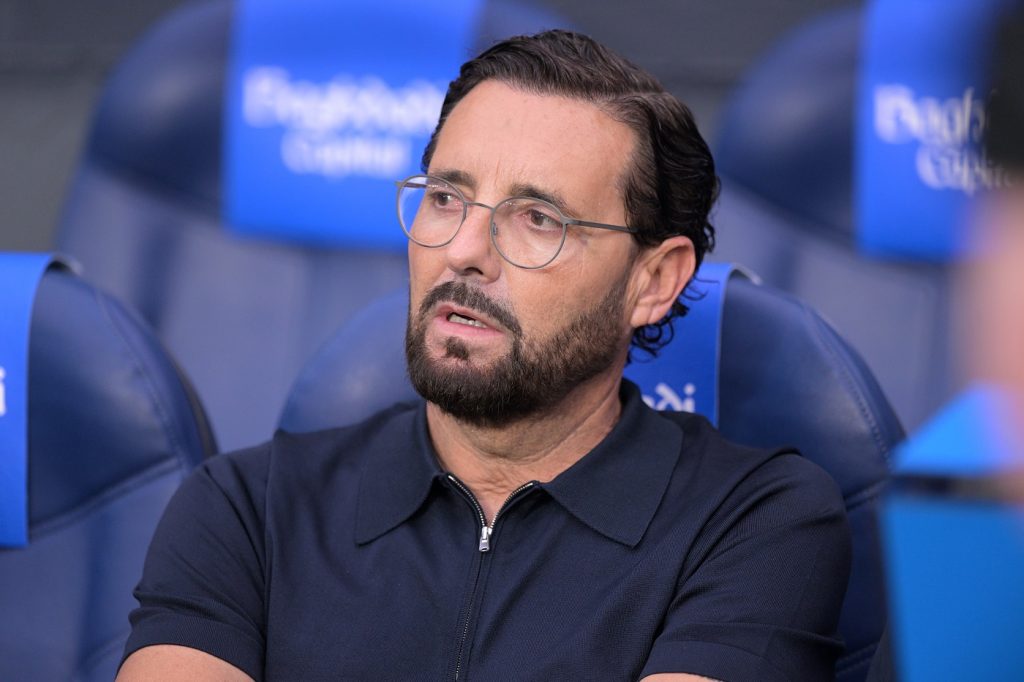
Looking at him like this, in a tight polo shirt, loose trousers and thin, round-framed glasses, he seems like one of those nerdy but somewhat stylish coaches, the kind who almost do not want you to realize that they spend every moment of their day inventing some new trick to make life complicated for their opponents. But in reality José Bordalás is one of the most divisive managers in Spain. Some people hate him because his game plan, at least on the surface, is based on destroying the other team’s game before building his own. At the same time, there are those who envy him, because with a team of modest technical value like Getafe, year after year he is laying the foundations for something that has been missing at the Coliseum Alfonso Pérez for a very long time: participation in a European cup. The table says as much: right now Getafe are sixth in La Liga, so at the moment they are qualified at least for the Conference League, even though they have scored just 28 goals.
Bordalás, in truth, cares only so much about all this. In fact: he does not care at all. He ignores the criticism, those who accuse him (sometimes rightly) of having a team that «only thinks about kicking people». The reality is that he and his staff try everything they can to surprise anyone who comes into his lair. The latest idea? A very particular use of artificial intelligence. The Getafe are making great use of it, and it has even reportedly led to a 53% increase in points performance. «Since we started using this model», Bordalás told Marca, «we have gone from 0.89 points per game to 1.37 points per game»». Javier Vidal, one of the Getafe coach’s closest collaborators and a key figure in the development of artificial intelligence within the azulón technical staff, had already begun working in 2017 with an Israeli big-data company that, through technologies developed in the military field and the use of GPS vests, monitored injury risk and players’ physical parameters in order to optimize performance, a central element in Bordalás’ model. But the leap in quality came over the past year with the introduction of AISM, to the point that today artificial intelligence is considered almost the eighth member of the technical staff. «It gives us an innovative vision that helps us make better tactical decisions based on the opponent», Bordalás stresses again.
Behind the famous “Bordalás method”, then, lies a major technological investment. AI has become a real technical assistant, useful both in preparing matches and while they are being played, especially at half-time. According to Alfonso Campo, founding partner of AISM, Getafe’s choice represents a modern vision of football in which technology does not replace human judgment, but enriches it. Artificial intelligence works by creating an additional layer of analysis, one capable of highlighting tactical details, hidden patterns and strategic opportunities that can prove decisive.
The change is also evident on the touchline. During matches, the Getafe staff have three tablets: the first monitors technical-tactical parameters in real time, such as aerial duels won, defensive effectiveness, number of crosses, speed of ball recovery and the position of the defensive line. The second analyses the physical data of their own players and of the opponents, offering useful projections to assess possible interventions. The third hosts a “winning panel”, a sort of dashboard in which the indicators that Getafe must dominate, according to the staff’s and AI’s projections, are compared live in order to increase the probability of success.
But the real evolutionary leap concerns the study of opponents and the prediction of playing models. AISM analyses hundreds of thousands of variables per team, player and match, both current and historical, providing the staff with new strategic perspectives. Three days before every match, the players receive a report based on artificial intelligence that identifies specific patterns: the height of the pressing line, build-up structures, behaviours after losing the ball or areas in which the opponent tends to lose effectiveness. It is not just about knowing what the opponent does, but when and why they do it, making it possible to establish precisely where to press, how to orient the play and in which moments to take greater risks.
AI, moreover, does not limit itself to describing scenarios, but suggests actions. It proposes tactical adjustments based on probabilities, identifies favourable match-ups, anticipates possible developments in the game and helps define the priorities of the week’s work. It can even project how certain behaviours will evolve based on variables such as the score, the minute of play or fatigue level, introducing a predictive dimension that until now had been little exploited in a systematic way. The system also makes it possible to measure the real impact of each training exercise on competitive performance: which kinds of work transfer better to the match, which produce effects below expectations and which players adapt more quickly to specific contexts. A continuous feedback loop that reduces the margin for error in decision-making.
What emerges is a more precise, more specific working model, one more closely aligned with the reality of the game. And the numbers seem to confirm it, especially in a season conditioned by salary limits and by a squad that was initially scaled back, revived only by the additions made in the winter market. At the base of everything are also the data provided by LaLiga through Mediacoach, an analytics platform that makes available more than 50 advanced metrics per player, including positioning, speed, pressing, duels and tactical decisions. In this way, coaches can understand not only what a player does, but how much he really affects the game.
The process follows a precise sequence. Before the match, a video shared three days before the game presents the analysis of the opponent and the behaviours that Getafe will have to adopt or avoid in order to increase their chances of victory. A personalized match plan is then developed, in which aerial duels, pressing and type of play become determining factors for the final outcome. During the match, artificial intelligence works in real time through the staff’s three tablets, while at half-time it generates a report that identifies the strengths and weaknesses of both teams, offering the coach an objective basis for immediate corrections and decisions. In the football of the future, which for many is already the present, the algorithm thus enters the dugout alongside the coach. And at Getafe, at least for now, it seems to be bringing quite a few points.