
The FIFA Headquarters in Zurich, also known as the “Home of FIFA” depending on the circumstances, is a place that contains, hides, and offers multitudes. To begin with, we are talking about the seat of global football governance, the environment where some of the richest, most followed, and most glamorous events ever invented by humans are organized, events that concern all of us. Yet the external architecture is essential, devoid of any wow effect: the central building of the complex rises on a hill and does not exceed two stories in height, surrounded by a large park that conveys peace and tranquility, six gardens dedicated to the equally numerous continental confederations that form the FIFA family, three football fields, and some installations that obviously refer to the game, its history, and its culture. But these are small and discreet references; perhaps only the giant version of some balls used in the World Cup gives a real sense of grandeur, everything else is designed and built to human scale.
Once inside, things change; opulence becomes clear and evident, even though it is non-invasive – in short: it does not fall into kitsch. The conference rooms, auditoriums, various aquarium offices, wellness area, and even a room dedicated to meditation blend sophistication and functionality, the design and materials used are of the highest quality and in perfect harmony with each other. Most of these environments run through six underground levels that also house the archives and storage, and thus are the true heart of the structure, the true heart of world football. It is right here that FIFA and its Official Technology Partner, Lenovo, have begun to set up and are completing a small, great revolution: one that, starting from the United 2026 World Cup, is destined to change the way the game of football is thought about, managed, and perceived. Both for those who govern it and for those who experience it as fans.
In reality, this revolution began in the second half of 2024, when the announcement of the partnership arrived. At that moment, an invisible, silent yet powerful machine was set in motion; from there, an active process of technologization began that concerns all areas and all FIFA events: the major tournaments with long intervals, starting with the 2026 men’s World Cup and the 2027 women’s World Cup; other global competitions, for example, those for youth teams; the congresses and activations that allow FIFA to design and update the roadmap of world football, as well as connect with fans. All these appointments are now guided by Lenovo’s expertise. Which, through its devices, applications, and strategies, expands and improves the work of those who manage and direct the locomotive of world football. Without replacing people, but by expanding their tools, their knowledge, and thus their possibilities.
In view of the 2026 World Cup, to start revealing some significant numbers, Lenovo and Motorola will provide a total of 17,000 devices. All these devices, after passing through the corporate facilities located in North Carolina, Mexico City, and Toronto, will be distributed to the 16 stadiums that will host the matches and in all other strategic locations of the event. So, it will go from the warehouses in Zurich to Houston, from China to Vancouver to Guadalajara: a huge territory that requires a huge logistical effort. And also a bit of imagination: each cardboard box containing the devices, for example, is characterized by a color sticker that somehow identifies its intended use, whether it is a computer to be used for projecting a presentation or a portable device that will be used to register accreditations. All steps must be quick and intuitive, every single shelf must be organized perfectly. Because the setup and dismantling times will be very short, because then each single peripheral must be cleaned, restored, and updated in view of the next event.
Lenovo and FIFA began collaborating starting from business services, then gradually the partnership extended to other events, other application contexts, and began to involve other figures: the Club World Cup in 2025 was a first test bed to test new technologies; during the tournament that took place last summer in the USA, Lenovo engineers began to enter the stadiums and coordinated a team equipped with 7,500 devices. Thus, the great explosion expected for the 2026 World Cup was prepared: the tablets on the sidelines used for substitutions, the Refcam worn by referees, the Hologram Solution used for draws and in e-gaming events, and the Smart Wayfinding that will guide spectators in FIFA areas will be just some of the technologies that will have a real impact on the course of the tournament, even if fans will not always see them in action. And they will be managed by Lenovo engineers. Just behind this front line, there will be all the other thousands of assets that will help manage logistics and security, hospitality, and the sporting part. Myles Spittle, FIFA DWS (Digital Workplace Solutions) Program Lead at Lenovo, said that “our work and our team will be the backbone of the World Cup.” A definition that may seem suggestive, but is very focused.
And that’s not all: the United 2026 World Cup will also be the first football World Cup in which artificial intelligence will play a powerful yet discreet role, especially from a practical standpoint. Lenovo’s two most visionary projects, in fact, will change the way two fundamental components of the game, the members of the technical staff and the refereeing teams, can interpret and experience the matches. It starts with Football AI Pro, a platform completely dedicated to tactical analysis: in this virtual environment, there will be databases, maps, and animated clips that exactly reproduce the course of the matches; coaches will be able to query the artificial intelligence through prompts, with intuitive questions and immediate answers, based on statistics and experiences accumulated during the tournament. Another feature of Football AI Pro is its cross-functionality: the platform and its tools will indeed be accessible to the match analysts of all 48 national teams qualified for the final phase of the World Cup. In this way, even teams with less prestige and fewer resources will be able to use the exact same tools as the historic big teams.
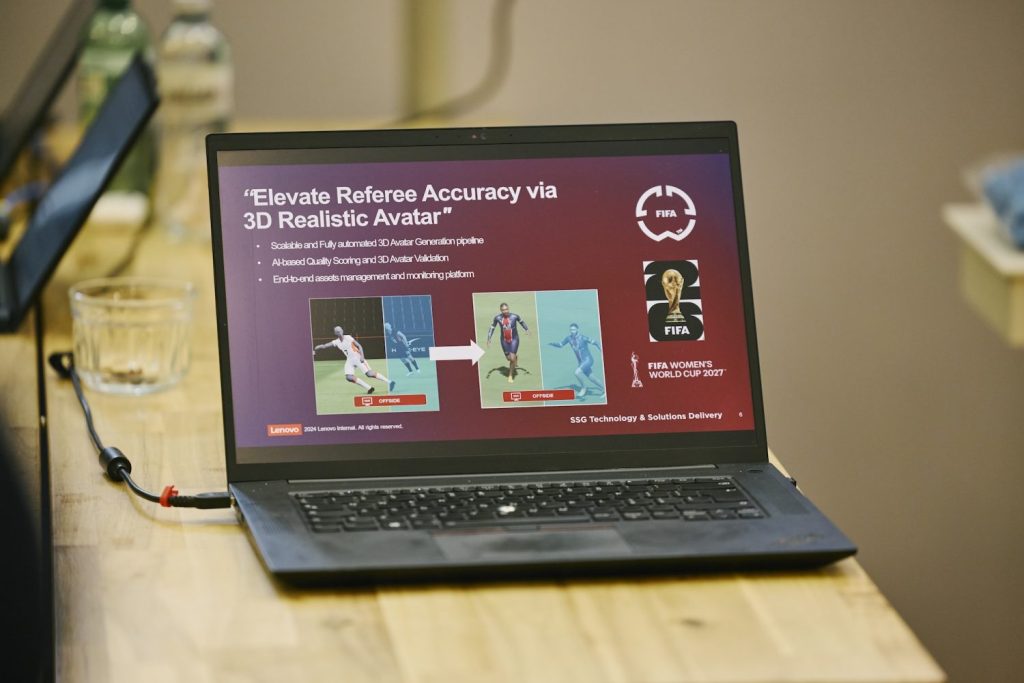
The other major area where AI and Lenovo will make the revolution, as mentioned, is the refereeing: all players called up for the final phase of the 2026 World Cup will indeed be represented by their 3D avatars in the animated replays used by referees and VAR officials to make their decisions – primarily for those that will involve the use of semi-automatic offside. To create these avatars, generative technologies based on artificial intelligence will be used: the first step is the “physical” scanning of the players, which will take place with 28 devices that will be moved to the various training camps of the qualified teams; then, subsequently, these digitized humans through the work of AI will allow for the processing of hyper-realistic clips, of a quality significantly higher than those used so far in major football competitions.
The result changes the aesthetic perception of those moments in the matches, but also increases the precision and transparency of refereeing decisions: referees and their collaborators, during the upcoming World Cup, will be able to resolve doubtful situations based on an animated figure that exactly replicates the features of Lamine Yamal, features completely different from those of Erling Haaland, Harry Kane, or Kylian Mbappé. It may seem like a minimal difference, but it is a huge thing. It is part of an electrifying transformation, a process that is bringing football into the contemporary era. And for this reason, it goes well beyond the underground plans of the headquarters in Zurich, beyond FIFA, beyond Lenovo: it concerns and will change the World Cups, and therefore all of us.