
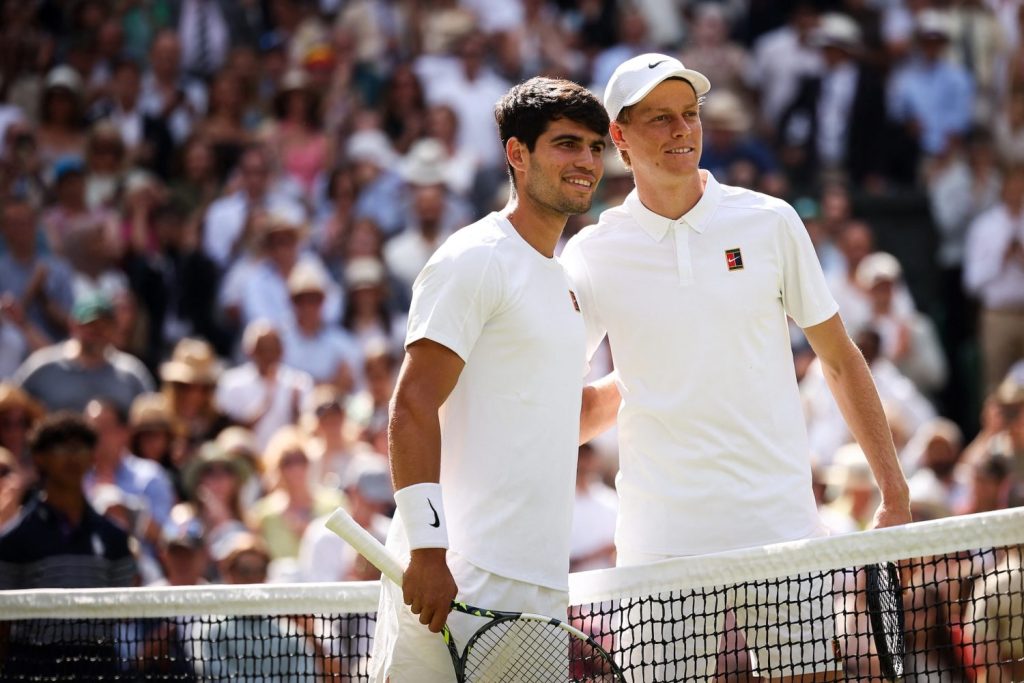
In 2024, the Sincaraz rivalry had settled into a satisfying symmetry. Alcaraz had won half of the Slams, those played on the “natural surfaces” of clay and grass; Sinner had won the two on hard courts. The Great Business of the Rivalry was in full swing. The clear superiority of these two players over the rest of the tour made me wonder how the game could evolve during their reign, and so I had asked some sharp tennis observers to look into their crystal balls and try to describe the future. According to expert commentator Gill Gross, we were heading towards an era of balanced and bomb-proof attack and defense. Its distinctive features would be extreme court coverage, the absence of exploitable weaknesses (think instead of Federer’s one-handed backhand vulnerability), and a high “weight of shot violence.”
As coach and analyst Hugh Clarke saw it, this playing style was the product of the technologies with which they had grown up. Even the most singular artists are ultimately children of their historical context, and Alcaraz and Sinner belonged to the first generation of tennis players raised with lighter carbon fiber rackets (which allowed for faster swings) and polyester strings (which produced even more spin). Technique and tactics had developed in symbiosis with the technology of the equipment. However, their applications differed in details, as materials expert Jonas Eriksson explained to me.
Alcaraz’s racket was lighter, suited to produce great topspin and maneuverable enough to allow him to manipulate the racket face at the last moment to deceive his opponent. Sinner’s was overall a bit heavier, with the weight distributed more towards the head, like a hammer: a choice that suited his groundstrokes driven from the hip. But both configurations rewarded the same thing: moving the racket as quickly as possible. The long and lazy shots of a distant past had been replaced by violent and blurred slashes. The new techniques had produced new tactics: whenever Sinner and Alcaraz saw an opportunity to attack, they seized it. The cautious and slow-burning exchanges of Djokovic against Nadal were over, with each one hunting for a momentary lapse in resistance or concentration from the other. For the newcomers, the plan was “first: attack, second: attack.”
There was little taste for cautious tennis, oriented towards reducing errors, the kind Djokovic had perfected in tie-breaks. Sinner instead explained in an interview with Sky Sports UK that his philosophy in tie-breaks was to rethink all the attacks attempted during the set and commit to those that had worked best. Sinner and Alcaraz were inaugurating an era of point-and-shoot tennis, to use Clarke’s expression, which evoked the visual language of first-person shooter video games. If the ball was there to hit, it was hit, and hard. In that same interview, Sinner expressed his prophecy for the sport: “I think everything will become faster. To play at a higher pace, you need to be physically stronger.”
But there was a part of the game, according to a theory dear to many players on the circuit, that was instead slowing down. The so-called “dead ball theory,” formulated by Daniil Medvedev and then echoed by others, claimed that during the pandemic the quality of the balls had deteriorated. It had become much more difficult to achieve a winning shot that surpassed the opponent. “It feels like badminton,” Sascha Zverev told me: “They fly very, very fast in the first two or three meters, then they stop.” A tennis ball is made of a core of pressurized rubber covered with felt, and according to Zverev, that core was now produced with lower quality materials and was prone to losing pressure. He believed this had also increased the rate of elbow and wrist injuries on the circuit, as players struggled to impose power on a ball that seemed to reject it. Alcaraz had cited the same theory when discussing the frequency of injuries.

Medvedev believed that the decay of the balls had sabotaged the game of less powerful counter-punchers like him, who now struggled to close points on their own terms, and thought that Sinner and Alcaraz were protected because they had excess power, enough to hit a “dead ball” and still put the opponent in difficulty. Meanwhile, that powerful baseline tennis mastered by Djokovic and Nadal had begun to expand along the vertical axis. After many years of veterans lamenting the disappearance of serve-and-volley, the circuit had rediscovered all-court tennis. With players like Medvedev and Nadal retreating their position in response well behind the baseline, suddenly serve-and-volley was becoming a viable strategy as a countermeasure.
As for the drop shot, Alcaraz had become a living argument in its favor: the more powerful players became from the baseline, the more effective it was to subvert the expectation of power with a soft drop shot. In 2024, to truly reach the top of the rankings, it had become essential to master good spin work, good volleys, and a good drop shot, which was not necessarily true a decade earlier, when the game was more stubbornly anchored to the baseline. Every generation thinks it has seen the apotheosis of the sport, yet bodies, technologies, and tactics continue to evolve in an intense intertwining. Sinner and Alcaraz are leading this phase, but it won’t be long before a player raised watching them emerges, with something new to say.