
The Canadian Premier League could make history in football. In fact, it has already started to do so. Not for some great achievement, as they are quite far from the elite of the game, but for the experimentation of a rule proposed six years ago by a big name in European football and much discussed in recent months. This is the “Wenger offside,” named after the former manager of Monaco and Arsenal, now a top consultant for FIFA. According to this interpretation, a forward would be offside when his entire body is completely beyond the body of the last defender; the term “light” is used to identify that virtual space, which would be “accepted” unlike the current offside rule in other countries, which determines the distance between the two most extreme points of the two players involved in the action, always at the moment of the last pass.
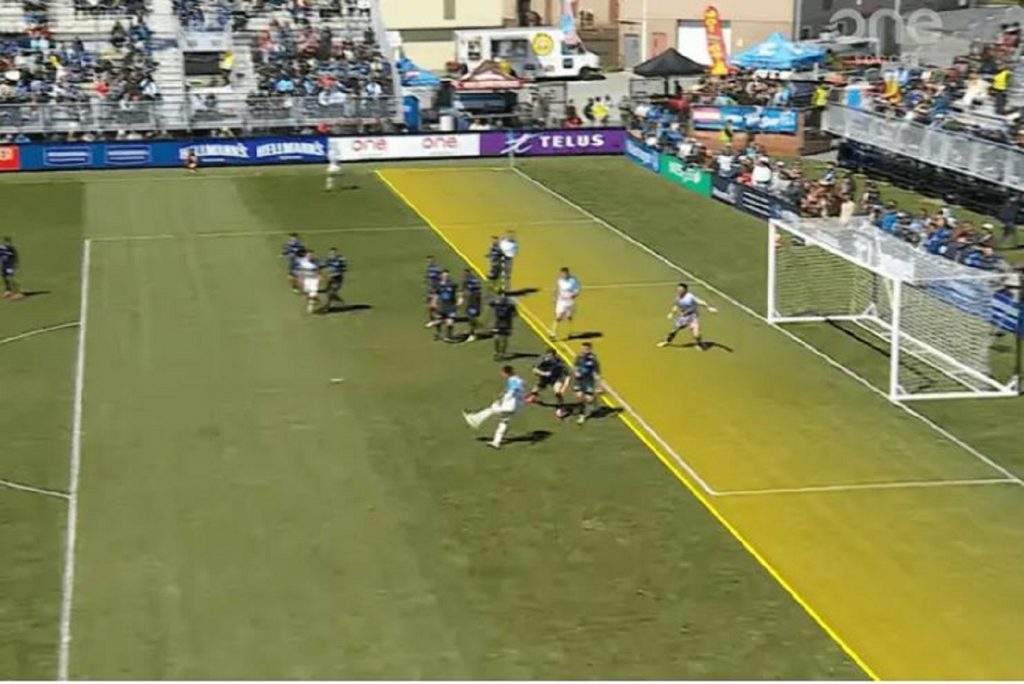
A change that seemed it could be rejected by IFAB, the international body that deals with modifications to the football rules, but which FIFA nonetheless wanted to try in Canada. Recently, the first matches with offside daylight have been played, and things went very indicatively. The goal by Alejandro Diaz that put Pacific FC ahead against Halifax Wanderers was validated despite the forward being slightly ahead of the second-to-last defender, a situation that under the standard offside rule would have led to the goal being disallowed. It’s all in these images:
Another view of the ‘daylight offside’ decision here: pic.twitter.com/I3m5NTcDkg
— Simon Evans (@sgevans) April 18, 2026
According to FIFA, this modification is designed to promote attacking play and to “improve the pace of the matches.” The new rule was introduced in a trial phase at the beginning of the 2026 season of the Canadian Premier League, in collaboration with FIFA and with the endorsement of theInternational Football Association Board – which, therefore, wants to see clearly on the application of this interpretation and has thus endorsed a field test.
During the third weekend of matches in the CPL, the new rule was applied for the first time in the 20th minute of the 2-2 draw on Saturday at Wanderers Grounds. After a corner kick, Pacific midfielder Matthew Baldisimo took a volley that was saved by Wanderers goalkeeper Marco Carducci. Diaz collected the rebound and scored from close range, while several Wanderers players protested for an alleged offside.
Diaz was ahead of Lorenzo Callegari, the last defender from whom offside is measured, and would therefore have been considered offside under the traditional rule. However, since it was not deemed that there was a visible space between the two players, the so-called “light,” Diaz was judged to be in a legal position according to the new CPL rule.
The offside rule has been particularly scrutinized after the introduction of VAR and semi-automatic offside, with goals sometimes disallowed for minimal infractions and situations where it is debatable whether the forward has actually gained an advantage from a few millimeters of shoulder or foot that are ahead of the second-to-last defender. Regarding the experimentation, “it is about positioning the Canadian Premier League at the forefront of innovation and significantly contributing to the global evolution of the game,” explained CPL commissioner James Johnson. “By closely collaborating with FIFA and IFAB, we are proud to play a role in shaping the future of football, continuing to build a competition that reflects our ambitions here in Canada,” Johnson added. Viewed this way, the rule is decidedly strange, certainly changing the way to understand the movements of forwards or defenders. And that’s not little, indeed.