
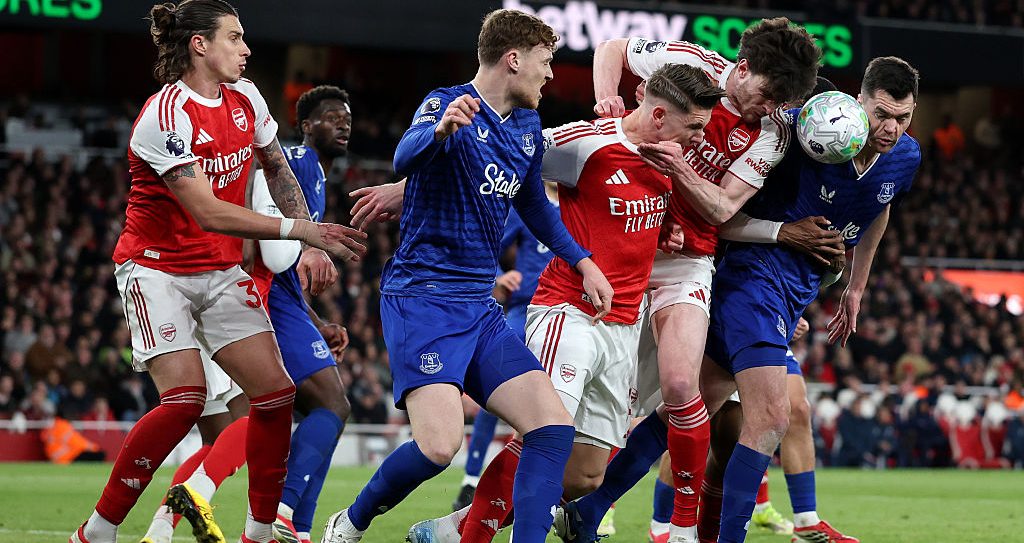
In the end, The Times has also arrived. In football, there is little play, too little. And if the effective time in ninety minutes keeps shrinking, much of it is due to the art – or rather, the trick – of dragging out scenes in slow motion whenever the opportunity arises: corners, free kicks, throw-ins. Let’s also consider that from set pieces, especially in the Premier League, goals are scored more frequently, and here lies the deadly combination. “We are facing an epidemic of time-wasting,” warns the English press. Admitting that even the most beautiful football in the world is being put to the test.
Let’s start with a merciless fact: this season, on average, a Premier League match lasts a total of 100 minutes and 24 seconds – including stoppage time in both halves. During this long stretch, the ball is in play for only 55 minutes and 31 seconds. That is, for 55.3% of the total time. The team raising the average is Manchester City (the ball in play for 58.99% of their matches), followed by Everton and Nottingham. Even Arsenal – perhaps surprisingly, given Arteta’s boys’ propensity to score from set pieces – performs better than many others: 55.51%. At the bottom of the table – and best wishes to the fans of the respective teams – we find Tottenham (53.24%), Newcastle (53.02%), and Bournemouth (52.99%). In short, looking at the standings, it is not particularly true that those who take the lead tend to slow down the pace more than their opponents – everyone has always done this, and it does not help to frame the trend. The problem tends to be deeper, almost physiological, an integral part of the structure of certain teams.
For this reason, The Times, using Opta data, has developed a second ranking that compares the differential of effective playing time between the twenty Premier League teams when they are ahead or not. Based on this gap, the most effective “time managers” are Brentford, Manchester City, and Sunderland: when they win, they are the only teams capable of slowing the pace by over 5 minutes per game – Guardiola’s team does this starting from the lowest figure in terms of time-wasting: over 62 minutes of effective play when City draws, dropping to less than 57 when they break the deadlock, and indeed they are also the team most affected by opponents’ time-wasting.
Where do these “pauses” fit in? Part of the explanation is physiological: goals are scored more often from corners also because the set pieces are becoming more elaborate and intricate, thus requiring longer preparation. In this regard, and not surprisingly, the specialists are Arsenal players: over 44 seconds on average before Declan Rice takes a corner. The quickest execution, at the opposite extreme, is that of Chelsea: just over 30 seconds. However, be careful of the technique that turns into comedy: when the Gunners are leading, the time to take the corner remains almost unchanged. In the case of Burnley – which, to be fair, does not happen very often – it jumps from 36 to 51 seconds. Not all corners are the same, you see.
And regarding free kicks, the data is even more discouraging: Liverpool takes almost 115 seconds, just under two minutes, before proceeding with the kick. And no one takes less than the 60 seconds of Crystal Palace. Considering that about 21 fouls are called per match in the Premier League – a figure still among the lowest in Europe – it is easy to calculate the merciless overview that alarms those in the know. Now even the famous English football is in danger: letting play means only playing half the time. In any case, a luxury compared to other leagues. In Serie A, they do not reach 53 minutes, one of the lowest scores on the continent. And perhaps, looking at the World Cups, this is not a coincidence either.