
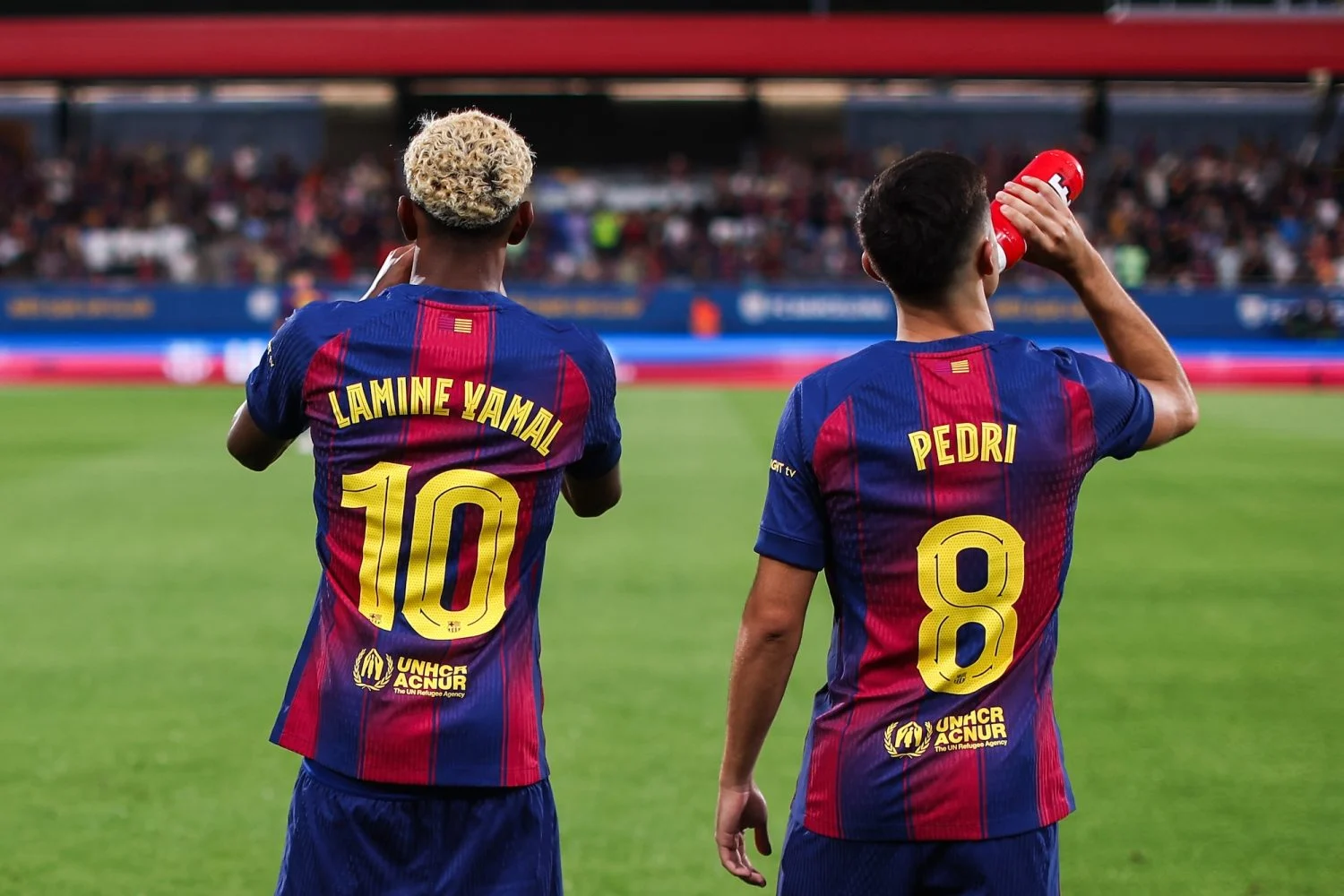
There were 12 Catalan players in the derby between Barcelona and Espanyol played on Saturday, April 11, 2026, seven starters, five coming off the bench. Almost half of the players who took the field in the ninety minutes were born in the same autonomous community. It is the most interesting piece of data from a match devoid of major surprises, illuminated only by the talent of Lamine Yamal, who once again proved he plays football on different frequencies from everyone else. A few hours earlier, in Sevilla-Atlético Madrid, Diego Pablo Simeone had heavily rotated the squad ahead of the Champions League quarter-finals and sent four homegrown players from the first minute, plus another three from the bench. Similar scenes are increasingly seen in Real Madrid matches too, especially since Álvaro Arbeloa became the coach. Thiago Pitarch is now a regular starter, but César Palacios, Diego Aguado, Manuel Ángel, and Daniel Yáñez have also played, and more will arrive in the coming weeks. In general, in La Liga, this happens everywhere.
Spanish clubs are required to register their players with numbers from 1 to 25 at the beginning of the championship, but every weekend shirts with higher numbers are seen on the pitch. They are the boys from the reserve teams, called upon to fill spaces and minutes from the Bernabéu to the Camp Nou, from the Wanda Metropolitano to the Sánchez-Pizjuán. It is the most obvious sign of a supply chain that works, that smoothly accompanies youngsters all the way to professionalism. In Spain, in fact, squads are never just 25 players.
Spain has always been strong in the last mile: not just developing talent, but bringing it all the way to the first team. It is a structural matter given by the historical presence of reserve teams, which allows great fluidity in the transition of young talents to the highest levels. But also a cultural one: “Football, in Spain, is a shared language, a system that crosses territories and generations. Clubs like Barcelona or Athletic Club do not just represent teams, but identities: places where talent is born, grows, and recognizes itself,” wrote Revista Líbero a few weeks ago. It is precisely this deep bond between club and development that explains the continuity with which Spain finds top-level reserves of talent in every generation, every year.
No other European league manages to bring so many homegrown players into professional football with such continuity. According to the CIES Football Observatory, 14 of the 100 best youth academies in the world – by presence in professional leagues – are in Spain. But the quantitative data alone is not enough to explain the phenomenon. La Liga has been working for years with projects and programs to go beyond individual excellence and create a widespread structure for identifying, developing, and blossoming talent. A study on the Spanish system speaks of “engineered excellence,” that is, a system designed to generate talent in a replicable way. In the 2024/25 season, homegrown players accounted for 19.8 percent of the minutes played in La Liga, more than any other top-tier league. One might be tempted to make a comparison with Italy, where the transition to professionalism, or generally to the first team, is always experienced and described as a “leap,” as a delicate moment where failure is always around the corner and the most likely scenario. In Spain, it is experienced as the natural continuation of a path. Then, obviously, there won’t be room for everyone, and not everyone will keep the promises of the youth sectors, not even those who grow up in Real Madrid Castilla or Barcelona B. But for this, there is no solution.
Alongside the technical dimension, there is an economic component driving this large-scale production of talent. La Liga, excluding the big teams, is a poor league. Clubs have had to make a virtue out of necessity and focus heavily on youth sectors, from which to extract capital gains season after season to keep the books in order. The real merit, in this case, is managing to maintain high competitiveness while selling the best available players every year. Over the last five years, the percentage of revenue derived from the sale of internally developed players has grown from 27% to 45%. Proof that talent development is a central component of the business model, and therefore also a structural necessity.
Every country and every football Federation has its own working methods for youth sectors and talent development, almost always dictated by traditions, culture, economic factors, and even habits. There is no single scheme and there is no winning model universally recognized as superior. Even Spain, after the great victories of the early 2010s, slowed down. Over the years, the model was exported, then copied, tweaked, updated, surpassed. Spain, instead, was less receptive to the game’s evolution. After the World Champion and two-time European Champion Generación de Oro came the Generación Perdida, that of Thiago Alcántara, Koke, De Gea, but also Isco, Bartra, Muniain. In a healthy political, footballing, and industrial system, however, downturns are followed by study and analysis, by attempts at renewal; sometimes only minor adjustments are needed. In Spain, this happens continuously, to fix what is broken or no longer in step with the times – not always with good timing, it must be said. The latest event to discuss the Spanish football system was Foro 26, organized in mid-March by the federation in Zaragoza: during the meeting, they talked about how to update youth competitions, women’s football, and the integration of futsal. These are the pulses of a living system. What until 2021 seemed like a failed project, or in any case no longer up to par, has blossomed to return to the top of the global football pyramid. It is no coincidence that today the two most expensive under-23s in the world play for Barcelona; they are Lamine Yamal and Pedri. In the top 10, there is also Fermín López, again from Barcelona. And in the top 30, there are also Pau Cubarsí, Dean Huijsen, Alvaro Carreras, Pablo Barrios (Transfermarkt data).
Much has been written about Spanish football’s training methods, and the references are now known to everyone. One-touch rondos have become material for Instagram reels or TikTok, then there are small-sided games, specific situations of numerical superiority or inferiority. An approach in which training is not built around the repetition of isolated technical gestures, but around the reproduction of different game situations, to force youngsters to make decisions in dynamic and variable contexts, just like those of a football match. In this, Spain is perfectly aligned with UEFA’s guidelines, which in the Youth Development in Football report writes “the contexts in which you learn the most are those in which real match situations are replicated.” In this sense, training does not aim to build a pure, abstract technique, as if it were separable from the context. The goal, instead, is to develop the ability to replicate technical gestures within the game. The consequence is that the player does not learn predefined solutions, but builds adaptive responses. Philipp Lahm spoke about this last week in the Guardian, when he said that Spanish football requires “cooperation, orientation, and decision-making within a collective structure.” All this to say how the competitive advantage of clubs and the National team derives precisely from this ability to integrate players within a common system.
More than on technique in the strict sense, the Spanish system focuses on the ability to read the game and make decisions in short times. “Football is making decisions, the faster you think, the better you play,” Xabi Alonso explained to The Coaches’ Voice. For this reason, situations that faithfully reproduce the match are trained: that is where the relationship between perception and action is developed, improving processing speed, anticipation, and spatial orientation.
One of the most obvious results of this system is also the homogeneity with which creative talent is produced in Spain. One of the few certainties in life is that Spain always maintains that adamantine ability to produce the best midfielders in the world in every generation. It is highly likely that national coach Luis de la Fuente will take a midfield package made up of Rodri, Pedri, Martín Zubimendi, Gavi, Fermín Lopez to the World Cup, and if they weren’t injured there would be room for Fabián Ruiz and Mikel Merino.
In short: young Spaniards grow up within the same methodological ecosystem, they cross different contexts but end up developing a shared footballing language. It is no coincidence that the main development basins – the Basque Country, Catalonia, and Madrid – coincide with the areas richest in infrastructure and technical expertise. But there is also continuity between the work of the clubs’ youth sectors and the National team. This is why, when they find themselves together, the players seem to reduce the complexity of the game: they already share references, timing, and spaces.
The comparison with Italy makes the systemic nature of the Spanish model even more evident. While in Spain talent is built within a coordinated and coherent infrastructure, in Italy the path is historically more fragmented, with strong differences between clubs, territories, and methodologies. The FIGC itself acknowledged this critical issue in its own development program, underlining the need to “provide a unique and coordinated training and educational direction through shared planning and methodology.” Similar wording was also contained in the strategic plan presented by the Spanish federation six years ago now.
“I’ve spent my whole life looking for space.” It is a phrase attributed to Xavi, the legendary Barcelona midfielder, quoted over and over again perhaps with different nuances. The original is in Damian Hughes’ book The Barcelona Way, published by Macmillan Pub Ltd in 2018. It explains why even in an increasingly fast and complex football, where the time to decide is reduced and spaces are compressed, the ability to read the game is always and in any case a decisive skill. It is the essence of Spanish football. And today it seems one of the most coherent with the spirit of the times. Perhaps that is exactly why talent continuously flourishes in Spain.