
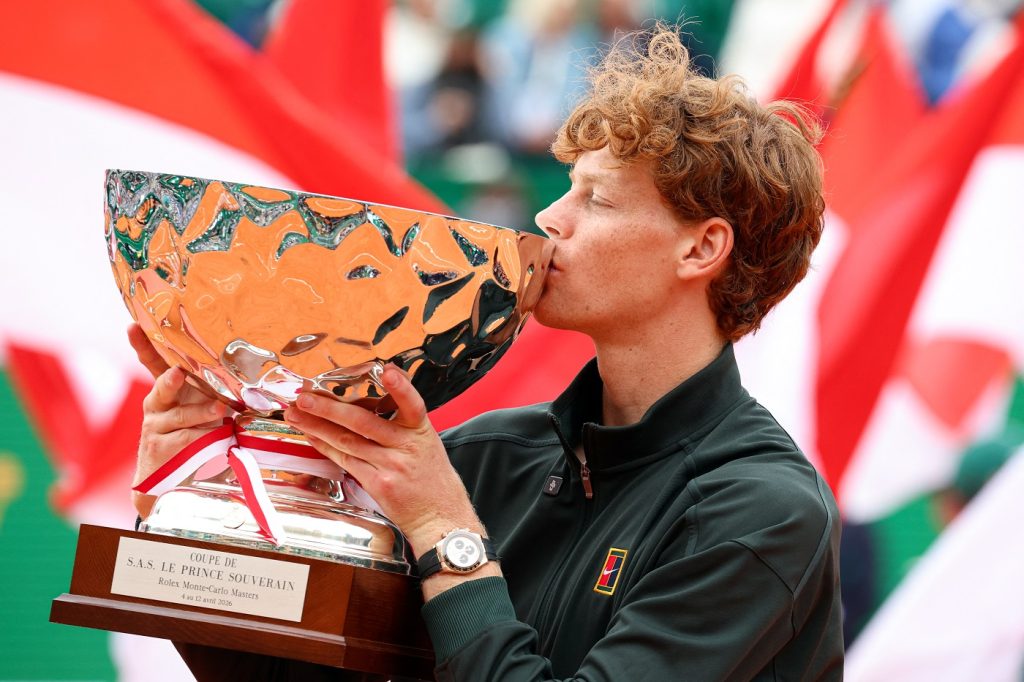
Now it can be said, but above all it is impossible to ignore: Jannik Sinner has surpassed Carlos Alcaraz, and not just in the world ranking. The return to the top of the ATP rankings is not just a numerical matter, but the reflection of an increasingly evident superiority in the moments that truly count. The victory at the Monte Carlo Masters certifies a change in hierarchies that, in this first half of 2026, has progressively consolidated. And that final smile from Sinner, broad yet composed, tells better than any statistic the awareness of someone who knows they have reached a new level.
The Monte Carlo final was anything but simple for Sinner. The weather conditions made the match extremely complicated to interpret: strong and sudden gusts of wind broke the rhythm of the rallies, altered the trajectories, and forced both players to make continuous adjustments. It was not – because it could not be – a technical match, purely about technical execution, rather a mental challenge, made of adaptation, reading, and managing the unexpected. In such an unstable context, Sinner once again demonstrated superior maturity. When Alcaraz often sought the spectacular solution, ultimately losing clarity, Jannik chose the path of effectiveness. He accepted the difficulties, incorporated them into his game plan, and built a significant victory point by point. His ability to find solutions even in the most uncomfortable situations was decisive.
The serve, in particular, proved to be a valuable ally in the most important moments – even though the weather conditions complicated even the simple toss of the ball. After a poor start in the first set, finishing with 55% on his first serve, Sinner managed to raise his serving level exactly when it mattered. The tie-break of the first set was emblematic: at the moment of maximum pressure, he found an extremely high percentage of first serves. A demonstration of coolness and control that made the difference.
Both sets followed a similar script, but that doesn’t make them any less exciting. In both sets, in fact, Sinner found himself down a break and was forced to chase an initially more aggressive Alcaraz. But it is precisely in these situations that the character of great champions emerges. Jannik never lost his composure, continued to work on the next point, and progressively turned the momentum of the match around. The second set, in particular, was a true masterpiece of resilience mixed with quality. After falling behind, Sinner strung together an impressive series of five consecutive games, extinguishing his opponent’s hopes and taking total control of the match. At that stage, all his evolution was evident: solidity from the baseline, ability to vary, management of timing, and above all, an unshakeable confidence in his own abilities.
Alcaraz tried to respond as he always does, relying on his explosive talent and creativity, finding interesting solutions at the net, but also forcing too much, as evidenced by the five double faults in his match. The difference was not so much in the spectacular shots, but in the continuity and understanding of the various phases of the match. The Italian minimized unforced errors and forced the Spaniard to push, often taking him out of his comfort zone.
The victory in the Principality holds significant value for Sinner, also from a historical perspective. It is indeed his first major title on clay, a surface where in the past he had been less dominant compared to others (the only other title in his career dated back to 2002, at the Croatian tournament in Umag). In short, this is a victory that demonstrates how his game is now complete, capable of adapting and imposing itself even on the most demanding surfaces from a technical and physical standpoint. “We came here trying to accumulate as many matches as possible to get feedback on clay,” Jannik explained in the post-match. “Today there were ups and downs for both of us, but it wasn’t easy due to the wind. Another incredible result: returning to No. 1 is important for me, but the ranking is secondary. I’m happy to have finally won a major tournament on this surface. I felt close in the return games, in the second set, down a break, I tried to stay mentally close, maintaining a positive attitude. This tournament means a lot to me.”
The triumph allows Sinner to extend his winning streak to 22 in Masters 1000 tournaments, an impressive and significant statistic. Looking to the future, the picture is even more interesting. With this success, Sinner only lacks the titles in Madrid and Rome to complete the Masters 1000 collection: a goal that until recently seemed ambitious, but now appears absolutely within his reach. The growth shown in recent months indeed suggests that the best is yet to come.
Everything stems from a new awareness, never had in the past: Sinner plays as if he knows he has become the reference point of the circuit, capable of beating anyone in any condition. This is the difference between him and Alcaraz, at least at this moment: Carlos can only beat him – and thus win tournaments – when he is truly at the top of his physical and mental condition, when the special effects of his cinematic tennis work smoothly, when he feels he can dominate the opponent and the match. When one of these conditions is lacking, even just one, Alcaraz seriously risks getting stuck. We have seen this in the tournaments following Indian Wells against Medvedev, in Miami against Korda. And then in Monte Carlo, where he faced a phenomenon like Sinner, and then this risk became a certainty. Solid, unmovable, just like Jannik.