
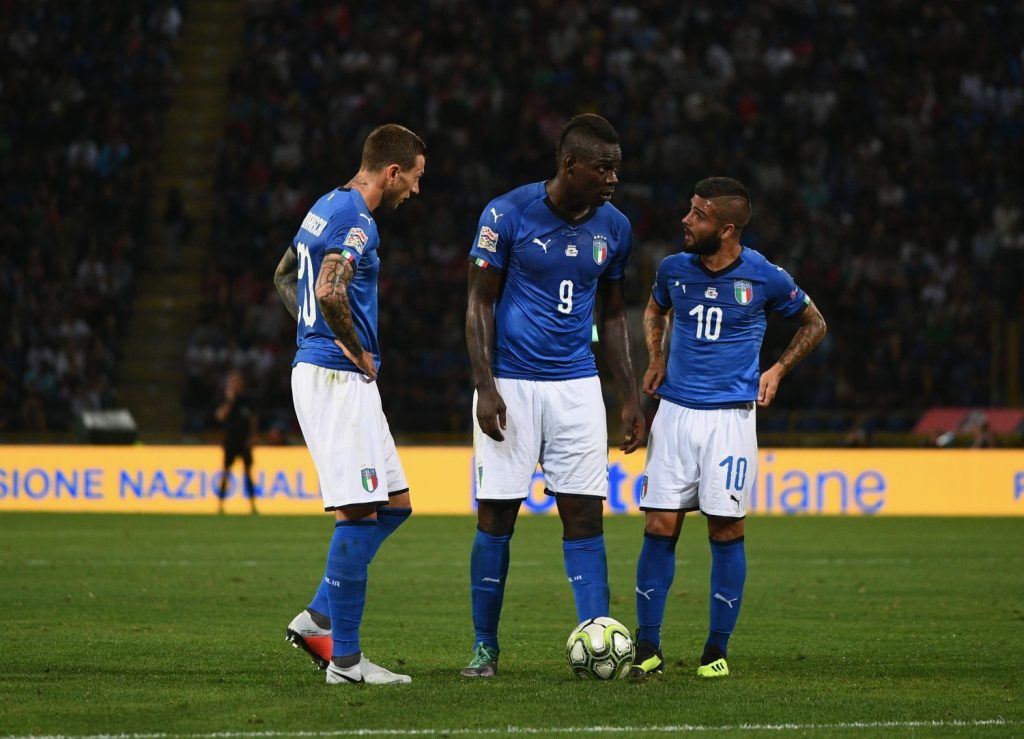
Luciano Spalletti’s latest idea is to make it mandatory for every Italian team to field an Under-19 player. “That way I have to develop at least four of them, and start understanding two years earlier who the potential youngsters we can count on are.” There has been endless talk about young talents and where to find them, after a third consecutive World Cup elimination. Someone quite rightly went back to the 900 pages of the plan written by Roberto Baggio more than 15 years ago, someone else regrets the old football played in the street: romantic, yes, certainly creative as well as practical, but far removed from the examples of countries that invest in structures, sports facilities, academies for sports educators. And yet a generation of talents passed right in front of us, and we did not even notice. In the age of scrolling on Instagram, swiping and snackable content, we forgot our millennials, caught up as we are in discovering the next generation of phenomena, or alleged ones.
Watching Lorenzo Insigne play for Pescara in recent weeks, we have all, more or less, asked ourselves what a player like that is doing in Serie B. You watch him run, celebrate happily as he once did, drag his teammates along, and you think that a player like that must be a 40-year-old who wants to take one last great satisfaction: saving the team that launched him into big-time football. But no: his ID card reminds us that Lorenzo Insigne was born in 1991, a few months before the definitive disintegration of the former Yugoslavia, an event that changed political Europe, football Europe — qualification campaigns would never be the same again, going from a few national teams to the current 54, excluding Russia — and even our destiny as Italy fans. Eliminated first by North Macedonia and then by Bosnia, outposts of a team that in 1992 would have been the favourites for the European Championship, if only war had not broken out and if, as Gigi Riva writes, Faruk Hadžibegić, captain of the last Yugoslav national team, had not missed that penalty at Italia ’90, in the quarter-finals against Argentina.
While the geography of our continent changed, the new states built national teams capable of competing within a few years: the Croatia that finished third at the World Cup in 1998 and second in 2018 is the main representative of a movement that today includes Shevchenko’s Ukraine, Kvaratskhelia’s Georgia, Džeko’s Bosnia, Serbia and even Vedat Muriqi’s Kosovo among the contenders for a place at the European Championship and the World Cup. And while in South America it is always the same countries racing ahead, going into play-offs against Asian or Oceanian teams, in Europe you have to be careful not to go out in the play-offs against national teams that 30 years ago dreamed of being able to play at least one official match, just like Bosnia, who made their debut against Italy in 1996. Lorenzo Insigne could have made a big contribution to our national team, exactly like Marco Verratti and Jorginho, now in Brazil, also from the same generation: they are all between 34 and 35, a perfect age to play a World Cup in the era of longevity, another very hot trend much explored by companies. But a little less fascinating for sport, and for football in particular.
Perhaps it is superfluous to recall that Leo Messi, June 24, 1987, and Cristiano Ronaldo, February 5, 1985, will play another World Cup. As will Modrić, who is 40 and seems not to lose his rhythm. What, then, became of our talents?Looking at the squad of the 2021 European champions, you notice that many of the players who have disappeared from the radar of top-level football would still be old enough to play at a high level. Matteo Pessina, 28, who also scored a hugely important goal against Austria in the round of 16, plays for Monza in Serie B; Federico Chiesa is the same age, while Mimmo Berardi was born in 1994 and has chosen to spend his entire life playing for Sassuolo. Without going too far, even Belotti and Immobile were born between 1990 and 1993, as was Mario Balotelli, who, had he done things differently, would now be preparing to play his fourth World Cup. Stephan El Shaarawy, born in 1992 and still not yet 34, was also one of the most exotic names in our Under-21 roster in 2010, and at the time of his breakthrough was even indicated as a precursor of that multi-ethnic Italy that would give us great satisfaction in the years to come.
There are other striking examples. For instance Gaetano Castrovilli, born in 1997 and now at Cesena in Serie B after a sad spell at Bari (he did not even manage the return home). And then there are two names who would have been very useful to Rino Gattuso in the play-offs, without any hindsight, given that their failure to be called up had raised more than a few doubts from the very beginning: Nicolò Zaniolo was born in 1999 and is having an excellent season with Udinese, after some truly complicated years; Federico Bernardeschi was born in 1994 and decided to leave big-time football at 28 to move to Toronto. Together with Insigne, no less. He has returned to playing, and playing well, at Bologna, but Gattuso did not take him into consideration for the play-offs, in favour of a group that had played only a few matches together, winning even fewer. Bernardeschi was one of the great discoveries of the Fiorentina side that ended up in the MTV reality show Giovani Speranze: filmed during the second half of the 2011/12 Primavera championship, the programme told the stories of ten young Fiorentina footballers aged between 16 and 17. Among them were Leonardo Capezzi, Alan Empereur, Cedric Gondo and Andy Bangu. Only one footballer did not grant the release for filming his private life: “I let them film me while I was playing,” Bernardeschi says, “but I did not want cameras in my private life. The initiative seemed interesting, but in the end I think it can divert you from the goal of becoming a footballer.” Today Berna plays for Bologna, where he lives very well after becoming a style icon in Canada, having his children learn English and becoming a meme, not necessarily in that order. He is also an excellent penalty taker, but that detail now leaves the time it finds.
How, then, did we manage to squander so much talent? And how did it come to the point of hearing Federico Chiesa say “no thanks, I’ll pass,” shortly before the two matches that would decide the fate of the national team? And why do we keep talking about where to find talents, if we are then unable to protect them and make them prosper? Every story would deserve a discussion of its own: difficult personalities, as with Zaniolo and Balotelli; serious injuries, as with Castrovilli, Berardi and Chiesa himself; wrong or rushed choices; leagues that are too little or, paradoxically, too competitive, like the Premier League for someone like Chiesa, who needs continuity; irresistible salaries preferred to teams capable of raising their level; but above all legitimate individual reasons and personal life choices in which football — thank God for them — is no longer at the centre of everything. All this without any kind of support from a Federation that, as things stand, can do nothing to preserve its talents.
The longevity everyone talks about, in short, has not arrived in our football. Add to that two great footballing depressions — elimination from the World Cup in Qatar was a huge blow for Mancini’s entire group, and you can also see it in the way the various Donnarumma, Barella, Mancini and Cristante approach the matches that burn with the national team, only to find them perfectly on it the following Sunday in the league — as well as for the coach who, more than anyone, had believed in that group of promises. There is an interview with Spinazzola, immediately after the penalties in Zenica, that says a lot. He apologises to the viewers, the children, the fans, then adds: “It was the last chance, there will not be another World Cup to qualify for, for me.” He was the same Spinazzola who smiled happily after his Napoli’s win over Milan, almost relieved to have taken off the weight of the national-team shirt.
That of a generation that contributed a great deal to its own fate, but certainly was not helped or properly supported. Our football is not only in great difficulty when it comes to finding the players of tomorrow, but also when the challenge is getting them to reach high levels between the ages of 30 and 35. The years in which, at the World Cup, you not only qualify, but sometimes even win it.