
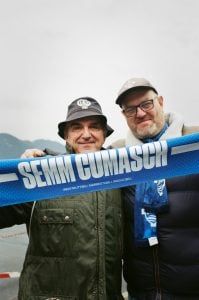
Como glided into Italian football almost suddenly, moving right from the start with the natural elegance of someone who already knows where to go. They did it like every new thing, arousing amazement and fear among people. That it is a profoundly different reality is perceived at first impact: you notice it from the international nature of the management and the locker room; you feel it in the unique atmosphere breathed in the stands of the Sinigaglia, admiring the Lake. It seems like a club that doesn’t belong to us, arriving from a distant and fascinating land. A place where the future manifests itself in advance. Because here, in Italy, it is inconceivable that a Serie A club starts the season without setting any ranking objective, or that it entrusts its coach with the choice of his successor. Yet, in Como this is normality. Of course, having an economic empire behind them like that of the Indonesian Hartono family is a big help. But in football, money alone is not enough. It is an industry too irregular, which escapes logic and lives by its own rules. Therefore, to tame the unpredictable, a clear vision is needed. To dictate it, in Como, arrived Mirwan Suwarso, trusted manager of the ownership and club president since October 2024. In a very short time he has transformed what was supposed to be a simple set for documentaries into one of the most intriguing football realities in Europe. We met him right on the shores of Lake Como. Where in the air you can breathe the distilled essence of the football of the future. And so our chat began.
There is great enthusiasm around Como: the team plays well and is collecting heavy results in Serie A. How do you experience the great victories?
With total indifference. For me, one match is worth as much as another.
The Indonesian ownership arrived in 2019, with the team in Serie D. Today it is a force in the championship. I imagine this was your plan right from the start…
Actually no. Before Covid we had bought the club only to use it as a television set: we wanted to shoot documentaries about Italian football for our Indonesian TV. Nothing else.
And then what changed?
In Serie B we realized that the project had become too big and expensive to remain a simple television show. Up until that moment I was following from Indonesia, but we couldn’t go on like this anymore. For this reason, in 2023, I moved to London, where we have a headquarters, to take charge of the club in person. Today I commute between Como and the United Kingdom to definitively transform the team into a profitable business.
Usually, in football people think in three-year cycles. You, on the other hand, have skipped stages. How did you manage it?
Honestly I wouldn’t know. We work with a business plan of five years and we simply try to follow it step by step. Como is a small city, where we developed everything from scratch. Paradoxically, this helped us. But the real turning point was the arrival of Cesc: although at the end of his career, he projected us onto a higher level and accelerated the entire process.
And what convinced you to entrust him with the bench?
We hadn’t signed him with that idea. Indeed, he arrived almost by chance: I didn’t even meet him in person, a simple phone call was enough. Then, however, we discovered how he thinks. He talked to us about how to build the team and create a sporting structure with a rigorous method. He thought about the team just as we did on a corporate level: his approach to the pitch perfectly reflected the corporate DNA we were creating. Combining the two things was natural, and the results are proving us right.
And you know that one day he could leave…
We would be fools not to take into account that one day he could go to Arsenal or Chelsea. If he continues to be successful, it’s normal for him to chase bigger dreams. But he himself will have to choose who will take his place.
Besides, Fàbregas is also a shareholder of the club. How much does his opinion weigh in corporate decisions?
Outside of tactical matters, he has the same say as the other directors: he proposes ideas and we discuss them together. For the transfer market and the team, on the other hand, we have a Board of Football composed of six people, mostly international. Decisions are always collective, but Cesc’s voice is obviously the most influential: among all of us, he is the only one to have direct experience at the highest levels of football.
View this post on Instagram
A Board with strong foreign traction. How much does this international vision count in an environment often closed and self-referential like Italian football?
It is fundamental to impose a true change of perspective. We want to push the club to look outside its own “backyard” to open up to the global market. To do this, a structural vision is needed: for example, we chose Mark-Jan Fledderus, a Dutchman, as Head of Strategy precisely because we needed someone capable of thinking about the next twenty years, not the usual two or three.
Speaking of looking beyond borders: what do you think of the idea of playing some championship matches abroad? There was talk of Milan-Como in Australia.
I am absolutely in favor. We must begin to think about Serie A as a collective product. If giants like the NBA or the NFL play outside the United States to expand, why shouldn’t we do it? Serie A has a strong domestic market, but globally we still struggle. It is up to the League to find strategies to grow. And we, as clubs, have a duty to support these initiatives.
And the Hollywood stars we see in the stands of the Sinigaglia, are they part of this international strategy? Are you the ones inviting them?
Actually they come of their own free will. This is the true strength of having Lake Como: we don’t have to look for the celebrities to invite. It is the Lake itself that attracts them on vacation. Among the most enthusiastic are actors Michael Fassbender and Chris Pine. Then there’s Cillian Murphy, who wanted to come at all costs last season, but due to last-minute changes we weren’t able to organize it…
So the true engine of Como is the charm of the Lake?
Exactly. The city is small, but the “Lake Como” brand is huge. We follow the Disney model: we use the pitch as a tool to attract attention (just as Disney did with animated films, ed.). Football is a saturated market: if you support Inter or Chelsea, you are unlikely to change teams. For “Lake Como,” on the other hand, there are no rivalries: it is a universal brand. Anyone would be pleased to wear a garment with the words “Lake Como” written on it. This is how we grow our business.
And did starting this project in football, such a particular and unique industry, create problems?
No. Indeed, it was an advantage. In the end, football revenues are easy to frame: TV rights, stadium, merchandising, and player-trading. Items that for us were non-existent, therefore easy to grow immediately.
What do the results say?
We managed to double ticketing revenues without having to expand the stadium, while merchandising has grown by 300%. Thanks to its size, Como Calcio is a laboratory for us: the economic strategies that prove successful on the team, we also successfully apply to the other branches of our company.
What other branches are you referring to exactly?
The sale of clothing related to luxury and lifestyle, for example. It is our fastest-growing sector. We created the Como Crest brand to represent the lake lifestyle, like the sailing collections. And we launched a premium line, Curva, where a jacket can cost as much as 4 thousand euros. The strategy is simple: we use the fame of football to open distribution channels and, once consolidated, we introduce increasingly high-end products. It is a gradual, but constant growth.
And how do you build such credibility in the fashion world?
We don’t do it alone, but through strategic partnerships with those who are already at the top. We collaborate with Rhude, a world-renowned premium streetwear brand. For us it is like a school: we learn how production and distribution work in luxury. But there’s more: starting from Como, we are creating new product lines where Rhude will also collaborate with other clubs. And the idea is that in our stores you will also be able to find the products of other teams.
Besides luxury retail, how are you transforming a team into a profitable investment?
We are also creating schools for kids who want to study while training in football. Then there is tourism. We never say we are “just football.” Como must be conceived as a premium destination. For this reason the team must express an entertaining and attractive game: it is also a tourist product. Those who come to the lake don’t do it just to sit and watch 90 minutes of a match: they come to live an experience.
But the risk is alienating your “historic” fans.
We cannot take away from the city what belongs to it. We must constantly ensure that our initiatives never have crazy prices for the people of Como. At the same time, however, we have the need to attract a new international clientele. These two souls, the local and the global one, must meet and coexist. And this is why offering exciting football is essential: beautiful play is the only thing capable of uniting and satisfying everyone.
And you even launched your own beer…
Yes, La Comasca. We took a local brewery that was about to go bankrupt. For now we supply the stadium and we have just closed an agreement to distribute it in a hotel chain. But the real future goal is licensing. We want to license the brand to partners to sell the beer in the United Kingdom and the United States. They will produce and distribute it locally, and we will grow the brand together.
What about the stadium?
Many say that without a new stadium nothing can be done. But that’s not true. For us, what is around us is very important. In fact, we are probably the only club in the world with hospitality in villas and boats outside the stadium. We have just opened The Club on the Lake, a new and exclusive members’ club. It is the strength of our location. The goal is first to triple the hospitality seats, making these facilities active 365 days a year, creating exclusive private clubs with restaurants on the lake.
At what point is the Como project today?
I would say that right now we are only at 30% of our potential. One day, non-football revenues will have to exceed those generated by the team. Obviously I exclude the transfer market, because it is unpredictable: if an 80 million offer for Nico Paz arrived tomorrow, that single operation would throw off every statistic.
Speaking of the transfer market, at the beginning you focused on experience, I think of Varane or Belotti. But now you invest in young players and in January you stayed still. Has your strategy changed?
In the first transfer windows the only goal was to survive: experience was needed to create solidity. Now that we have a foundation, we have moved to the logic of investments: we take young players whom we consider as assets. The focus has changed: buy to sell. Building a team is like building a house: at the beginning you spend a lot on the foundations, then you only add the details. That’s why we didn’t buy anyone in January. And from next summer we will only make targeted additions to lower the average age, spending less and less.
And how important is it for you to grow talent at home?
It is an absolute priority. Also because buying players in Italy today is a problem due to the rigidity of payments. If I want an Italian talent worth 15 million, I have to pay it all in advance or block the money with a surety bond. Abroad it is much more convenient and flexible: we got Caqueret from Lyon for the same amount, but paying him in installments of three million a year. Therefore the only solution to have Italians is to buy them very young for our Primavera team, hoping they become starters in three or four years.
View this post on Instagram
Now what are your goals? What do you say to each other at the beginning of the season?
We, as ownership, do not set ranking goals. Our only goal is to reach profitability in the shortest possible time. It is solely up to Cesc and the team to decide how far to push themselves. My conversations with Fàbregas are purely corporate: I never tell him who to field or what formation to use. It’s not my job. I turn to him only for off-pitch matters: I ask him for support on specific projects that can help us increase revenues and hit our budget goals.
And long term?
To grow.
Finally, in the past you were a director. What is your happy ending for Como?
Talking about a happy ending implies an ending. But in this project there isn’t one: we are on a constant journey. We just want to continue developing. That’s why I always tell the guys not to face the season thinking about the results. If you set rigid goals for yourself, you only risk being disappointed. Growth, instead, is a path that does not end in a single year. When you grow, you always learn new things, finding hidden opportunities. And you don’t set limits for yourself.