
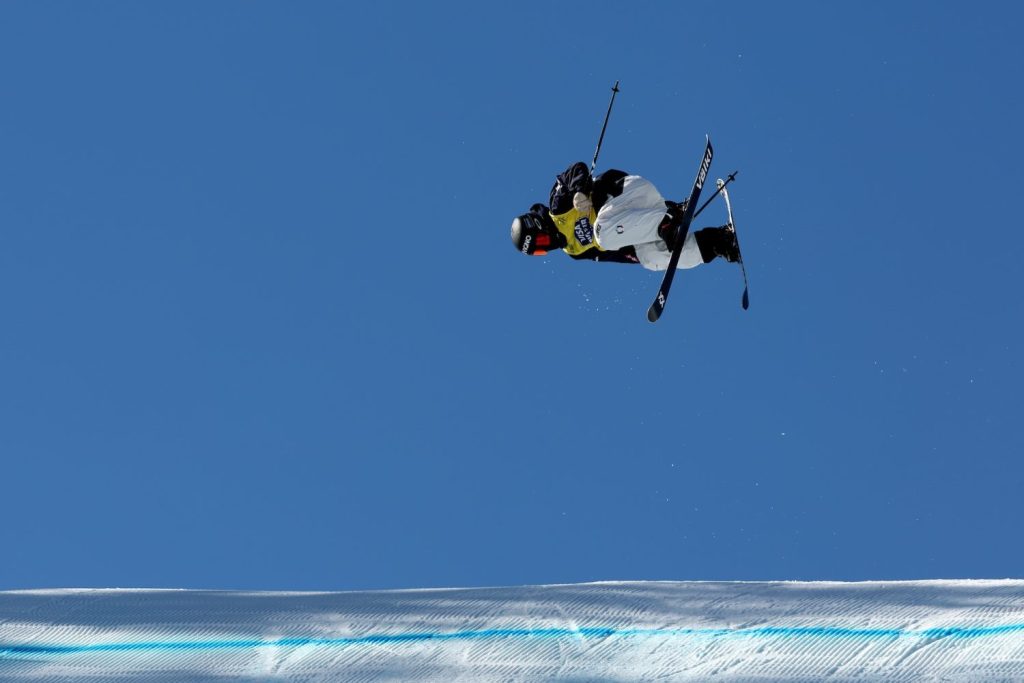
Four years of sacrifices in a few moments. This is where the essence of the Olympic Games lies, celebrating the greatness of the world’s most important sporting event. The anticipation to see the best performers of the white circus in action is the common thread that unites fans around the globe, with a whirlwind of emotions that enhances the spectacle on slopes and ice. Without taking anything away from the tradition and effort embodied by many winter sports, if there is a discipline that resonates with show, it must be freestyle skiing. After all, just the word is enough to understand the reasons: jumps, moguls, descents over 100 km/h, tight duels, technique, and breathtaking evolutions. A menu not quite suited to traditional mountain sports, but very effective for the many enthusiasts who have embraced acrobatic skiing as an artistic alternative to the classic mode.
Born in the 1960s with the first descents enriched by tricks on the slopes, freestyle skiing has spread in its various forms over the following decades, for example with group competitions from which ski cross originated. In 1979, the International Ski and Snowboard Federation recognized the acrobatic version as a full-fledged discipline, while the 1988 Winter Olympic Games in Calgary marked its debut, albeit as a demonstration sport.
Over time, the term acrobatics has unfolded into multiple nuances, expanding the scope of a sport that, precisely because of the diversity of formats united by a high level of adrenaline and unpredictability, has been able to attract those who know little or nothing about skiing, poles, and boots to the snow. From tight turns on mogul-rich slopes to aerial maneuvers that alternate rotations and flips after launching from a steep ramp, through direct elimination races among four athletes battling on the same slope with turns, bumps, jumps, and moguls (ski cross) to the more recent creative tricks with launches and landings for the strong-hearted on tubes, slopes, and rails (halfpipe, slopestyle, and big air), acrobatic skiing has gained a large following, especially among the younger generation. Speed of action, technical gestures on extreme terrain, and lively movements have contributed to attracting wide and diverse segments of the audience, opening the doors of fame to freestyle skiing.
At the Milan Cortina 2026 Olympics, there will be 15 acrobatic events scheduled from February 7 to 21, 2026, with seven events evenly divided by gender plus one mixed team event. All competitions will take place at Livigno Snow Park (ski cross, halfpipe, slopestyle, big air) and at Livigno Aerials & Moguls Park (which will host the mogul and jump competitions). It is noteworthy that the Italian edition will mark the first time for dual moguls, with two athletes competing in a close duel, but without contact, on the same slope in a descent that requires technical skills, speed of execution, and the ability to perform certain acrobatics.
Regardless of the different evolutions that unite slopestyle, halfpipe, and big air, it is undeniable that ski cross is the most electrifying discipline for spectators. Because from the moment the gates open, the descents among the four challengers offer two minutes of racing to be experienced in breathless anticipation, enjoying the sequence of turns and jumps, with continuous overtakes and constant duels, even physical (albeit within the prescribed limits, with warnings and expulsions assigned to those who go beyond). An ideal mode to make the competition uncertain, exhilarating, and unmissable until the finish line (often at the photo finish), to the point that some have lost an already won Olympic gold due to a bad and unexpected landing.
In pursuit of the first medal at the five rings, Italy arrives at Milan Cortina 2026 with great confidence to break the taboo. Despite the knee injury that last November disrupted Flora Tabanelli’s preparation, the brightest star of the Italian team at just 18 years old and with a stunning 2025 in which she secured the Winter X Games in the big air category, the World Cup in the same specialty, and the Crystal Globe for freestyle, plus the World Championships, there are several standout athletes ready to make their mark on home slopes.
In addition to Tabanelli herself, who has resumed training with her national teammates, the growth of Jole Galli in ski cross offers hope among the women. On the men’s side, Miro Tabanelli, Flora’s brother and a winner with her at the Winter X Games 2025 in the same specialty on the same day, is joined by Simone Deromedis, the 2023 ski cross world champion, second in the 2025 World Cup, and a key player in the first part of this season (with a special mention for teammate Edoardo Zorzi). In a mix of desire, obligation, and hope, Deromedis’s goal is to deliver the breakthrough that defines a career. Achieving this in front of his fans would be the ultimate.