
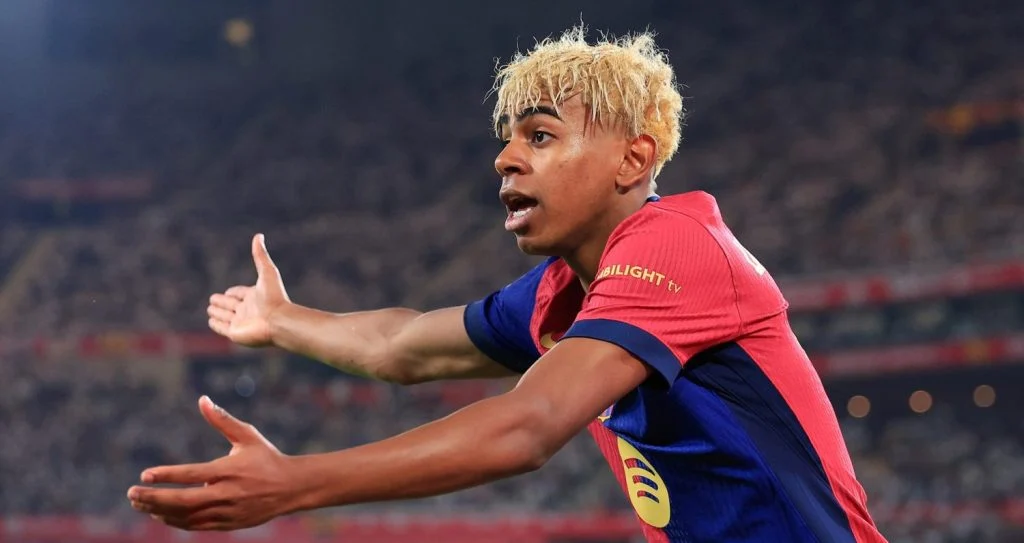
During a post-match interview given directly on the pitch at La Cartuja, just after winning the Copa del Rey, Lamine Yamal was wearing two pairs of sunglasses: one over his eyes and one on his head, as if he wanted to make the blond hair he had shown off for the final between Barcelona and Real Madrid shine even more. This way of being photographed almost makes the words he said seem marginal, even though they were fairly strong words: «It doesn’t matter how many goals they [Real Madrid, ed.] manage to score against us. One, two, three, this year they can’t beat us».
They are exactly the kinds of sentences you would expect from a 17-year-old after he has won the tournament he took part in, and if you think about it, that is exactly how things stand. Except that Yamal, how to put it, is the best teenager in the history of football, is one of the strongest players in the world and is destined to define an era. He will do so however his career goes: being already now an absolute superstar, what he manages to do will either be a spectacular success or a resounding flop, there will be — because there cannot be — any middle ground.
In reality, if we stop for a moment to think, we discover that Lamine Yamal has already changed the game. Not in a technical or tactical sense, but in the way it is perceived and therefore told. What happened in the Copa del Rey final between Barcelona and Real Madrid — a match played at a frantic pace and in which sublime quality was seen from both teams — is a perfect testimony to this ongoing metamorphosis: Yamal did not score, and yet he was decisive. With the two assists he provided for Pedri and Ferran Torres, especially the second, a masterpiece of reading and technical sensitivity, and then with so many extremely refined plays made at supersonic speed. Not only inside or near the opponent’s penalty area, but in every area of the pitch. If you don’t believe it, you should watch this video:
Lamine Yamal vs Real Madrid
Baller💫pic.twitter.com/ZVs1ceeoIV
— 𝙵𝚊𝚝𝚒𝙴𝚁𝙰¹⁰ (@FatiPrime_) April 26, 2025
For many years, let’s say the last ten or fifteen, we have been almost forced to “measure” the strength of great superstars by the number of goals they scored — numbers that were ever higher, ever more alien. First Cristiano Ronaldo and Messi, then also Mbappé and Haaland: all these phenomena have been compared with one another as if they were stocks, as if their performance were essentially a numerical fact. For heaven’s sake, there was and there is nothing wrong with that: the fact that Ronaldo and Messi turned themselves into unparalleled finishers should be considered a blessing, a great intuition on the part of those who guided them in this development, after all it is a simple optimization; and then, with them and after them, the number of goals remained an objective and therefore fascinating parameter, a safe haven for settling doubts about the quality of players, along the lines of Mbappé is stronger than Haaland because he won a World Cup and scored a hat-trick in the final of the following edition, Haaland is stronger than Mbappé because he won the Champions League and has a higher goals-per-game average, everyone can bring out whichever number they want.
With Yamal, as we have already suggested between the lines, things are working differently. Because the young Barcelona superstar scores relatively little (21 goals in 99 official matches for Barcelona, four goals in 19 games with the Spanish national team) and in reality does not even provide that many assists (33 with Barça, four with Spain), yet he is always a decisive player, always impactful. He is so on a technical-tactical level, as we saw during the Copa del Rey final, and not only because of the two decisive passes he provided for Pedri and Ferran Torres. He is so also on a purely narrative level: thanks to him, just to give one example, the Trivela has returned to being a useful play, not a meme that brings to mind Quaresma’s wasted talent.
And so, in light of all this, it is right to say it forcefully and joyfully: Lamine Yamal is the superstar we were waiting for, the one who will free us — he has already begun to do so — from the tyranny of statistics, who will erase our cognitive bias whereby a superstar is such only if he scores a goal per game, or maybe two. Of course, this does not mean we are talking about a player who does not score: for information on that, just ask the French national team, against whom Yamal scored an unforgettable and hugely important goal at the last European Championship. The point, however, is that the blinding sparkle of this champion is not an exclusively goalscoring fact with a vaguely industrial flavor; it is varied and spontaneous, it is art that lights up even in midfield, with a sudden nutmeg after a sole control. Or in many other ways. Maybe in two or three years things will have changed, Yamal too will have undergone an optimization, Yamal too will have become a lethal forward capable of scoring 50 goals a year. Today, however, that is not the case: Yamal is making us live and savor something different, a gigantic talent that is not measured only through the number of goals or assists. We had forgotten that it could be done, or perhaps we had never seen a player like this.